

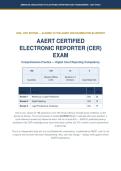
AMERICAN ASSOCIATION OF ELECTRONIC REPORTERS AND TRANSCRIBERS - CER TRACK
EDITION — ALIGNED TO THE AAERT CER EXAMINATION BLUEPRINT
AAERT CERTIFIED
ELECTRONIC REPORTER (CER)
EXAM
Comprehensive Practice — Digital Court Reporting Competency
188 120 13 5
Minutes (Official Sections in 3
Questions Limit) Domains Case-Study Sets
Weigh
Domain Content t Items
Domain 1 Working as a Legal Professional 20% 38
Domain 2 Digital Reporting 40% 75
Domain 3 Legal Procedures & Vocabulary 40% 75
How to use: answer all 188 questions in one 120-minute sitting to simulate exam conditions, or drill
domain by domain. The correct answer is marked [CORRECT] with a rationale after every question; a
quick-reference answer key follows the exam. Aim for at least 80% — AAERT's published passing
standard for the CER knowledge exam (some third-party outlines cite 70%; confirm current requirements
at aaert.org).
This is an independent study aid. It is not affiliated with, endorsed by, or published by AAERT, and it is not
a copy of any live exam item pool. Requirements, fees, and rules change — always verify against official
AAERT publications.
, DOMAIN 1 — WORKING AS A LEGAL PROFESSIONAL (20% — 38
Questions)
Section 1A: Court Reporting Ethics
Ethical Obligations, Conflicts of Interest, Gift-Giving (12 questions)
Q1. According to the AAERT Code of Ethics and standard digital reporting practice, the certified electronic
reporter's foundational obligation in every proceeding is to:
A. remain an impartial, non-party capture specialist whose sole allegiance is to creating a complete and
accurate record [CORRECT]
B. assist the retaining attorney in presenting the strongest possible case
C. advise the court when a witness appears untruthful
D. represent the interests of the court administration that scheduled the proceeding
Correct Answer: A
Rationale: The reporter serves the record, not any party — impartiality is the anchor of admissibility and credibility.
Advocacy, credibility judgments, and loyalty to a scheduling entity all compromise the neutral role.
Q2. A digital reporter assigned to a trial discovers the plaintiff's lead attorney is her brother-in-law. The
correct action is to:
A. continue without comment because in-laws are not blood relatives
B. disclose the relationship to the presiding officer and the parties immediately and withdraw from the
assignment [CORRECT]
C. continue but promise herself she will stay neutral
D. mention it casually to the defense team after the trial concludes
Correct Answer: B
Rationale: A close family relationship with counsel creates a conflict of interest that must be disclosed so the parties can
decide — quietly promising neutrality (or disclosing after the fact) leaves the record's integrity open to challenge.
Q3. Which course of conduct best describes the 'appearance of impropriety' standard for digital reporters?
A. Avoiding only conduct that is formally illegal
B. Keeping misconduct confidential so it never appears improper
C. Avoiding not only actual misconduct but also situations a reasonable observer could view as biased or
improper [CORRECT]
D. Allowing casual social contact with parties because friendliness is never improper
Correct Answer: C
Rationale: Ethics rules target the optic as well as the act: a reporter seen chatting privately with a party during recess
invites challenges to the record even when nothing improper occurred. Legality alone is a lower bar than the professional
standard.
AAERT Certified Electronic Reporter (CER) Practice Exam (2026/2027) Page 2
, Q4. During a recess, counsel asks the digital reporter, 'Between us — do you think the witness was
credible?' The reporter's proper response is to:
A. share a candid impression since the conversation is off the record
B. nod noncommittally to avoid offense
C. report the attorney to the state bar immediately for asking
D. politely decline to offer any opinion, explaining that the reporter must remain a neutral participant in the
proceedings [CORRECT]
Correct Answer: D
Rationale: Expressing credibility opinions — even privately — erodes the reporter's neutral function. Declining is
professional, not rude, and bar complaints are reserved for actual misconduct rather than a passing question.
Q5. A law firm that regularly sends the reporter work offers a $500 gift card at the holidays. Under ethical
guidance on gift-giving, the reporter should:
A. decline the gift or refer the matter to firm policy, because gifts of more than nominal value can create a
sense of obligation and the appearance of favoritism [CORRECT]
B. accept it since it arrives after the year's jobs are finished
C. accept it and reciprocate with a comparable gift
D. accept it quietly and not mention it to anyone
Correct Answer: A
Rationale: Substantial gifts from referral sources create reciprocal pressure and the appearance of influence over who
gets the next job. Modest promotional courtesies are different; $500 is far past the nominal line.
Q6. A reporter notices her annotation of a key spelling conflicts with what was said. Ethical record-keeping
requires her to:
A. delete the original annotation and replace it with the correct spelling
B. preserve the original entry and add a corrective annotation tied to the relevant timecode [CORRECT]
C. edit the audio file so the pronunciation matches the annotation
D. say nothing and let the transcriber resolve the discrepancy
Correct Answer: B
Rationale: The record — audio and annotations alike — must remain intact and unaltered; corrections are made by
supplemental entries, never by deletion or editing. Silent reliance on the transcrier to sort it out risks an undetected error.
Q7. After a deposition, the examining attorney asks the reporter to delete the portion where the witness
misspoke and start a 'clean' recording. The reporter should:
A. delete the segment as a courtesy to a regular client
B. delete it but keep an unmarked private copy
C. refuse: the original recording must be preserved, and any changes to testimony come through witness
review and errata procedures or an appropriate stipulation or order [CORRECT]
D. charge an extra fee for the deletion
Correct Answer: C
Rationale: Nothing is ever cut from the master recording on request — correction runs through the errata process, party
stipulation, or court order. A 'quiet' copy changes nothing ethically, and a fee cannot launder an improper act.
AAERT Certified Electronic Reporter (CER) Practice Exam (2026/2027) Page 3
, Q8. Which social media practice is consistent with a digital reporter's ethical obligations?
A. Sharing amusing moments from yesterday's deposition without names
B. Commenting on how sympathetic a witness seemed, without naming the case
C. Posting from the courtroom between sessions to show followers the work
D. Posting generic professional content while never discussing parties, witnesses, cases, or anything
heard on the record [CORRECT]
Correct Answer: D
Rationale: Confidentiality and impartiality follow the reporter online: no commentary on parties, witnesses, or record
content, even anonymized. Posting from the proceeding itself also signals inattention to the record.
Q9. Regarding soliciting business at proceedings, ethical practice permits the reporter to:
A. provide a business card or contact information when requested by a participant, without pressing
services on anyone [CORRECT]
B. circulate flyers in the gallery during recess
C. approach the winning attorney to request future referrals before leaving
D. offer a discount to any counsel who books before the proceeding ends
Correct Answer: A
Rationale: Court and deposition venues are not marketing venues; responding to a direct request is professional, while
promotional approaches to counsel in the room create discomfort and the appearance of partiality.
Q10. SCENARIO — The improper 'gratuity' (use for the next three questions). During a break in a
personal-injury deposition, the defendant's paralegal quietly hands the digital reporter a $200 bill, saying,
'Just make sure the boss's answers come through nice and clear,' and then asks what the witness said while
the recorder was off. Question 1 of 3: What has just occurred?
A. A routine gratuity for good service that may be accepted and reported as income
B. An attempted improper influence on a neutral officer of the proceeding — the reporter must not accept
the money or share off-record information [CORRECT]
C. A permissible tip so long as the audio is unchanged
D. A harmless joke that can be laughed off and ignored
Correct Answer: B
Rationale: Money offered with an expectation of favorable treatment toward one party is an attempted bribe, and
off-record communications are confidential — neither the cash nor the information can be accepted or shared.
Q11. (Gratuity scenario continued.) What is the reporter's correct course of action?
A. Keep the money but ignore the request
B. Return the money and say nothing further to anyone
C. Return the money, decline to discuss anything off the record, document the exchange, and promptly
report it to the presiding officer or supervising counsel and the reporter's firm per policy [CORRECT]
D. Accept the money as evidence and turn it over to police without notifying anyone else
Correct Answer: C
Rationale: Declining is only the first step — the attempt itself must be documented and escalated so the parties can
address it on the record. Silence leaves the proceeding's integrity exposed and the reporter exposed to accusation.
AAERT Certified Electronic Reporter (CER) Practice Exam (2026/2027) Page 4
EDITION — ALIGNED TO THE AAERT CER EXAMINATION BLUEPRINT
AAERT CERTIFIED
ELECTRONIC REPORTER (CER)
EXAM
Comprehensive Practice — Digital Court Reporting Competency
188 120 13 5
Minutes (Official Sections in 3
Questions Limit) Domains Case-Study Sets
Weigh
Domain Content t Items
Domain 1 Working as a Legal Professional 20% 38
Domain 2 Digital Reporting 40% 75
Domain 3 Legal Procedures & Vocabulary 40% 75
How to use: answer all 188 questions in one 120-minute sitting to simulate exam conditions, or drill
domain by domain. The correct answer is marked [CORRECT] with a rationale after every question; a
quick-reference answer key follows the exam. Aim for at least 80% — AAERT's published passing
standard for the CER knowledge exam (some third-party outlines cite 70%; confirm current requirements
at aaert.org).
This is an independent study aid. It is not affiliated with, endorsed by, or published by AAERT, and it is not
a copy of any live exam item pool. Requirements, fees, and rules change — always verify against official
AAERT publications.
, DOMAIN 1 — WORKING AS A LEGAL PROFESSIONAL (20% — 38
Questions)
Section 1A: Court Reporting Ethics
Ethical Obligations, Conflicts of Interest, Gift-Giving (12 questions)
Q1. According to the AAERT Code of Ethics and standard digital reporting practice, the certified electronic
reporter's foundational obligation in every proceeding is to:
A. remain an impartial, non-party capture specialist whose sole allegiance is to creating a complete and
accurate record [CORRECT]
B. assist the retaining attorney in presenting the strongest possible case
C. advise the court when a witness appears untruthful
D. represent the interests of the court administration that scheduled the proceeding
Correct Answer: A
Rationale: The reporter serves the record, not any party — impartiality is the anchor of admissibility and credibility.
Advocacy, credibility judgments, and loyalty to a scheduling entity all compromise the neutral role.
Q2. A digital reporter assigned to a trial discovers the plaintiff's lead attorney is her brother-in-law. The
correct action is to:
A. continue without comment because in-laws are not blood relatives
B. disclose the relationship to the presiding officer and the parties immediately and withdraw from the
assignment [CORRECT]
C. continue but promise herself she will stay neutral
D. mention it casually to the defense team after the trial concludes
Correct Answer: B
Rationale: A close family relationship with counsel creates a conflict of interest that must be disclosed so the parties can
decide — quietly promising neutrality (or disclosing after the fact) leaves the record's integrity open to challenge.
Q3. Which course of conduct best describes the 'appearance of impropriety' standard for digital reporters?
A. Avoiding only conduct that is formally illegal
B. Keeping misconduct confidential so it never appears improper
C. Avoiding not only actual misconduct but also situations a reasonable observer could view as biased or
improper [CORRECT]
D. Allowing casual social contact with parties because friendliness is never improper
Correct Answer: C
Rationale: Ethics rules target the optic as well as the act: a reporter seen chatting privately with a party during recess
invites challenges to the record even when nothing improper occurred. Legality alone is a lower bar than the professional
standard.
AAERT Certified Electronic Reporter (CER) Practice Exam (2026/2027) Page 2
, Q4. During a recess, counsel asks the digital reporter, 'Between us — do you think the witness was
credible?' The reporter's proper response is to:
A. share a candid impression since the conversation is off the record
B. nod noncommittally to avoid offense
C. report the attorney to the state bar immediately for asking
D. politely decline to offer any opinion, explaining that the reporter must remain a neutral participant in the
proceedings [CORRECT]
Correct Answer: D
Rationale: Expressing credibility opinions — even privately — erodes the reporter's neutral function. Declining is
professional, not rude, and bar complaints are reserved for actual misconduct rather than a passing question.
Q5. A law firm that regularly sends the reporter work offers a $500 gift card at the holidays. Under ethical
guidance on gift-giving, the reporter should:
A. decline the gift or refer the matter to firm policy, because gifts of more than nominal value can create a
sense of obligation and the appearance of favoritism [CORRECT]
B. accept it since it arrives after the year's jobs are finished
C. accept it and reciprocate with a comparable gift
D. accept it quietly and not mention it to anyone
Correct Answer: A
Rationale: Substantial gifts from referral sources create reciprocal pressure and the appearance of influence over who
gets the next job. Modest promotional courtesies are different; $500 is far past the nominal line.
Q6. A reporter notices her annotation of a key spelling conflicts with what was said. Ethical record-keeping
requires her to:
A. delete the original annotation and replace it with the correct spelling
B. preserve the original entry and add a corrective annotation tied to the relevant timecode [CORRECT]
C. edit the audio file so the pronunciation matches the annotation
D. say nothing and let the transcriber resolve the discrepancy
Correct Answer: B
Rationale: The record — audio and annotations alike — must remain intact and unaltered; corrections are made by
supplemental entries, never by deletion or editing. Silent reliance on the transcrier to sort it out risks an undetected error.
Q7. After a deposition, the examining attorney asks the reporter to delete the portion where the witness
misspoke and start a 'clean' recording. The reporter should:
A. delete the segment as a courtesy to a regular client
B. delete it but keep an unmarked private copy
C. refuse: the original recording must be preserved, and any changes to testimony come through witness
review and errata procedures or an appropriate stipulation or order [CORRECT]
D. charge an extra fee for the deletion
Correct Answer: C
Rationale: Nothing is ever cut from the master recording on request — correction runs through the errata process, party
stipulation, or court order. A 'quiet' copy changes nothing ethically, and a fee cannot launder an improper act.
AAERT Certified Electronic Reporter (CER) Practice Exam (2026/2027) Page 3
, Q8. Which social media practice is consistent with a digital reporter's ethical obligations?
A. Sharing amusing moments from yesterday's deposition without names
B. Commenting on how sympathetic a witness seemed, without naming the case
C. Posting from the courtroom between sessions to show followers the work
D. Posting generic professional content while never discussing parties, witnesses, cases, or anything
heard on the record [CORRECT]
Correct Answer: D
Rationale: Confidentiality and impartiality follow the reporter online: no commentary on parties, witnesses, or record
content, even anonymized. Posting from the proceeding itself also signals inattention to the record.
Q9. Regarding soliciting business at proceedings, ethical practice permits the reporter to:
A. provide a business card or contact information when requested by a participant, without pressing
services on anyone [CORRECT]
B. circulate flyers in the gallery during recess
C. approach the winning attorney to request future referrals before leaving
D. offer a discount to any counsel who books before the proceeding ends
Correct Answer: A
Rationale: Court and deposition venues are not marketing venues; responding to a direct request is professional, while
promotional approaches to counsel in the room create discomfort and the appearance of partiality.
Q10. SCENARIO — The improper 'gratuity' (use for the next three questions). During a break in a
personal-injury deposition, the defendant's paralegal quietly hands the digital reporter a $200 bill, saying,
'Just make sure the boss's answers come through nice and clear,' and then asks what the witness said while
the recorder was off. Question 1 of 3: What has just occurred?
A. A routine gratuity for good service that may be accepted and reported as income
B. An attempted improper influence on a neutral officer of the proceeding — the reporter must not accept
the money or share off-record information [CORRECT]
C. A permissible tip so long as the audio is unchanged
D. A harmless joke that can be laughed off and ignored
Correct Answer: B
Rationale: Money offered with an expectation of favorable treatment toward one party is an attempted bribe, and
off-record communications are confidential — neither the cash nor the information can be accepted or shared.
Q11. (Gratuity scenario continued.) What is the reporter's correct course of action?
A. Keep the money but ignore the request
B. Return the money and say nothing further to anyone
C. Return the money, decline to discuss anything off the record, document the exchange, and promptly
report it to the presiding officer or supervising counsel and the reporter's firm per policy [CORRECT]
D. Accept the money as evidence and turn it over to police without notifying anyone else
Correct Answer: C
Rationale: Declining is only the first step — the attempt itself must be documented and escalated so the parties can
address it on the record. Silence leaves the proceeding's integrity exposed and the reporter exposed to accusation.
AAERT Certified Electronic Reporter (CER) Practice Exam (2026/2027) Page 4


