
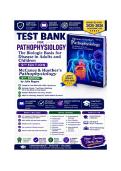
,Test Bank for Pathophysiology: The Biologic Basis for Disease in Adults and Children, 9th Edition
McCance & Huether's Pathophysiology, 9th Edition by Julia Rogers
Updated for 2025–2026 Academic Use
Chapter 1: Cellular Biology – Complete Test Bank (50 Questions)
Section A: Multiple-Choice Questions (Questions 1–40)
Question 1
Which statement best describes the cellular function of metabolic absorption?
A) Cells can produce proteins.
B) Cells can secrete digestive enzymes.
C) Cells can take in and use nutrients.
D) Cells can synthesize fats.
Answer: C
Rationale: In metabolic absorption, all cells take in and use nutrients and other substances from their
surroundings . This is a fundamental cellular function that allows cells to acquire the materials needed
for metabolism, growth, and maintenance. The remaining options describe other cellular functions:
protein production (A) is synthesis, secretion of digestive enzymes (B) is a specialized function of certain
cells, and fat synthesis (D) is a specific metabolic pathway rather than the general function of metabolic
absorption.
Question 2
Where is most of a cell's genetic information, including RNA and DNA, contained?
A) Mitochondria
B) Ribosome
C) Nucleolus
D) Lysosome
Answer: C
Rationale: The nucleus contains the nucleolus, a small dense structure composed largely of RNA, most of
the cellular DNA, and the DNA-binding proteins (such as histones) that regulate its activity . The
mitochondria (A) are responsible for cellular respiration and energy production. Ribosomes (B) function
to provide sites for cellular protein synthesis. Lysosomes (D) function as the intracellular digestive
system.
,Question 3
Which component of the cell produces hydrogen peroxide (H₂O₂) by using oxygen to remove hydrogen
atoms from specific substrates in an oxidative reaction?
A) Lysosomes
B) Peroxisomes
C) Ribosomes
D) Oxyhydrosomes
Answer: B
Rationale: Peroxisomes are so named because they usually contain enzymes that use oxygen to remove
hydrogen atoms from specific substrates in an oxidative reaction that produces H₂O₂ . Hydrogen
peroxide is a powerful oxidant and potentially destructive if it accumulates or escapes from
peroxisomes. Ribosomes (C) are RNA-protein complexes synthesized in the nucleolus. Lysosomes (A) are
saclike structures containing digestive enzymes.
Question 4
Which cell component is capable of cellular autodigestion when it is released during cell injury?
A) Ribosome
B) Golgi complex
C) Smooth endoplasmic reticulum
D) Lysosome
Answer: D
Rationale: The lysosomal membrane acts as a protective shield between the powerful digestive enzymes
within the lysosome and the cytoplasm . Disruption of the membrane by various treatments or cellular
injury leads to a release of the lysosomal enzymes, which can then react with their specific substrates,
causing cellular self-digestion (autodigestion). The chief function of a ribosome (A) is to provide sites for
cellular protein synthesis. The Golgi complex (B) is a network of flattened vesicles involved in protein
modification. The smooth endoplasmic reticulum (C) is involved in steroid hormone production and
detoxification.
Question 5
Which cAMP-mediated response is related to antidiuretic hormone (ADH)?
A) Increased heart rate and force of contraction
B) Secretion of cortisol
C) Increased retention of water
D) Breakdown of fat
Answer: C
Rationale: Antidiuretic hormone (ADH) leads to increased retention of water in the body through cAMP-
mediated signaling . Epinephrine causes increases in heart rate and force of contraction (A). Increased
, cortisol secretion (B) is due to ACTH (adrenocorticotropic hormone). Breakdown of fat (D) is due to
glucagon and other lipolytic hormones.
Question 6
During which phase of the cell cycle is DNA synthesized?
A) G₁ phase
B) S phase
C) G₂ phase
D) M phase
Answer: B
Rationale: The four designated phases of the cell cycle are: (1) the G₁ phase, which is the period between
the M phase and the start of DNA synthesis; (2) the S phase, during which DNA is synthesized in the cell
nucleus; (3) the G₂ phase, during which RNA and protein synthesis occurs; and (4) the M phase, which
includes nuclear and cytoplasmic division . Therefore, DNA synthesis occurs during the S phase.
Question 7
What organic compound facilitates transportation across cell membranes by acting as receptors,
transport channels for electrolytes, and enzymes to drive active pumps?
A) Lipids
B) Proteases
C) Proteins
D) Carbohydrates
Answer: C
Rationale: Proteins have several functions, including acting as receptors, transport channels for
electrolytes, and enzymes to drive active pumps . Lipids (A) help act as the "glue" holding cell
membranes together. Proteases (B) cause the breakdown of protein. Carbohydrates (D) are involved in
cellular protection and lubrication and help produce energy via oxidative phosphorylation.
Question 8
Which structure prevents water-soluble molecules from entering cells across the plasma membrane?
A) Carbohydrate chains
B) Glycoprotein channels
C) Membrane channel proteins
D) Lipid bilayer
Answer: D
Rationale: The bilayer's structure accounts for one of the essential functions of the plasma membrane .
It is impermeable to most water-soluble molecules because these molecules are insoluble in the oily
core region. The bilayer serves as a barrier to the diffusion of water and hydrophilic substances while
allowing lipid-soluble molecules (such as oxygen and carbon dioxide) to diffuse through readily.
McCance & Huether's Pathophysiology, 9th Edition by Julia Rogers
Updated for 2025–2026 Academic Use
Chapter 1: Cellular Biology – Complete Test Bank (50 Questions)
Section A: Multiple-Choice Questions (Questions 1–40)
Question 1
Which statement best describes the cellular function of metabolic absorption?
A) Cells can produce proteins.
B) Cells can secrete digestive enzymes.
C) Cells can take in and use nutrients.
D) Cells can synthesize fats.
Answer: C
Rationale: In metabolic absorption, all cells take in and use nutrients and other substances from their
surroundings . This is a fundamental cellular function that allows cells to acquire the materials needed
for metabolism, growth, and maintenance. The remaining options describe other cellular functions:
protein production (A) is synthesis, secretion of digestive enzymes (B) is a specialized function of certain
cells, and fat synthesis (D) is a specific metabolic pathway rather than the general function of metabolic
absorption.
Question 2
Where is most of a cell's genetic information, including RNA and DNA, contained?
A) Mitochondria
B) Ribosome
C) Nucleolus
D) Lysosome
Answer: C
Rationale: The nucleus contains the nucleolus, a small dense structure composed largely of RNA, most of
the cellular DNA, and the DNA-binding proteins (such as histones) that regulate its activity . The
mitochondria (A) are responsible for cellular respiration and energy production. Ribosomes (B) function
to provide sites for cellular protein synthesis. Lysosomes (D) function as the intracellular digestive
system.
,Question 3
Which component of the cell produces hydrogen peroxide (H₂O₂) by using oxygen to remove hydrogen
atoms from specific substrates in an oxidative reaction?
A) Lysosomes
B) Peroxisomes
C) Ribosomes
D) Oxyhydrosomes
Answer: B
Rationale: Peroxisomes are so named because they usually contain enzymes that use oxygen to remove
hydrogen atoms from specific substrates in an oxidative reaction that produces H₂O₂ . Hydrogen
peroxide is a powerful oxidant and potentially destructive if it accumulates or escapes from
peroxisomes. Ribosomes (C) are RNA-protein complexes synthesized in the nucleolus. Lysosomes (A) are
saclike structures containing digestive enzymes.
Question 4
Which cell component is capable of cellular autodigestion when it is released during cell injury?
A) Ribosome
B) Golgi complex
C) Smooth endoplasmic reticulum
D) Lysosome
Answer: D
Rationale: The lysosomal membrane acts as a protective shield between the powerful digestive enzymes
within the lysosome and the cytoplasm . Disruption of the membrane by various treatments or cellular
injury leads to a release of the lysosomal enzymes, which can then react with their specific substrates,
causing cellular self-digestion (autodigestion). The chief function of a ribosome (A) is to provide sites for
cellular protein synthesis. The Golgi complex (B) is a network of flattened vesicles involved in protein
modification. The smooth endoplasmic reticulum (C) is involved in steroid hormone production and
detoxification.
Question 5
Which cAMP-mediated response is related to antidiuretic hormone (ADH)?
A) Increased heart rate and force of contraction
B) Secretion of cortisol
C) Increased retention of water
D) Breakdown of fat
Answer: C
Rationale: Antidiuretic hormone (ADH) leads to increased retention of water in the body through cAMP-
mediated signaling . Epinephrine causes increases in heart rate and force of contraction (A). Increased
, cortisol secretion (B) is due to ACTH (adrenocorticotropic hormone). Breakdown of fat (D) is due to
glucagon and other lipolytic hormones.
Question 6
During which phase of the cell cycle is DNA synthesized?
A) G₁ phase
B) S phase
C) G₂ phase
D) M phase
Answer: B
Rationale: The four designated phases of the cell cycle are: (1) the G₁ phase, which is the period between
the M phase and the start of DNA synthesis; (2) the S phase, during which DNA is synthesized in the cell
nucleus; (3) the G₂ phase, during which RNA and protein synthesis occurs; and (4) the M phase, which
includes nuclear and cytoplasmic division . Therefore, DNA synthesis occurs during the S phase.
Question 7
What organic compound facilitates transportation across cell membranes by acting as receptors,
transport channels for electrolytes, and enzymes to drive active pumps?
A) Lipids
B) Proteases
C) Proteins
D) Carbohydrates
Answer: C
Rationale: Proteins have several functions, including acting as receptors, transport channels for
electrolytes, and enzymes to drive active pumps . Lipids (A) help act as the "glue" holding cell
membranes together. Proteases (B) cause the breakdown of protein. Carbohydrates (D) are involved in
cellular protection and lubrication and help produce energy via oxidative phosphorylation.
Question 8
Which structure prevents water-soluble molecules from entering cells across the plasma membrane?
A) Carbohydrate chains
B) Glycoprotein channels
C) Membrane channel proteins
D) Lipid bilayer
Answer: D
Rationale: The bilayer's structure accounts for one of the essential functions of the plasma membrane .
It is impermeable to most water-soluble molecules because these molecules are insoluble in the oily
core region. The bilayer serves as a barrier to the diffusion of water and hydrophilic substances while
allowing lipid-soluble molecules (such as oxygen and carbon dioxide) to diffuse through readily.


