8/21/26, 3:50 PM Quiz: Comprehensive Final Exam: JURI625: Administrative Law (D01)
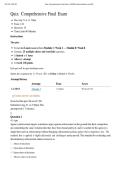
Quiz: Comprehensive Final Exam
Due Aug 21 at 1 1 :59pm
Points 1 00
Questions 25
Time Limit 60 Minutes
Instructions
The quiz:
Covers the Learn material from Module 1 : Week 1 — Module 8: Week 8.
Contains 25 multiple-choice and true/false questions.
Is limited to 1 hour.
Allows 1 attempt.
Is worth 1 00 points.
Each quiz will be open-book/open-notes.
Submit this assignment by 1 1 :59 p.m. (ET) on Friday of Module 8: Week 8.
Attempt History
Attempt Time Score
LATEST Attempt 1 1 7 minutes 96 out of 1 00
Correct answers are hidden.
Score for this quiz: 96 out of 1 00
Submitted Aug 21 at 3:50pm This
attempt took 1 7 minutes.
Question 1
pts
Agency enforcement targets sometimes argue against enforcement on the ground that their competitors
are committing the same violation that they have been found guilty of, and it is unfair for the agency to
single them out for enforcement without bringing enforcement actions against their competitors also. The
standard that is applied is highly deferential and challengers rarely prevail. The standard for evaluating such
discriminatory enforcement claims is known as:
Abuse of discretion
Clear abuse of discretion
Patent abuse of discretion
Obvious abuse of discretion
, 8/21/26, 3:50 PM Quiz: Comprehensive Final Exam: JURI625: Administrative Law (D01)
Question 2
pts
The Constitution directly mentions the “separation of powers.”
True
False
Question 3
pts
The public analysis of administrative law analyzes regulation from the perspective of the
political forces that result in regulation and the structure of agencies, such as how narrow but organized
interests seem to capture the attention of agencies while unorganized broad interests such as the public
at large have difficulty advancing their interests in the administrative process.
intelligence
interest
choice
culture
Question 4
pts
Agencies have a great deal of discretion over whether to regulate and over the choice of targets for
enforcement action. Ambiguous statutory standards that provide an agency with discretion for when to act
and against whom to enforce the action can narrow the discretion.
True
False
Question 5
pts
Under the Federal Torts Claim Act, the government is liable for negligence torts of government officials if a
private party would be liable in tort under state law.
True
False
Question 6
pts
Due process requires and an adjudicatory hearing when agency action affects a
particular party and is based on facts specific to the situation of that party. These facts are
Quiz: Comprehensive Final Exam
Due Aug 21 at 1 1 :59pm
Points 1 00
Questions 25
Time Limit 60 Minutes
Instructions
The quiz:
Covers the Learn material from Module 1 : Week 1 — Module 8: Week 8.
Contains 25 multiple-choice and true/false questions.
Is limited to 1 hour.
Allows 1 attempt.
Is worth 1 00 points.
Each quiz will be open-book/open-notes.
Submit this assignment by 1 1 :59 p.m. (ET) on Friday of Module 8: Week 8.
Attempt History
Attempt Time Score
LATEST Attempt 1 1 7 minutes 96 out of 1 00
Correct answers are hidden.
Score for this quiz: 96 out of 1 00
Submitted Aug 21 at 3:50pm This
attempt took 1 7 minutes.
Question 1
pts
Agency enforcement targets sometimes argue against enforcement on the ground that their competitors
are committing the same violation that they have been found guilty of, and it is unfair for the agency to
single them out for enforcement without bringing enforcement actions against their competitors also. The
standard that is applied is highly deferential and challengers rarely prevail. The standard for evaluating such
discriminatory enforcement claims is known as:
Abuse of discretion
Clear abuse of discretion
Patent abuse of discretion
Obvious abuse of discretion
, 8/21/26, 3:50 PM Quiz: Comprehensive Final Exam: JURI625: Administrative Law (D01)
Question 2
pts
The Constitution directly mentions the “separation of powers.”
True
False
Question 3
pts
The public analysis of administrative law analyzes regulation from the perspective of the
political forces that result in regulation and the structure of agencies, such as how narrow but organized
interests seem to capture the attention of agencies while unorganized broad interests such as the public
at large have difficulty advancing their interests in the administrative process.
intelligence
interest
choice
culture
Question 4
pts
Agencies have a great deal of discretion over whether to regulate and over the choice of targets for
enforcement action. Ambiguous statutory standards that provide an agency with discretion for when to act
and against whom to enforce the action can narrow the discretion.
True
False
Question 5
pts
Under the Federal Torts Claim Act, the government is liable for negligence torts of government officials if a
private party would be liable in tort under state law.
True
False
Question 6
pts
Due process requires and an adjudicatory hearing when agency action affects a
particular party and is based on facts specific to the situation of that party. These facts are