
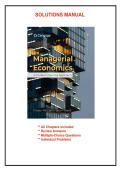
SOLUTIONS MANUAL
** All Chapters included
** Review Answers
** Multiple-Choice Questions
** Individual Problems
,Table of Contents are given below
Chapter 1. Solving Problems with Economics
Chapter 2. The One Lesson of Business
Chapter 3. Benefits, Costs, and Decisions
Chapter 4. Extent (How Much) Decisions
Chapter 5. Investment Decisions: Look Ahead and Reason Back
Chapter 6. Simple Pricing
Chapter 7. Economies of Scale and Scope
Chapter 8. Understanding Markets and Industry Changes
Chapter 9. Market Structure and Long-Run Equilibrium
Chapter 10. Strategy: The Quest to Keep Profit from Eroding
Chapter 11. Foreign Exchange, Trade, and Bubbles
Chapter 12. More Realistic and Complex Pricing
Chapter 13. Direct Price Discrimination
Chapter 14. Indirect Price Discrimination
Chapter 15. Strategic Games
Chapter 16. Bargaining
Chapter 17. Making Decisions with Uncertainty
Chapter 18. Auctions
Chapter 19. The Problem of Adverse Selection
Chapter 20. The Problem of Moral Hazard
Chapter 21. Getting Employees to Work in the Firm’s Best Interests
Chapter 22. Getting Divisions to Work in the Firm’s Best Interests
Chapter 23. Managing Vertical Relationships
Chapter 24. Test Yourself
, Solution and Answer Guide: Froeb/McCann/Ward/Shor, Managerial Economics: A Problem Solving Approach,
7e, ©2027, 9798214055640; Chapter 1: Solving Problems with Economics
Solution and Answer Guide
FROEB/MCC ANN/WARD/SHOR, MANAGERIAL ECONOMICS: A PROBLEM SOLVING APPROACH,
7E, ©2027, 9798214055640; C HAPTER 1: SOLVING PROBLEMS WITH ECONOMICS
TABLE OF CONTENTS
Section Review Answers .................................................................................................................1
Multiple-Choice Questions.........................................................................................................1
Individual Problems .................................................................................................................... 4
SECTION REVIEW ANSWERS
MULTIPLE-CHOICE QUESTIONS
1. What are the two main steps in the economic problem-solving framework presented in
the chapter?
a. Design incentives and monitor performance [Designing incentives and monitoring
performance are part of implementing solutions, but don’t address finding the
cause of the problem.]
b. Identify who is responsible and assign blame [Finding who is responsible is part of
finding the cause of a problem, but assigning blame is not an effective solution.]
c. Figure out what went wrong and how to fix it [Correct. The problem-solving model
is used to figure out what went wrong and how to fix it.]
d. Collect data and run a cost-benefit analysis [Data collection can help identify the
cause of problems, and a cost-benefit analysis can help prevent certain problems.]
Solution: c
Figure out what went wrong and how to fix it [Correct. The problem-solving model is
used to figure out what went wrong and how to fix it.]
2. According to the rational actor paradigm, why do people make mistakes?
a. They are irrational and unpredictable. [The rational actor paradigm assumes that
people act rationally.]
b. They are often too emotional to decide clearly. [Acting rationally precludes
decision-making clouded by emotion.]
c. They lack information or the right incentives. [Correct. According to the rational
actor paradigm, people make mistakes because they don’t have enough
information or they lack the proper incentives.]
d. They are not trained in economics. [A lack of economics training is not part of the
rational actor paradigm.]
Solution: c
1
, Solution and Answer Guide: Froeb/McCann/Ward/Shor, Managerial Economics: A Problem Solving Approach,
7e, ©2027, 9798214055640; Chapter 1: Solving Problems with Economics
They lack information or the right incentives. [Correct. According to the rational actor
paradigm, people make mistakes because they don’t have enough information or they
lack the proper incentives.]
3. Which of the following is not one of the three key diagnostic questions used to analyze
a decision problem?
a. Who made the decision? [This is the first of the three key diagnostic questions.]
b. Did they have enough information? [This is the second of the three key diagnostic
questions.]
c. Did they consult a supervisor? [Correct. The three key diagnostic questions are:
Who is making the bad decision? Does the decision-maker have enough
information to make a good decision? Does the decision-maker have the incentive
to make a good decision?]
d. Did they have the right incentives? [This is the third of the three key diagnostic
questions.]
Solution: c
Did they consult a supervisor? [Correct. The three key diagnostic questions are: Who is
making the bad decision? Does the decision-maker have enough information to make a
good decision? Does the decision-maker have the incentive to make a good decision?]
4. When measurement and incentives break down, why is ethics important?
a. It prevents companies from being regulated. [Ethics does not preclude regulation.]
b. It helps maintain trust and guide behavior where incentives fall short. [Correct.
Organizations rely not just on economic incentives, but also on culture, trust, and
shared ethical norms to guide behavior.]
c. It allows firms to avoid costly lawsuits. [Ethics does not prevent costly lawsuits
and, in some cases, provides the incentive to initiate them.]
d. It replaces the need for economic thinking. [Ethics and economics complement one
another. They do not replace one another.]
Solution: b
It helps maintain trust and guide behavior where incentives fall short. [Correct.
Organizations rely not just on economic incentives, but also on culture, trust, and
shared ethical norms to guide behavior.]
5. Why were Uber drivers canceling long rides in favor of shorter ones?
a. Their bonuses were based on the location and quantity of the rides, not quality.
[Correct. Uber drivers were taking advantage of an incentive system that gave
bonuses for completing rides within specific high-demand areas.]
b. Long rides consumed more fuel, and Uber didn’t reimburse for fuel. [Multiple short
rides often consume more fuel than single longer rides.]
c. The app was malfunctioning and giving inaccurate trip times. [The driver’s
preference for short rides was not due to an app malfunction; it was due to a
desire to take advantage of an incentive system.]
d. Drivers were lazy and didn’t want to go far away. [Drivers did not cancel long drives
because they were lazy; they canceled because they received incentives for short
rides in high-demand areas.]
Solution: a
2
** All Chapters included
** Review Answers
** Multiple-Choice Questions
** Individual Problems
,Table of Contents are given below
Chapter 1. Solving Problems with Economics
Chapter 2. The One Lesson of Business
Chapter 3. Benefits, Costs, and Decisions
Chapter 4. Extent (How Much) Decisions
Chapter 5. Investment Decisions: Look Ahead and Reason Back
Chapter 6. Simple Pricing
Chapter 7. Economies of Scale and Scope
Chapter 8. Understanding Markets and Industry Changes
Chapter 9. Market Structure and Long-Run Equilibrium
Chapter 10. Strategy: The Quest to Keep Profit from Eroding
Chapter 11. Foreign Exchange, Trade, and Bubbles
Chapter 12. More Realistic and Complex Pricing
Chapter 13. Direct Price Discrimination
Chapter 14. Indirect Price Discrimination
Chapter 15. Strategic Games
Chapter 16. Bargaining
Chapter 17. Making Decisions with Uncertainty
Chapter 18. Auctions
Chapter 19. The Problem of Adverse Selection
Chapter 20. The Problem of Moral Hazard
Chapter 21. Getting Employees to Work in the Firm’s Best Interests
Chapter 22. Getting Divisions to Work in the Firm’s Best Interests
Chapter 23. Managing Vertical Relationships
Chapter 24. Test Yourself
, Solution and Answer Guide: Froeb/McCann/Ward/Shor, Managerial Economics: A Problem Solving Approach,
7e, ©2027, 9798214055640; Chapter 1: Solving Problems with Economics
Solution and Answer Guide
FROEB/MCC ANN/WARD/SHOR, MANAGERIAL ECONOMICS: A PROBLEM SOLVING APPROACH,
7E, ©2027, 9798214055640; C HAPTER 1: SOLVING PROBLEMS WITH ECONOMICS
TABLE OF CONTENTS
Section Review Answers .................................................................................................................1
Multiple-Choice Questions.........................................................................................................1
Individual Problems .................................................................................................................... 4
SECTION REVIEW ANSWERS
MULTIPLE-CHOICE QUESTIONS
1. What are the two main steps in the economic problem-solving framework presented in
the chapter?
a. Design incentives and monitor performance [Designing incentives and monitoring
performance are part of implementing solutions, but don’t address finding the
cause of the problem.]
b. Identify who is responsible and assign blame [Finding who is responsible is part of
finding the cause of a problem, but assigning blame is not an effective solution.]
c. Figure out what went wrong and how to fix it [Correct. The problem-solving model
is used to figure out what went wrong and how to fix it.]
d. Collect data and run a cost-benefit analysis [Data collection can help identify the
cause of problems, and a cost-benefit analysis can help prevent certain problems.]
Solution: c
Figure out what went wrong and how to fix it [Correct. The problem-solving model is
used to figure out what went wrong and how to fix it.]
2. According to the rational actor paradigm, why do people make mistakes?
a. They are irrational and unpredictable. [The rational actor paradigm assumes that
people act rationally.]
b. They are often too emotional to decide clearly. [Acting rationally precludes
decision-making clouded by emotion.]
c. They lack information or the right incentives. [Correct. According to the rational
actor paradigm, people make mistakes because they don’t have enough
information or they lack the proper incentives.]
d. They are not trained in economics. [A lack of economics training is not part of the
rational actor paradigm.]
Solution: c
1
, Solution and Answer Guide: Froeb/McCann/Ward/Shor, Managerial Economics: A Problem Solving Approach,
7e, ©2027, 9798214055640; Chapter 1: Solving Problems with Economics
They lack information or the right incentives. [Correct. According to the rational actor
paradigm, people make mistakes because they don’t have enough information or they
lack the proper incentives.]
3. Which of the following is not one of the three key diagnostic questions used to analyze
a decision problem?
a. Who made the decision? [This is the first of the three key diagnostic questions.]
b. Did they have enough information? [This is the second of the three key diagnostic
questions.]
c. Did they consult a supervisor? [Correct. The three key diagnostic questions are:
Who is making the bad decision? Does the decision-maker have enough
information to make a good decision? Does the decision-maker have the incentive
to make a good decision?]
d. Did they have the right incentives? [This is the third of the three key diagnostic
questions.]
Solution: c
Did they consult a supervisor? [Correct. The three key diagnostic questions are: Who is
making the bad decision? Does the decision-maker have enough information to make a
good decision? Does the decision-maker have the incentive to make a good decision?]
4. When measurement and incentives break down, why is ethics important?
a. It prevents companies from being regulated. [Ethics does not preclude regulation.]
b. It helps maintain trust and guide behavior where incentives fall short. [Correct.
Organizations rely not just on economic incentives, but also on culture, trust, and
shared ethical norms to guide behavior.]
c. It allows firms to avoid costly lawsuits. [Ethics does not prevent costly lawsuits
and, in some cases, provides the incentive to initiate them.]
d. It replaces the need for economic thinking. [Ethics and economics complement one
another. They do not replace one another.]
Solution: b
It helps maintain trust and guide behavior where incentives fall short. [Correct.
Organizations rely not just on economic incentives, but also on culture, trust, and
shared ethical norms to guide behavior.]
5. Why were Uber drivers canceling long rides in favor of shorter ones?
a. Their bonuses were based on the location and quantity of the rides, not quality.
[Correct. Uber drivers were taking advantage of an incentive system that gave
bonuses for completing rides within specific high-demand areas.]
b. Long rides consumed more fuel, and Uber didn’t reimburse for fuel. [Multiple short
rides often consume more fuel than single longer rides.]
c. The app was malfunctioning and giving inaccurate trip times. [The driver’s
preference for short rides was not due to an app malfunction; it was due to a
desire to take advantage of an incentive system.]
d. Drivers were lazy and didn’t want to go far away. [Drivers did not cancel long drives
because they were lazy; they canceled because they received incentives for short
rides in high-demand areas.]
Solution: a
2


