ati PN Fundamentals Online Practice 2023 A CLOSE
Time Elapsed: 00:34:40
Question: 1 of 60 CORRECT Pause Remaining: 08:19:18 PAUSE FLAG
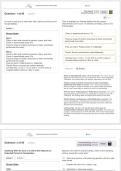
A nurse is caring for a client who had a spinal cord injury and Click to highlight the findings below that that require
has paraplegia. intervention by the nurse. To deselect a finding, click on the
finding again.
Exhibit 1
Nurses Notes Client is repositioned every 2 hr.
Day 1: Passive range-of-motion exercises to lower extremities
Client is alert and oriented to person, place, and time. performed once daily.
Client is repositioned every 2 hr.
Passive range-of-motion exercises to lower extremities
performed once daily. Feet are warm. Pedal pulses 2+ bilaterally.
Day 2: Plantar flexion contractures noted bilaterally.
Client is alert and oriented to person, place, and time.
Client is repositioned every 2 hr.
Passive range-of-motion exercises to lower extremities Left heel has 1.3 cm x 1.3 cm (0.5 in x 0.5 in) area of
performed once daily. nonblanchable erythema. Skin is intact.
Feet are warm. Pedal pulses 2+ bilaterally.
Plantar flexion contractures noted bilaterally.
Left heel has 1.3 cm x 1.3 cm (0.5 in x 0.5 in) area of CORRECT My Answer
nonblanchable erythema. Skin is intact.
Client is repositioned every 2 hr is incorrect. The nurse should
reposition the client every 2 hr to reduce the risk for skin breakdown.
Therefore, this finding does not require intervention at this time.
Passive range-of-motion exercises to lower extremities
performed once daily is correct. The nurse should perform
passive range-of-motion exercises to the client's lower extremities
two to three times daily to reduce the risk for contractures.
Feet are warm. Pedal pulses 2+ bilaterally is incorrect. The nurse
should identify that the client has adequate circulation to the feet.
Therefore, this finding does not require intervention at this time.
Plantar flexion contractures noted bilaterally is correct. The
nurse should place a foot board at the end of the client's bed or
apply foot boots to the client's feet to protect the client's heels and
decrease the contracture.
Left heel has 1.3 cm x 1.3 cm (0.5 in x 0.5 in) area of
nonblanchable erythema, skin is intact is correct. The client has
a stage 1 pressure injury on their left heel. The nurse should apply
foot boots to the client's feet to protect the client's heels and promote
healing.
ati PN Fundamentals Online Practice 2023 A CLOSE
Question: 2 of 60 CORRECT
PAUSE FLAG
Assisting With the Care of a Client Who Reports an Based on the client's clinical findings, which of the following
Extended Period of Constipation actions should the nurse take?
Exhibit 1 Exhibit 2 Assist the client to a left side-lying position with the right
knee flexed.
Nurses Notes Prepare the client for a chest x-ray.
1200: Administer a cleansing enema.
, Client arrives to ED and reports abdominal pain and no Auscultate the client's bowel sounds.
bowel movement for the past 7 days. Client is undergoing
chemotherapy for pancreatic cancer and has been taking Administer oxycodone extended-release tablets.
40 mg oxycodone extended release tablets daily for the
past 3 months. Client states they have attempted to Perform a manual digital examination of the client's
relieve constipation for the last 7 days with bisacodyl rectum.
suppositories and magnesium citrate oral suspension.
Client reports that neither therapy initiated defecation. CORRECT My Answer
1230:
Client transported for abdominal x-ray. Assist the client to a left side-lying position with the right knee
flexed is correct. The nurse should place the client in a left side-
1245: lying position with the right knee flexed prior to administering an
enema. Since the provider prescribed a cleansing enema for the
Client returned from x-ray. Provider prescribes a client, the nurse should prepare the client for the procedure.
hypertonic cleansing enema.
Prepare the client for a chest x-ray is incorrect. The nurse should
not prepare the client for a chest x-ray. A chest x-ray is usually
performed for a client who has an impairment of the upper thorax or
lungs, not the abdomen. The client has already received an
abdominal x-ray; therefore, a chest x-ray is not necessary.
Administer a cleansing enema is correct. The nurse should
administer a cleansing enema for the client because of the provider's
prescription. A cleansing enema is intended to assist with bowel
elimination and remove any impacted fecal matter indicated by the
abdominal x-ray.
Auscultate the client's bowel sounds is correct. The nurse
should auscultate the client's bowel sounds to determine the status
of the client's abdomen.
ati PN Fundamentals Online Practice 2023 A CLOSE
Time Elapsed: 00:35:12se
Question: 3 of 60 CORRECT Remaining:
PAUSE08:19:18
FLAG
Caring for a Client Receiving Supplemental Oxygen Based on the client's clinical findings, which of the following
Therapy actions should the nurse take? (Select all that apply.)
Exhibit 1 Exhibit 2 Apply a water-soluble lubricant to the client's nares.
Apply petroleum jelly inside the client's nares.
Nurses Notes
Place padding over the client's ears under the oxygen
0800: tubing.
Client admitted with exacerbation of COPD. Oxygen
therapy initiated at 2 L/min via nasal cannula. SpO2 is Increase the oxygen flow rate to 6 L/min via nasal
89% on room air. Respirations are 24/min, unlabored. cannula.
1000: Attach humidification to the oxygen flow meter if
Client reports dry nasal passages and mild irritation increased above 4 L/min.
behind both ears. SpO2 is 92% on 2 L/min nasal cannula.
Skin surrounding ears is intact without redness. CORRECT My Answer
Apply a water-soluble lubricant to the client's nares is
correct. The nurse should apply a water-soluble lubricant to relieve
dry nasal mucosa. Petroleum-based products are combustible and
should be avoided during oxygen therapy.
Apply petroleum jelly inside the client's nares is
incorrect. Petroleum-based products pose a fire hazard when used
around supplemental oxygen.
Place padding over the client's ears under the oxygen tubing is
correct. Padding reduces friction and skin breakdown over pressure
points behind the ears.
Increase the oxygen flow rate to 6 L/min via nasal cannula is
incorrect. High concentrations of oxygen can depress the
respiratory drive in clients who have COPD.
Attach humidification to the oxygen flow meter if increased
above 4 L/min is correct. Humidification prevents drying of nasal
, membranes when oxygen flow rates exceed 4 L/min.
ati PN Fundamentals Online Practice 2023 A CLOSE
Time Elapsed: 00:36:10
Question: 4 of 60 CORRECT PAUSE FLAG
Assessing Skin Integrity and Pressure Injury Risk Click to highlight the findings below that require intervention
by the nurse. To deselect a finding, click on the finding again.
Exhibit 1 Exhibit 2
Client is restricted to bed rest.
Nurses Notes
0700: Braden scale score evaluated at 13.
Client is a 78-year-old admitted following a hip
replacement. Client is restricted to bed rest. Braden scale
Nonblanchable erythema over the sacrum.
score evaluated at 13 (moderate risk for pressure injury).
1100: Client denies pain at the site.
Skin assessment reveals nonblanchable erythema over
the sacrum. Client denies pain at the site. Moisture noted
from occasional urinary incontinence. Moisture noted from occasional urinary incontinence.
CORRECT My Answer
Braden scale score evaluated at 13 is correct. A Braden scale
score below 18 indicates an elevated risk for skin breakdown and
requires immediate implementation of a pressure injury prevention
protocol.
Nonblanchable erythema over the sacrum is correct. This finding
indicates a Stage 1 pressure injury, requiring interventions such as
repositioning every 2 hours and offloading sacral pressure.
Moisture noted from occasional urinary incontinence is
correct. Skin exposure to urine promotes maceration and
breakdown. The nurse must implement barrier creams and a
frequent hygiene routine.
ati PN Fundamentals Online Practice 2023 A CLOSE
Question: 5 of 60 CORRECT
Care of a Client Receiving Continuous Enteral Nutrition Based on the client's clinical
findings, which of the following actions should the nurse take?
(Select all that apply.)
Exhibit 1 Exhibit 2
Hold the enteral tube feeding.
Nurses Notes Reinfuse the aspirated residual volume.
0600: Lower the head of the bed to a flat position.
Continuous nasogastric tube feeding infusing at 60 mL/hr.
Head of bed elevated to 45 degrees. Gastric residual Notify the health care provider.
volume checked: 80 mL.
Increase the feeding rate to clear the residual volume.
1000:
Client reports abdominal distention and nausea. Gastric CORRECT My Answer
, residual volume checked: 280 mL. Bowel sounds present
in all four quadrants but hypoactive. Hold the enteral tube feeding is correct. High residual volume
(>250 mL) accompanied by abdominal distention and nausea
indicates delayed gastric emptying and increased risk for
aspiration.
Reinfuse the aspirated residual volume is correct. Gastric
contents should be reinfused to prevent electrolyte imbalances
and metabolic alkalosis, unless institutional policy states otherwise
for volumes exceeding specific thresholds.
Notify the health care provider is correct. The provider should
be alerted to delayed gastric emptying to consider prokinetic agents
or modifying the enteral feeding order.
ati PN Fundamentals Online Practice 2023 A CLOSE
Question: 6 of 60 CORRECT PAUSE FLAG
Caring for a Client with a Urinary Retention Catheter Based on the client's clinical findings, which of the following
actions should the nurse take first?
Exhibit 1 Exhibit 2
Notify the primary care provider immediately.
Nurses Notes Check the catheter tubing for occlusion or dependent
loops.
0730:
Indwelling urinary catheter inserted 48 hours ago following Irrigate the catheter with 30 mL of sterile normal saline.
pelvic surgery. Urine output over the last 4 hours was 120
mL of clear, amber urine. Drainage bag positioned below Obtain a prescription to remove the indwelling catheter.
the level of the bladder.
CORRECT My Answer
1130:
Client reports lower abdominal fullness and discomfort. No
urine output observed in the collection bag over the past 2 Check the catheter tubing for occlusion or dependent loops is
hours. Tubing is free of kinks. correct. Applying the nursing process, assessment is the first step.
The nurse should inspect the tubing for positional obstructions or
dependent loops before implementing invasive procedures or
contacting the provider.
ati PN Fundamentals Online Practice 2023 A CLOSE
Time Elapsed: 00:39:40
Question: 7 of 60 CORRECT PAUSE FLAG
Administering Medication via Gastrostomy Tube Click to highlight the findings below that indicate an error in
medication administration. To deselect a finding, click on the
Exhibit 1 Exhibit 2 finding again.
Nurses Notes
Placement verified by gastric fluid aspiration (pH 4.0).
0900:
Preparing to administer morning crushed medications via Tube flushed with 30 mL of water prior to
G-tube. G-tube placement verified by gastric fluid administration.
aspiration (pH 4.0). Tube flushed with 30 mL of water prior
to administration.
Crushed extended-release metoprolol tartrate.
0915:
Client receives crushed extended-release metoprolol Mixed with liquid medication solution.
tartrate mixed with liquid medication solution.
Time Elapsed: 00:34:40
Question: 1 of 60 CORRECT Pause Remaining: 08:19:18 PAUSE FLAG
A nurse is caring for a client who had a spinal cord injury and Click to highlight the findings below that that require
has paraplegia. intervention by the nurse. To deselect a finding, click on the
finding again.
Exhibit 1
Nurses Notes Client is repositioned every 2 hr.
Day 1: Passive range-of-motion exercises to lower extremities
Client is alert and oriented to person, place, and time. performed once daily.
Client is repositioned every 2 hr.
Passive range-of-motion exercises to lower extremities
performed once daily. Feet are warm. Pedal pulses 2+ bilaterally.
Day 2: Plantar flexion contractures noted bilaterally.
Client is alert and oriented to person, place, and time.
Client is repositioned every 2 hr.
Passive range-of-motion exercises to lower extremities Left heel has 1.3 cm x 1.3 cm (0.5 in x 0.5 in) area of
performed once daily. nonblanchable erythema. Skin is intact.
Feet are warm. Pedal pulses 2+ bilaterally.
Plantar flexion contractures noted bilaterally.
Left heel has 1.3 cm x 1.3 cm (0.5 in x 0.5 in) area of CORRECT My Answer
nonblanchable erythema. Skin is intact.
Client is repositioned every 2 hr is incorrect. The nurse should
reposition the client every 2 hr to reduce the risk for skin breakdown.
Therefore, this finding does not require intervention at this time.
Passive range-of-motion exercises to lower extremities
performed once daily is correct. The nurse should perform
passive range-of-motion exercises to the client's lower extremities
two to three times daily to reduce the risk for contractures.
Feet are warm. Pedal pulses 2+ bilaterally is incorrect. The nurse
should identify that the client has adequate circulation to the feet.
Therefore, this finding does not require intervention at this time.
Plantar flexion contractures noted bilaterally is correct. The
nurse should place a foot board at the end of the client's bed or
apply foot boots to the client's feet to protect the client's heels and
decrease the contracture.
Left heel has 1.3 cm x 1.3 cm (0.5 in x 0.5 in) area of
nonblanchable erythema, skin is intact is correct. The client has
a stage 1 pressure injury on their left heel. The nurse should apply
foot boots to the client's feet to protect the client's heels and promote
healing.
ati PN Fundamentals Online Practice 2023 A CLOSE
Question: 2 of 60 CORRECT
PAUSE FLAG
Assisting With the Care of a Client Who Reports an Based on the client's clinical findings, which of the following
Extended Period of Constipation actions should the nurse take?
Exhibit 1 Exhibit 2 Assist the client to a left side-lying position with the right
knee flexed.
Nurses Notes Prepare the client for a chest x-ray.
1200: Administer a cleansing enema.
, Client arrives to ED and reports abdominal pain and no Auscultate the client's bowel sounds.
bowel movement for the past 7 days. Client is undergoing
chemotherapy for pancreatic cancer and has been taking Administer oxycodone extended-release tablets.
40 mg oxycodone extended release tablets daily for the
past 3 months. Client states they have attempted to Perform a manual digital examination of the client's
relieve constipation for the last 7 days with bisacodyl rectum.
suppositories and magnesium citrate oral suspension.
Client reports that neither therapy initiated defecation. CORRECT My Answer
1230:
Client transported for abdominal x-ray. Assist the client to a left side-lying position with the right knee
flexed is correct. The nurse should place the client in a left side-
1245: lying position with the right knee flexed prior to administering an
enema. Since the provider prescribed a cleansing enema for the
Client returned from x-ray. Provider prescribes a client, the nurse should prepare the client for the procedure.
hypertonic cleansing enema.
Prepare the client for a chest x-ray is incorrect. The nurse should
not prepare the client for a chest x-ray. A chest x-ray is usually
performed for a client who has an impairment of the upper thorax or
lungs, not the abdomen. The client has already received an
abdominal x-ray; therefore, a chest x-ray is not necessary.
Administer a cleansing enema is correct. The nurse should
administer a cleansing enema for the client because of the provider's
prescription. A cleansing enema is intended to assist with bowel
elimination and remove any impacted fecal matter indicated by the
abdominal x-ray.
Auscultate the client's bowel sounds is correct. The nurse
should auscultate the client's bowel sounds to determine the status
of the client's abdomen.
ati PN Fundamentals Online Practice 2023 A CLOSE
Time Elapsed: 00:35:12se
Question: 3 of 60 CORRECT Remaining:
PAUSE08:19:18
FLAG
Caring for a Client Receiving Supplemental Oxygen Based on the client's clinical findings, which of the following
Therapy actions should the nurse take? (Select all that apply.)
Exhibit 1 Exhibit 2 Apply a water-soluble lubricant to the client's nares.
Apply petroleum jelly inside the client's nares.
Nurses Notes
Place padding over the client's ears under the oxygen
0800: tubing.
Client admitted with exacerbation of COPD. Oxygen
therapy initiated at 2 L/min via nasal cannula. SpO2 is Increase the oxygen flow rate to 6 L/min via nasal
89% on room air. Respirations are 24/min, unlabored. cannula.
1000: Attach humidification to the oxygen flow meter if
Client reports dry nasal passages and mild irritation increased above 4 L/min.
behind both ears. SpO2 is 92% on 2 L/min nasal cannula.
Skin surrounding ears is intact without redness. CORRECT My Answer
Apply a water-soluble lubricant to the client's nares is
correct. The nurse should apply a water-soluble lubricant to relieve
dry nasal mucosa. Petroleum-based products are combustible and
should be avoided during oxygen therapy.
Apply petroleum jelly inside the client's nares is
incorrect. Petroleum-based products pose a fire hazard when used
around supplemental oxygen.
Place padding over the client's ears under the oxygen tubing is
correct. Padding reduces friction and skin breakdown over pressure
points behind the ears.
Increase the oxygen flow rate to 6 L/min via nasal cannula is
incorrect. High concentrations of oxygen can depress the
respiratory drive in clients who have COPD.
Attach humidification to the oxygen flow meter if increased
above 4 L/min is correct. Humidification prevents drying of nasal
, membranes when oxygen flow rates exceed 4 L/min.
ati PN Fundamentals Online Practice 2023 A CLOSE
Time Elapsed: 00:36:10
Question: 4 of 60 CORRECT PAUSE FLAG
Assessing Skin Integrity and Pressure Injury Risk Click to highlight the findings below that require intervention
by the nurse. To deselect a finding, click on the finding again.
Exhibit 1 Exhibit 2
Client is restricted to bed rest.
Nurses Notes
0700: Braden scale score evaluated at 13.
Client is a 78-year-old admitted following a hip
replacement. Client is restricted to bed rest. Braden scale
Nonblanchable erythema over the sacrum.
score evaluated at 13 (moderate risk for pressure injury).
1100: Client denies pain at the site.
Skin assessment reveals nonblanchable erythema over
the sacrum. Client denies pain at the site. Moisture noted
from occasional urinary incontinence. Moisture noted from occasional urinary incontinence.
CORRECT My Answer
Braden scale score evaluated at 13 is correct. A Braden scale
score below 18 indicates an elevated risk for skin breakdown and
requires immediate implementation of a pressure injury prevention
protocol.
Nonblanchable erythema over the sacrum is correct. This finding
indicates a Stage 1 pressure injury, requiring interventions such as
repositioning every 2 hours and offloading sacral pressure.
Moisture noted from occasional urinary incontinence is
correct. Skin exposure to urine promotes maceration and
breakdown. The nurse must implement barrier creams and a
frequent hygiene routine.
ati PN Fundamentals Online Practice 2023 A CLOSE
Question: 5 of 60 CORRECT
Care of a Client Receiving Continuous Enteral Nutrition Based on the client's clinical
findings, which of the following actions should the nurse take?
(Select all that apply.)
Exhibit 1 Exhibit 2
Hold the enteral tube feeding.
Nurses Notes Reinfuse the aspirated residual volume.
0600: Lower the head of the bed to a flat position.
Continuous nasogastric tube feeding infusing at 60 mL/hr.
Head of bed elevated to 45 degrees. Gastric residual Notify the health care provider.
volume checked: 80 mL.
Increase the feeding rate to clear the residual volume.
1000:
Client reports abdominal distention and nausea. Gastric CORRECT My Answer
, residual volume checked: 280 mL. Bowel sounds present
in all four quadrants but hypoactive. Hold the enteral tube feeding is correct. High residual volume
(>250 mL) accompanied by abdominal distention and nausea
indicates delayed gastric emptying and increased risk for
aspiration.
Reinfuse the aspirated residual volume is correct. Gastric
contents should be reinfused to prevent electrolyte imbalances
and metabolic alkalosis, unless institutional policy states otherwise
for volumes exceeding specific thresholds.
Notify the health care provider is correct. The provider should
be alerted to delayed gastric emptying to consider prokinetic agents
or modifying the enteral feeding order.
ati PN Fundamentals Online Practice 2023 A CLOSE
Question: 6 of 60 CORRECT PAUSE FLAG
Caring for a Client with a Urinary Retention Catheter Based on the client's clinical findings, which of the following
actions should the nurse take first?
Exhibit 1 Exhibit 2
Notify the primary care provider immediately.
Nurses Notes Check the catheter tubing for occlusion or dependent
loops.
0730:
Indwelling urinary catheter inserted 48 hours ago following Irrigate the catheter with 30 mL of sterile normal saline.
pelvic surgery. Urine output over the last 4 hours was 120
mL of clear, amber urine. Drainage bag positioned below Obtain a prescription to remove the indwelling catheter.
the level of the bladder.
CORRECT My Answer
1130:
Client reports lower abdominal fullness and discomfort. No
urine output observed in the collection bag over the past 2 Check the catheter tubing for occlusion or dependent loops is
hours. Tubing is free of kinks. correct. Applying the nursing process, assessment is the first step.
The nurse should inspect the tubing for positional obstructions or
dependent loops before implementing invasive procedures or
contacting the provider.
ati PN Fundamentals Online Practice 2023 A CLOSE
Time Elapsed: 00:39:40
Question: 7 of 60 CORRECT PAUSE FLAG
Administering Medication via Gastrostomy Tube Click to highlight the findings below that indicate an error in
medication administration. To deselect a finding, click on the
Exhibit 1 Exhibit 2 finding again.
Nurses Notes
Placement verified by gastric fluid aspiration (pH 4.0).
0900:
Preparing to administer morning crushed medications via Tube flushed with 30 mL of water prior to
G-tube. G-tube placement verified by gastric fluid administration.
aspiration (pH 4.0). Tube flushed with 30 mL of water prior
to administration.
Crushed extended-release metoprolol tartrate.
0915:
Client receives crushed extended-release metoprolol Mixed with liquid medication solution.
tartrate mixed with liquid medication solution.