

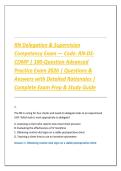
RN Delegation & Supervision
Competency Exam — Code: RN-DS-
COMP | 100-Question Advanced
Practice Exam 2026 | Questions &
Answers with Detailed Rationales |
Complete Exam Prep & Study Guide
1.
The RN is caring for four clients and needs to delegate tasks to an experienced
UAP. Which task is most appropriate to delegate?
A. Assessing a client who reports new-onset chest pressure
B. Evaluating the effectiveness of IV morphine
C. Obtaining routine vital signs on a stable postoperative client
D. Teaching a client how to use an incentive spirometer
Answer: C. Obtaining routine vital signs on a stable postoperative client
,Rationale: Routine, predictable data collection on a stable client can be
delegated to a UAP. Assessment, evaluation, and teaching remain RN
responsibilities.
2.
A newly licensed RN asks the charge nurse whether an LPN can administer IV
medications. What should the charge nurse emphasize?
A. LPNs can administer all IV medications independently
B. Scope of practice depends on state law, facility policy, and the LPN's
competency
C. Only RNs may administer medications by any IV route
D. LPNs may administer IV medications only when the patient is unstable
Answer: B. Scope of practice depends on state law, facility policy, and the LPN's
competency
Rationale: Delegation and assignment must comply with applicable laws,
regulations, organizational policies, and individual competency.
3.
Which client should the RN assess personally rather than delegate the initial
assessment to another team member?
A. Client needing routine postoperative ambulation
B. Client requiring assistance with bathing
C. Client newly admitted with sudden unilateral weakness
D. Client requiring routine intake and output measurement
Answer: C. Client newly admitted with sudden unilateral weakness
Rationale: New or potentially unstable conditions require RN assessment and
clinical judgment. Sudden unilateral weakness may indicate an acute neurologic
emergency.
4.
,An RN delegates ambulation of a stable client to a UAP. The client becomes dizzy
while standing. What is the UAP's priority action?
A. Continue ambulation slowly
B. Return the client safely to a seated or lying position and notify the RN
C. Document the event after completing the walk
D. Give the client oral fluids
Answer: B. Return the client safely to a seated or lying position and notify the
RN
Rationale: The UAP should protect the client from injury and immediately report
a change in condition. The RN then assesses the client.
5.
Which assignment is most appropriate for an LPN/LVN?
A. Developing the initial nursing care plan for a newly admitted client
B. Performing the initial assessment of a client with sepsis
C. Reinforcing teaching for a stable client with diabetes
D. Determining whether a client is ready for discharge
Answer: C. Reinforcing teaching for a stable client with diabetes
Rationale: Reinforcement of established teaching may be appropriate for an
LPN/LVN when permitted by scope and policy. Initial assessment, care planning,
and evaluation require RN-level judgment.
6.
The RN is delegating care using the five rights of delegation. Which element
addresses whether the selected staff member possesses the necessary knowledge
and skill?
A. Right task
B. Right circumstance
, C. Right person
D. Right supervision
Answer: C. Right person
Rationale: The right person means the individual has the appropriate
competence, education, experience, and legal authority to perform the
delegated activity.
7.
A UAP reports that a client's respiratory rate is 8/min. What should the RN do
first?
A. Ask the UAP to recheck the respiratory rate in 30 minutes
B. Assess the client's respiratory status immediately
C. Document the finding as an expected postoperative change
D. Delegate administration of oxygen to another UAP
Answer: B. Assess the client's respiratory status immediately
Rationale: An abnormally low respiratory rate may indicate respiratory
depression. The RN must assess the client and determine the appropriate
intervention.
8.
Which task should the RN avoid delegating to a UAP?
A. Feeding a client with no swallowing concerns
B. Measuring urine output
C. Assessing a newly developed stage 2 pressure injury
D. Assisting with repositioning
Answer: C. Assessing a newly developed stage 2 pressure injury
Rationale: Assessment and clinical interpretation of a new pressure injury
require nursing judgment and should not be delegated to a UAP.
Competency Exam — Code: RN-DS-
COMP | 100-Question Advanced
Practice Exam 2026 | Questions &
Answers with Detailed Rationales |
Complete Exam Prep & Study Guide
1.
The RN is caring for four clients and needs to delegate tasks to an experienced
UAP. Which task is most appropriate to delegate?
A. Assessing a client who reports new-onset chest pressure
B. Evaluating the effectiveness of IV morphine
C. Obtaining routine vital signs on a stable postoperative client
D. Teaching a client how to use an incentive spirometer
Answer: C. Obtaining routine vital signs on a stable postoperative client
,Rationale: Routine, predictable data collection on a stable client can be
delegated to a UAP. Assessment, evaluation, and teaching remain RN
responsibilities.
2.
A newly licensed RN asks the charge nurse whether an LPN can administer IV
medications. What should the charge nurse emphasize?
A. LPNs can administer all IV medications independently
B. Scope of practice depends on state law, facility policy, and the LPN's
competency
C. Only RNs may administer medications by any IV route
D. LPNs may administer IV medications only when the patient is unstable
Answer: B. Scope of practice depends on state law, facility policy, and the LPN's
competency
Rationale: Delegation and assignment must comply with applicable laws,
regulations, organizational policies, and individual competency.
3.
Which client should the RN assess personally rather than delegate the initial
assessment to another team member?
A. Client needing routine postoperative ambulation
B. Client requiring assistance with bathing
C. Client newly admitted with sudden unilateral weakness
D. Client requiring routine intake and output measurement
Answer: C. Client newly admitted with sudden unilateral weakness
Rationale: New or potentially unstable conditions require RN assessment and
clinical judgment. Sudden unilateral weakness may indicate an acute neurologic
emergency.
4.
,An RN delegates ambulation of a stable client to a UAP. The client becomes dizzy
while standing. What is the UAP's priority action?
A. Continue ambulation slowly
B. Return the client safely to a seated or lying position and notify the RN
C. Document the event after completing the walk
D. Give the client oral fluids
Answer: B. Return the client safely to a seated or lying position and notify the
RN
Rationale: The UAP should protect the client from injury and immediately report
a change in condition. The RN then assesses the client.
5.
Which assignment is most appropriate for an LPN/LVN?
A. Developing the initial nursing care plan for a newly admitted client
B. Performing the initial assessment of a client with sepsis
C. Reinforcing teaching for a stable client with diabetes
D. Determining whether a client is ready for discharge
Answer: C. Reinforcing teaching for a stable client with diabetes
Rationale: Reinforcement of established teaching may be appropriate for an
LPN/LVN when permitted by scope and policy. Initial assessment, care planning,
and evaluation require RN-level judgment.
6.
The RN is delegating care using the five rights of delegation. Which element
addresses whether the selected staff member possesses the necessary knowledge
and skill?
A. Right task
B. Right circumstance
, C. Right person
D. Right supervision
Answer: C. Right person
Rationale: The right person means the individual has the appropriate
competence, education, experience, and legal authority to perform the
delegated activity.
7.
A UAP reports that a client's respiratory rate is 8/min. What should the RN do
first?
A. Ask the UAP to recheck the respiratory rate in 30 minutes
B. Assess the client's respiratory status immediately
C. Document the finding as an expected postoperative change
D. Delegate administration of oxygen to another UAP
Answer: B. Assess the client's respiratory status immediately
Rationale: An abnormally low respiratory rate may indicate respiratory
depression. The RN must assess the client and determine the appropriate
intervention.
8.
Which task should the RN avoid delegating to a UAP?
A. Feeding a client with no swallowing concerns
B. Measuring urine output
C. Assessing a newly developed stage 2 pressure injury
D. Assisting with repositioning
Answer: C. Assessing a newly developed stage 2 pressure injury
Rationale: Assessment and clinical interpretation of a new pressure injury
require nursing judgment and should not be delegated to a UAP.


