
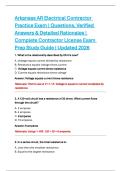
Arkansas AR Electrical Contractor
Practice Exam | Questions, Verified
Answers & Detailed Rationales |
Complete Contractor License Exam
Prep Study Guide | Updated 2026
1. What is the relationship described by Ohm’s Law?
A. Voltage equals current divided by resistance
B. Resistance equals voltage times current
C. Voltage equals current times resistance
D. Current equals resistance times voltage
Answer: Voltage equals current times resistance
Rationale: Ohm’s Law is V = I × R. Voltage is equal to current multiplied by
resistance.
2. A 120-volt circuit has a resistance of 20 ohms. What current flows
through the circuit?
A. 2 amperes
B. 4 amperes
C. 6 amperes
D. 10 amperes
Answer: 6 amperes
Rationale: Using I = V/R, 120 ÷ 20 = 6 amperes.
3. In a series circuit, the total resistance is:
A. Less than the smallest resistance
B. Equal to the largest resistance
,C. The average of all resistances
D. The sum of all individual resistances
Answer: The sum of all individual resistances
Rationale: Series resistances add directly: RT = R1 + R2 + R3 and so forth.
4. In a parallel circuit, the voltage across each parallel branch is generally:
A. Different in every branch
B. Zero
C. Half the source voltage
D. Equal to the source voltage
Answer: Equal to the source voltage
Rationale: Parallel branches are connected across the same two points, so
each branch receives the source voltage.
5. What is the primary purpose of a circuit breaker?
A. Increase circuit voltage
B. Reduce conductor resistance
C. Protect conductors from excessive current
D. Improve power factor
Answer: Protect conductors from excessive current
Rationale: Overcurrent protective devices open a circuit when current
exceeds permitted levels, protecting conductors and equipment.
6. Which unit measures electrical power?
A. Ohm
B. Volt
C. Ampere
D. Watt
Answer: Watt
,Rationale: Electrical power is measured in watts and can be calculated as
P = V × I for a simple DC or unity-power-factor circuit.
7. What is the purpose of the grounding electrode system?
A. Increase circuit voltage
B. Carry normal branch-circuit current
C. Connect the electrical system to earth and provide a reference and path
for certain fault conditions
D. Replace overcurrent protection
Answer: Connect the electrical system to earth and provide a reference
and path for certain fault conditions
Rationale: Grounding connects the system to earth and helps stabilize
voltage to ground and dissipate certain electrical disturbances.
8. What is the primary purpose of equipment grounding conductors?
A. Carry normal neutral current
B. Increase available voltage
C. Provide a low-impedance path for fault current
D. Reduce the size of overcurrent devices
Answer: Provide a low-impedance path for fault current
Rationale: The equipment grounding path allows fault current to return to
the source so the overcurrent device can operate quickly.
9. Where is the grounded conductor normally bonded to the equipment
grounding system in a typical service?
A. At every receptacle
B. At every subpanel
C. At the service disconnecting means
D. At every branch-circuit breaker
Answer: At the service disconnecting means
, Rationale: The service bonding connection establishes the main
connection between the grounded conductor and equipment grounding
system. Downstream separately bonded neutral points can create
objectionable current paths.
10. What does GFCI protection primarily protect against?
A. Overvoltage
B. Overheating motors
C. Electric shock from ground-fault current
D. Low power factor
Answer: Electric shock from ground-fault current
Rationale: A GFCI detects an imbalance between current leaving and
returning through the circuit and disconnects the circuit when the
imbalance reaches its trip level.
11. What does AFCI protection primarily address?
A. Voltage drop
B. Transformer overload
C. Unintended arcing that can create a fire hazard
D. Utility power factor
Answer: Unintended arcing that can create a fire hazard
Rationale: Arc-fault circuit interrupters are designed to detect dangerous
arcing conditions that conventional overcurrent protection may not detect.
12. What is conductor ampacity?
A. Maximum voltage of a conductor
B. Resistance of a conductor
C. Maximum current a conductor can carry under specified conditions
without exceeding its allowable temperature
D. Maximum conduit capacity
Practice Exam | Questions, Verified
Answers & Detailed Rationales |
Complete Contractor License Exam
Prep Study Guide | Updated 2026
1. What is the relationship described by Ohm’s Law?
A. Voltage equals current divided by resistance
B. Resistance equals voltage times current
C. Voltage equals current times resistance
D. Current equals resistance times voltage
Answer: Voltage equals current times resistance
Rationale: Ohm’s Law is V = I × R. Voltage is equal to current multiplied by
resistance.
2. A 120-volt circuit has a resistance of 20 ohms. What current flows
through the circuit?
A. 2 amperes
B. 4 amperes
C. 6 amperes
D. 10 amperes
Answer: 6 amperes
Rationale: Using I = V/R, 120 ÷ 20 = 6 amperes.
3. In a series circuit, the total resistance is:
A. Less than the smallest resistance
B. Equal to the largest resistance
,C. The average of all resistances
D. The sum of all individual resistances
Answer: The sum of all individual resistances
Rationale: Series resistances add directly: RT = R1 + R2 + R3 and so forth.
4. In a parallel circuit, the voltage across each parallel branch is generally:
A. Different in every branch
B. Zero
C. Half the source voltage
D. Equal to the source voltage
Answer: Equal to the source voltage
Rationale: Parallel branches are connected across the same two points, so
each branch receives the source voltage.
5. What is the primary purpose of a circuit breaker?
A. Increase circuit voltage
B. Reduce conductor resistance
C. Protect conductors from excessive current
D. Improve power factor
Answer: Protect conductors from excessive current
Rationale: Overcurrent protective devices open a circuit when current
exceeds permitted levels, protecting conductors and equipment.
6. Which unit measures electrical power?
A. Ohm
B. Volt
C. Ampere
D. Watt
Answer: Watt
,Rationale: Electrical power is measured in watts and can be calculated as
P = V × I for a simple DC or unity-power-factor circuit.
7. What is the purpose of the grounding electrode system?
A. Increase circuit voltage
B. Carry normal branch-circuit current
C. Connect the electrical system to earth and provide a reference and path
for certain fault conditions
D. Replace overcurrent protection
Answer: Connect the electrical system to earth and provide a reference
and path for certain fault conditions
Rationale: Grounding connects the system to earth and helps stabilize
voltage to ground and dissipate certain electrical disturbances.
8. What is the primary purpose of equipment grounding conductors?
A. Carry normal neutral current
B. Increase available voltage
C. Provide a low-impedance path for fault current
D. Reduce the size of overcurrent devices
Answer: Provide a low-impedance path for fault current
Rationale: The equipment grounding path allows fault current to return to
the source so the overcurrent device can operate quickly.
9. Where is the grounded conductor normally bonded to the equipment
grounding system in a typical service?
A. At every receptacle
B. At every subpanel
C. At the service disconnecting means
D. At every branch-circuit breaker
Answer: At the service disconnecting means
, Rationale: The service bonding connection establishes the main
connection between the grounded conductor and equipment grounding
system. Downstream separately bonded neutral points can create
objectionable current paths.
10. What does GFCI protection primarily protect against?
A. Overvoltage
B. Overheating motors
C. Electric shock from ground-fault current
D. Low power factor
Answer: Electric shock from ground-fault current
Rationale: A GFCI detects an imbalance between current leaving and
returning through the circuit and disconnects the circuit when the
imbalance reaches its trip level.
11. What does AFCI protection primarily address?
A. Voltage drop
B. Transformer overload
C. Unintended arcing that can create a fire hazard
D. Utility power factor
Answer: Unintended arcing that can create a fire hazard
Rationale: Arc-fault circuit interrupters are designed to detect dangerous
arcing conditions that conventional overcurrent protection may not detect.
12. What is conductor ampacity?
A. Maximum voltage of a conductor
B. Resistance of a conductor
C. Maximum current a conductor can carry under specified conditions
without exceeding its allowable temperature
D. Maximum conduit capacity


