
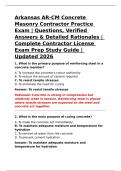
Arkansas AR-CM Concrete
Masonry Contractor Practice
Exam | Questions, Verified
Answers & Detailed Rationales |
Complete Contractor License
Exam Prep Study Guide |
Updated 2026
1. What is the primary purpose of reinforcing steel in a
concrete member?
A. To increase the concrete's colour uniformity
B. To reduce the amount of cement required
C. To resist tensile stresses
D. To eliminate the need for curing
Answer: To resist tensile stresses
Rationale: Concrete is strong in compression but
relatively weak in tension. Reinforcing steel is placed
where tensile stresses are expected so the steel and
concrete act together.
2. What is the main purpose of curing concrete?
A. To make the concrete set immediately
B. To maintain adequate moisture and temperature for
hydration
C. To remove all water from the concrete
D. To prevent cement hydration
Answer: To maintain adequate moisture and
temperature for hydration
,Rationale: Proper curing allows cement hydration to
continue, improving strength, durability, and resistance
to cracking.
3. What does a lower water-cement ratio generally
produce when the concrete is properly placed and
cured?
A. Lower strength
B. Greater shrinkage in every case
C. Higher potential strength and durability
D. Longer aggregate size
Answer: Higher potential strength and durability
Rationale: Excess mixing water creates additional
capillary pores after evaporation. Reducing the water-
cement ratio generally increases strength and durability
when workability remains adequate.
4. What is the purpose of an air-entraining admixture in
concrete exposed to freezing and thawing?
A. To eliminate cement
B. To increase aggregate size
C. To provide microscopic air voids that relieve freezing
pressure
D. To prevent all evaporation
Answer: To provide microscopic air voids that relieve
freezing pressure
Rationale: Properly distributed microscopic air voids
give freezing water room to expand and reduce internal
pressure in hardened concrete.
5. What is concrete slump primarily used to measure?
,A. Compressive strength
B. Consistency or workability
C. Cement content
D. Aggregate hardness
Answer: Consistency or workability
Rationale: The slump test provides an indication of
fresh concrete consistency. It does not directly measure
compressive strength.
6. Adding excessive water to a concrete load at the
jobsite can result in:
A. Guaranteed higher strength
B. Reduced shrinkage
C. Increased water-cement ratio and potentially lower
strength
D. Elimination of segregation
Answer: Increased water-cement ratio and potentially
lower strength
Rationale: Uncontrolled water addition increases the
water-cement ratio and may reduce strength and
durability while increasing bleeding and shrinkage.
7. What is segregation in concrete?
A. Chemical bonding of cement
B. Separation of coarse aggregate from the mortar or
paste
C. Proper consolidation
D. Controlled curing
Answer: Separation of coarse aggregate from the
mortar or paste
, Rationale: Segregation occurs when concrete
components separate, often because of excessive
handling, improper placement, or overly wet mixtures.
8. What is the primary purpose of concrete
consolidation?
A. To increase the amount of entrapped air
B. To dry the concrete
C. To remove undesirable air voids and ensure proper
contact around reinforcement and forms
D. To replace curing
Answer: To remove undesirable air voids and ensure
proper contact around reinforcement and forms
Rationale: Consolidation helps concrete flow around
reinforcement and into form corners while reducing
unintended voids and honeycombing.
9. What is honeycombing in concrete?
A. A type of curing compound
B. A reinforcing bar pattern
C. Voids or exposed aggregate caused by inadequate
consolidation or improper placement
D. A type of concrete admixture
Answer: Voids or exposed aggregate caused by
inadequate consolidation or improper placement
Rationale: Honeycombing occurs when mortar does not
adequately surround coarse aggregate, commonly
because of poor consolidation, congested
reinforcement, or improper placement.
10. What is the purpose of construction joints?
Masonry Contractor Practice
Exam | Questions, Verified
Answers & Detailed Rationales |
Complete Contractor License
Exam Prep Study Guide |
Updated 2026
1. What is the primary purpose of reinforcing steel in a
concrete member?
A. To increase the concrete's colour uniformity
B. To reduce the amount of cement required
C. To resist tensile stresses
D. To eliminate the need for curing
Answer: To resist tensile stresses
Rationale: Concrete is strong in compression but
relatively weak in tension. Reinforcing steel is placed
where tensile stresses are expected so the steel and
concrete act together.
2. What is the main purpose of curing concrete?
A. To make the concrete set immediately
B. To maintain adequate moisture and temperature for
hydration
C. To remove all water from the concrete
D. To prevent cement hydration
Answer: To maintain adequate moisture and
temperature for hydration
,Rationale: Proper curing allows cement hydration to
continue, improving strength, durability, and resistance
to cracking.
3. What does a lower water-cement ratio generally
produce when the concrete is properly placed and
cured?
A. Lower strength
B. Greater shrinkage in every case
C. Higher potential strength and durability
D. Longer aggregate size
Answer: Higher potential strength and durability
Rationale: Excess mixing water creates additional
capillary pores after evaporation. Reducing the water-
cement ratio generally increases strength and durability
when workability remains adequate.
4. What is the purpose of an air-entraining admixture in
concrete exposed to freezing and thawing?
A. To eliminate cement
B. To increase aggregate size
C. To provide microscopic air voids that relieve freezing
pressure
D. To prevent all evaporation
Answer: To provide microscopic air voids that relieve
freezing pressure
Rationale: Properly distributed microscopic air voids
give freezing water room to expand and reduce internal
pressure in hardened concrete.
5. What is concrete slump primarily used to measure?
,A. Compressive strength
B. Consistency or workability
C. Cement content
D. Aggregate hardness
Answer: Consistency or workability
Rationale: The slump test provides an indication of
fresh concrete consistency. It does not directly measure
compressive strength.
6. Adding excessive water to a concrete load at the
jobsite can result in:
A. Guaranteed higher strength
B. Reduced shrinkage
C. Increased water-cement ratio and potentially lower
strength
D. Elimination of segregation
Answer: Increased water-cement ratio and potentially
lower strength
Rationale: Uncontrolled water addition increases the
water-cement ratio and may reduce strength and
durability while increasing bleeding and shrinkage.
7. What is segregation in concrete?
A. Chemical bonding of cement
B. Separation of coarse aggregate from the mortar or
paste
C. Proper consolidation
D. Controlled curing
Answer: Separation of coarse aggregate from the
mortar or paste
, Rationale: Segregation occurs when concrete
components separate, often because of excessive
handling, improper placement, or overly wet mixtures.
8. What is the primary purpose of concrete
consolidation?
A. To increase the amount of entrapped air
B. To dry the concrete
C. To remove undesirable air voids and ensure proper
contact around reinforcement and forms
D. To replace curing
Answer: To remove undesirable air voids and ensure
proper contact around reinforcement and forms
Rationale: Consolidation helps concrete flow around
reinforcement and into form corners while reducing
unintended voids and honeycombing.
9. What is honeycombing in concrete?
A. A type of curing compound
B. A reinforcing bar pattern
C. Voids or exposed aggregate caused by inadequate
consolidation or improper placement
D. A type of concrete admixture
Answer: Voids or exposed aggregate caused by
inadequate consolidation or improper placement
Rationale: Honeycombing occurs when mortar does not
adequately surround coarse aggregate, commonly
because of poor consolidation, congested
reinforcement, or improper placement.
10. What is the purpose of construction joints?


