
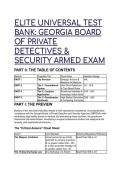
ELITE UNIVERSAL TEST
BANK: GEORGIA BOARD
OF PRIVATE
DETECTIVES &
SECURITY ARMED EXAM
PART 0: THE TABLE OF CONTENTS
Section Cognitive Tier Focus Area Question Range
PART I The Preview Strategic Axioms & N/A
Baseline Architecture
PART II Tier 1: Foundational Hard Deck Definitions Q1 – Q18
Syntax & Core Board Rules
PART II Tier 2: Complex Situational Variables & Q19 – Q37
Application Immediate Action Drills
PART II Tier 3: Grandmaster High-Stakes Simulation Q38 – Q55
Synthesis & Competing Concepts
PART I: THE PREVIEW
Mastery of this test bank translates directly to elite operational competence, ensuring absolute
compliance with the Georgia Board of Private Detective and Security Agencies (GBPDSA) while
neutralizing high-liability threats in the field. By internalizing these doctrines, the practitioner
transcends rote memorization, developing a surgical professional intuition that safeguards life,
property, and organizational licensure.
The "Critical Axioms" Cheat Sheet
Axiom Core Mandate Statutory/Regulatory Reference
The Weapon Limitation Armed personnel are strictly Board Rule 509-4-.01
restricted to carrying a revolver
of no greater caliber than .357,
or a semi-automatic handgun of
no greater caliber than .45.
The 10-Day Discharge Law Any discharge of a firearm Board Rule 509-4-.05
,Axiom Core Mandate Statutory/Regulatory Reference
while on duty (excluding
supervised range training)
mandates an immediate report
to the Board within ten (10)
business days.
Shopkeeper's Privilege Suspected shoplifters may be O.C.G.A. 51-7-60
detained upon reasonable
suspicion, but solely for a
reasonable time and in a
reasonable manner to avert
False Imprisonment.
The Deadly Force Threshold Deadly force is justified only if O.C.G.A. 16-3-21
reasonably necessary to
prevent death, great bodily
injury, or the commission of a
forcible felony. It is never for
property.
The Training Baseline 24 hours (Unarmed) + 15 hours Board Rule 509-3-.10
(Armed). Qualification requires
2 strings of 48 rounds with the
duty caliber, achieving a
minimum score of 80%.
PART II: THE ELITE TEST BANK
Tier 1: Foundational Syntax & Application
Q1: To achieve armed security registration under Georgia law, an applicant must complete a
specific matrix of training hours. Based on the principles of Board Rule 509-3-.02 and 509-3-.10,
which timeline is the MOST ACCURATE? A) 15 hours of classroom theory and 24 hours of
firearms range training. B) 40 hours of blended training completed exclusively online. C) 24
hours of unarmed training followed by 15 hours of armed training. D) 70 hours of basic training
prior to firearms authorization.
● Answer: C (24 hours of unarmed training followed by 15 hours of armed training.)
● Distractor Analysis:
○ A is incorrect: The hours are inverted; the unarmed requirement is 24 hours, and
the armed addition is 15 hours.
○ B is incorrect: Firearms training (Phase 3) requires practical, live-fire range
qualification and cannot be completed exclusively online.
○ D is incorrect: The 70-hour requirement applies to Private Detectives, not standard
armed security officers.
The Mentor's Analysis: Foundational compliance relies on the 24/15 paradigm. A security officer
must first master unarmed observation and legal boundaries before introducing a lethal force
multiplier. Professional/Academic Intuition: Armed status requires exactly 39 hours of
modular training: 24 unarmed plus 15 armed.
Q2: During firearms qualification, a candidate fires their designated course. Based on the
principles of Board Rule 509-3-.10, which standard dictates a passing score? A) 1 string of 50
, rounds with a 75% minimum score. B) 2 strings of 48 rounds with an 80% minimum score. C) 3
strings of 30 rounds with an 85% minimum score. D) 2 strings of 50 rounds with a 100%
minimum score.
● Answer: B (2 strings of 48 rounds with an 80% minimum score.)
● Distractor Analysis:
○ A is incorrect: The state standard is 80%, and the round count is statistically
incorrect.
○ C is incorrect: 85% is a fabricated metric; the Board strictly enforces the 80%
baseline.
○ D is incorrect: While 100% may be an internal agency goal, the legal state minimum
is 80% on 48-round strings.
The Mentor's Analysis: The Board establishes an empirical, unyielding baseline for lethal
proficiency. Failure to hit the 80% threshold immediately disqualifies the applicant from carrying
a firearm. Professional/Academic Intuition: The golden metric for Georgia firearms
qualification is 2 strings, 48 rounds, and an 80% minimum.
Q3: A 19-year-old applicant applies for an armed security position. Based on the Georgia
Private Detective and Security Agencies Act, what is the MOST ACCURATE determination? A)
The applicant may work armed provided they pass the 15-hour firearms course. B) The
applicant is restricted to unarmed duties, as the minimum age for armed registration is 21. C)
The applicant may work armed if they possess a valid military ID. D) The applicant is entirely
ineligible for any security licensure until age 21.
● Answer: B (The applicant is restricted to unarmed duties, as the minimum age for armed
registration is 21.)
● Distractor Analysis:
○ A is incorrect: Passing the course does not bypass statutory age limits.
○ C is incorrect: Military service does not explicitly waive the statutory age
requirement of 21 for armed security personnel.
○ D is incorrect: Unarmed security officers may be registered at 18 years of age.
The Mentor's Analysis: The state bifurcates liability by age. Eighteen-year-olds may observe
and report, but the state demands the maturity of a 21-year-old before authorizing lethal force.
Professional/Academic Intuition: Age minimums are absolute: 18 for unarmed duties, 21 for
armed deployment.
Q4: An armed guard purchases a .50 caliber semi-automatic handgun for duty use to maximize
stopping power. Based on the principles of Board Rule 509-4-.01, what is the legality of this
action? A) Lawful, provided the guard qualifies with the weapon on the range. B) Unlawful, as
semi-automatic handguns are restricted to a maximum of .45 caliber. C) Lawful, provided the
employer authorizes it in writing. D) Unlawful, as all security guards must carry 9mm weapons.
● Answer: B (Unlawful, as semi-automatic handguns are restricted to a maximum of .45
caliber.)
● Distractor Analysis:
○ A is incorrect: Range qualification does not override the Board's strict caliber
ceiling.
○ C is incorrect: Employers cannot authorize violations of state administrative
regulations.
○ D is incorrect: Guards are not restricted to a single caliber, but they must remain at
or below the mandated ceilings (.357 revolver / .45 semi-auto).
The Mentor's Analysis: Kinetic potential is capped to protect bystanders from over-penetration.
Exceeding the maximum caliber instantly invalidates the officer's weapon permit.
BANK: GEORGIA BOARD
OF PRIVATE
DETECTIVES &
SECURITY ARMED EXAM
PART 0: THE TABLE OF CONTENTS
Section Cognitive Tier Focus Area Question Range
PART I The Preview Strategic Axioms & N/A
Baseline Architecture
PART II Tier 1: Foundational Hard Deck Definitions Q1 – Q18
Syntax & Core Board Rules
PART II Tier 2: Complex Situational Variables & Q19 – Q37
Application Immediate Action Drills
PART II Tier 3: Grandmaster High-Stakes Simulation Q38 – Q55
Synthesis & Competing Concepts
PART I: THE PREVIEW
Mastery of this test bank translates directly to elite operational competence, ensuring absolute
compliance with the Georgia Board of Private Detective and Security Agencies (GBPDSA) while
neutralizing high-liability threats in the field. By internalizing these doctrines, the practitioner
transcends rote memorization, developing a surgical professional intuition that safeguards life,
property, and organizational licensure.
The "Critical Axioms" Cheat Sheet
Axiom Core Mandate Statutory/Regulatory Reference
The Weapon Limitation Armed personnel are strictly Board Rule 509-4-.01
restricted to carrying a revolver
of no greater caliber than .357,
or a semi-automatic handgun of
no greater caliber than .45.
The 10-Day Discharge Law Any discharge of a firearm Board Rule 509-4-.05
,Axiom Core Mandate Statutory/Regulatory Reference
while on duty (excluding
supervised range training)
mandates an immediate report
to the Board within ten (10)
business days.
Shopkeeper's Privilege Suspected shoplifters may be O.C.G.A. 51-7-60
detained upon reasonable
suspicion, but solely for a
reasonable time and in a
reasonable manner to avert
False Imprisonment.
The Deadly Force Threshold Deadly force is justified only if O.C.G.A. 16-3-21
reasonably necessary to
prevent death, great bodily
injury, or the commission of a
forcible felony. It is never for
property.
The Training Baseline 24 hours (Unarmed) + 15 hours Board Rule 509-3-.10
(Armed). Qualification requires
2 strings of 48 rounds with the
duty caliber, achieving a
minimum score of 80%.
PART II: THE ELITE TEST BANK
Tier 1: Foundational Syntax & Application
Q1: To achieve armed security registration under Georgia law, an applicant must complete a
specific matrix of training hours. Based on the principles of Board Rule 509-3-.02 and 509-3-.10,
which timeline is the MOST ACCURATE? A) 15 hours of classroom theory and 24 hours of
firearms range training. B) 40 hours of blended training completed exclusively online. C) 24
hours of unarmed training followed by 15 hours of armed training. D) 70 hours of basic training
prior to firearms authorization.
● Answer: C (24 hours of unarmed training followed by 15 hours of armed training.)
● Distractor Analysis:
○ A is incorrect: The hours are inverted; the unarmed requirement is 24 hours, and
the armed addition is 15 hours.
○ B is incorrect: Firearms training (Phase 3) requires practical, live-fire range
qualification and cannot be completed exclusively online.
○ D is incorrect: The 70-hour requirement applies to Private Detectives, not standard
armed security officers.
The Mentor's Analysis: Foundational compliance relies on the 24/15 paradigm. A security officer
must first master unarmed observation and legal boundaries before introducing a lethal force
multiplier. Professional/Academic Intuition: Armed status requires exactly 39 hours of
modular training: 24 unarmed plus 15 armed.
Q2: During firearms qualification, a candidate fires their designated course. Based on the
principles of Board Rule 509-3-.10, which standard dictates a passing score? A) 1 string of 50
, rounds with a 75% minimum score. B) 2 strings of 48 rounds with an 80% minimum score. C) 3
strings of 30 rounds with an 85% minimum score. D) 2 strings of 50 rounds with a 100%
minimum score.
● Answer: B (2 strings of 48 rounds with an 80% minimum score.)
● Distractor Analysis:
○ A is incorrect: The state standard is 80%, and the round count is statistically
incorrect.
○ C is incorrect: 85% is a fabricated metric; the Board strictly enforces the 80%
baseline.
○ D is incorrect: While 100% may be an internal agency goal, the legal state minimum
is 80% on 48-round strings.
The Mentor's Analysis: The Board establishes an empirical, unyielding baseline for lethal
proficiency. Failure to hit the 80% threshold immediately disqualifies the applicant from carrying
a firearm. Professional/Academic Intuition: The golden metric for Georgia firearms
qualification is 2 strings, 48 rounds, and an 80% minimum.
Q3: A 19-year-old applicant applies for an armed security position. Based on the Georgia
Private Detective and Security Agencies Act, what is the MOST ACCURATE determination? A)
The applicant may work armed provided they pass the 15-hour firearms course. B) The
applicant is restricted to unarmed duties, as the minimum age for armed registration is 21. C)
The applicant may work armed if they possess a valid military ID. D) The applicant is entirely
ineligible for any security licensure until age 21.
● Answer: B (The applicant is restricted to unarmed duties, as the minimum age for armed
registration is 21.)
● Distractor Analysis:
○ A is incorrect: Passing the course does not bypass statutory age limits.
○ C is incorrect: Military service does not explicitly waive the statutory age
requirement of 21 for armed security personnel.
○ D is incorrect: Unarmed security officers may be registered at 18 years of age.
The Mentor's Analysis: The state bifurcates liability by age. Eighteen-year-olds may observe
and report, but the state demands the maturity of a 21-year-old before authorizing lethal force.
Professional/Academic Intuition: Age minimums are absolute: 18 for unarmed duties, 21 for
armed deployment.
Q4: An armed guard purchases a .50 caliber semi-automatic handgun for duty use to maximize
stopping power. Based on the principles of Board Rule 509-4-.01, what is the legality of this
action? A) Lawful, provided the guard qualifies with the weapon on the range. B) Unlawful, as
semi-automatic handguns are restricted to a maximum of .45 caliber. C) Lawful, provided the
employer authorizes it in writing. D) Unlawful, as all security guards must carry 9mm weapons.
● Answer: B (Unlawful, as semi-automatic handguns are restricted to a maximum of .45
caliber.)
● Distractor Analysis:
○ A is incorrect: Range qualification does not override the Board's strict caliber
ceiling.
○ C is incorrect: Employers cannot authorize violations of state administrative
regulations.
○ D is incorrect: Guards are not restricted to a single caliber, but they must remain at
or below the mandated ceilings (.357 revolver / .45 semi-auto).
The Mentor's Analysis: Kinetic potential is capped to protect bystanders from over-penetration.
Exceeding the maximum caliber instantly invalidates the officer's weapon permit.


