

Mitochondria 1 and II Question
1. What statement is False? – Cardiolipins are located in the plasma membrane of eukaryotes
2. Where did all the other mitochondrial/chloroplast genes go? – They degraded and disappeared
and They were transferred into the nuclear genome
3. If you wanted to get GFP into the mitochondrial matrix, what kind of genetic engineering would
you have to do? – Add a mitochondrial signal sequence to the GFP gene.
4. Which statement is True? – The electron transport processes in the inner membrane helps
establish an electrochemical gradient that is required to move proteins into the mitochondrial
matrix
5. Inheritance of mitochondrial diseases: Diseases arising from mutations in mitochondrial DNA
pass from affected mothers to both daughters and sons, with the daughters but not the sons
producing children with the disease. – True
6. Some mitochondrial diseases are caused by mutations in nuclear-encoded mitochondrial protein
– These diseases follow regular Mendelian inheritance patterns.
7. What overall effects would you expect the Dynamin inhibitor “Dynasore” to exert on a cell? – I
would expect this treatment to inhibit clathrin-mediated endocytosis, Exposure to this
treatment should prevent mitochondrial fission, This drug will disrupt lysosomal function.
8. What direct effects would you expect the Dynamin inhibitor “Dynasore” to exert on
mitochondria? – This treatment will result in very large mitochondria.
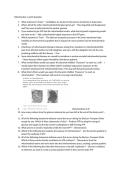
9. Mitochondrion in B
10. How many carbons from the glucose molecule do you have left at the end of the Krebs cycle? –
0
11. All of the following statements indicate events that occur during the Electron Transport Chain
except for one. Which of these statements is False? – Produce ATP by using the energy in
glucose and oxygen to directly transfer a phosphate to ADP forming ATP.
12. What process in aerobic respiration yields the most ATP? – Chemiosmosis
13. Which of the following best explains the purpose of chemiosmosis? – Use the proton gradient to
power the synthesis of ATP
14. All of the following statements indicate events that occur during the Electron Transport Chain.
Which of these events directly contributes to ATP synthesis? – Take protons from the
mitochondrial matrix and move them into the intermembrane space, creating a proton gradient.
15. Which of the following best describes the process of aerobic respiration? – Glucose is oxidized,
its electrons are used to create a proton gradient which is then used to make ATP
, 16. What molecule does “Nutrients” refer to here? (What molecule enter mitochondrion?) –
Pyruvate
17. Which steps of cellular respiration are interfered with by the this MPC mutation? – Pyruvate
oxidation, Krebs cycle, Electron transport chain, and Chemiosmosis
18. For the experiment that was just described (punching holes in the mitochondrion), what would
they have concluded if the PDH activity for the MPC mutant yeast was very low in comparison to
the normal yeast? – That would indicate that the mutation likely interferes with the ability of
PDH to convert pyruvate to Acetyl CoA, rather than with pyruvates ability to enter the cell.
19. The flowering spike of skunk cabbage can be up to 20 degrees Fahrenheit higher than the
environment, helping to spread the flowers, and thus recruit pollinators. What must the plant
cells be doing in order to generate this much heat? – The cells have an uncoupling agent in the
inner mitochondrial membrane.
Intro to Cytoskeleton, Microtubules
1. The cytoskeleton is LEAST relevant for the following situation: - Pyruvate gaining entry into a
mitochondrion
2. Microtubules are similar to Actin microfilaments in that both – can be assembled at one end at
the same time that they are disassembled at the other end (“treadmilling”)
3. A microtubule is currently treadmilling. Suddenly, the concentration of tubulin heterodimers in
the surrounding solution drops far below that required for (+) assembly. What happens to the
microtubule? – Dimers start falling off of both ends of the microtubule.
4. Beta-tubulin is DIFFERENT than other GTPases (Sar1, Rab, and Ran) because – Beta-tubulin
undergoes a conformational changes that has an effect on microtubule stability.
5. Beta-tubulin-GTP is hydrolyzed to Beta-tubulin GDP. The GAP protein that hydrolyzed it is
located: - Closer to the (+) end of the protofilament that the beta-tubulin protein
6. What is the “GTP-cap” of a microtubule? – An are where many GTP-bound beta tubulins are
found.
7. Beta-tubulin-GDP is associated with – curved protofilaments
8. What would you expect protofilaments to look like if the beta-tubulin proteins were bound to
GMP-CPP? (a non-hydrolyzable form of GTP) – Figure A
Actin Microfilaments
1. Let’s say that you have a very high concentration of ATP-bound G-actin in a test tube. Then
you add some purified ARP2/3 complex (including WASp) to that. What do you expect to
see? – The actin will polymerize, forming branched filaments
2. A microfilament in a steady state/treadmilling. What do you think might be the
concentration of available G-actin-ATP monomers surrounding this microfilament? The
Critical concentration of the plus end is 0.1 uM, and the crit conc of the minus end is 0.8 uM.
– 0.5 uM
1. What statement is False? – Cardiolipins are located in the plasma membrane of eukaryotes
2. Where did all the other mitochondrial/chloroplast genes go? – They degraded and disappeared
and They were transferred into the nuclear genome
3. If you wanted to get GFP into the mitochondrial matrix, what kind of genetic engineering would
you have to do? – Add a mitochondrial signal sequence to the GFP gene.
4. Which statement is True? – The electron transport processes in the inner membrane helps
establish an electrochemical gradient that is required to move proteins into the mitochondrial
matrix
5. Inheritance of mitochondrial diseases: Diseases arising from mutations in mitochondrial DNA
pass from affected mothers to both daughters and sons, with the daughters but not the sons
producing children with the disease. – True
6. Some mitochondrial diseases are caused by mutations in nuclear-encoded mitochondrial protein
– These diseases follow regular Mendelian inheritance patterns.
7. What overall effects would you expect the Dynamin inhibitor “Dynasore” to exert on a cell? – I
would expect this treatment to inhibit clathrin-mediated endocytosis, Exposure to this
treatment should prevent mitochondrial fission, This drug will disrupt lysosomal function.
8. What direct effects would you expect the Dynamin inhibitor “Dynasore” to exert on
mitochondria? – This treatment will result in very large mitochondria.
9. Mitochondrion in B
10. How many carbons from the glucose molecule do you have left at the end of the Krebs cycle? –
0
11. All of the following statements indicate events that occur during the Electron Transport Chain
except for one. Which of these statements is False? – Produce ATP by using the energy in
glucose and oxygen to directly transfer a phosphate to ADP forming ATP.
12. What process in aerobic respiration yields the most ATP? – Chemiosmosis
13. Which of the following best explains the purpose of chemiosmosis? – Use the proton gradient to
power the synthesis of ATP
14. All of the following statements indicate events that occur during the Electron Transport Chain.
Which of these events directly contributes to ATP synthesis? – Take protons from the
mitochondrial matrix and move them into the intermembrane space, creating a proton gradient.
15. Which of the following best describes the process of aerobic respiration? – Glucose is oxidized,
its electrons are used to create a proton gradient which is then used to make ATP
, 16. What molecule does “Nutrients” refer to here? (What molecule enter mitochondrion?) –
Pyruvate
17. Which steps of cellular respiration are interfered with by the this MPC mutation? – Pyruvate
oxidation, Krebs cycle, Electron transport chain, and Chemiosmosis
18. For the experiment that was just described (punching holes in the mitochondrion), what would
they have concluded if the PDH activity for the MPC mutant yeast was very low in comparison to
the normal yeast? – That would indicate that the mutation likely interferes with the ability of
PDH to convert pyruvate to Acetyl CoA, rather than with pyruvates ability to enter the cell.
19. The flowering spike of skunk cabbage can be up to 20 degrees Fahrenheit higher than the
environment, helping to spread the flowers, and thus recruit pollinators. What must the plant
cells be doing in order to generate this much heat? – The cells have an uncoupling agent in the
inner mitochondrial membrane.
Intro to Cytoskeleton, Microtubules
1. The cytoskeleton is LEAST relevant for the following situation: - Pyruvate gaining entry into a
mitochondrion
2. Microtubules are similar to Actin microfilaments in that both – can be assembled at one end at
the same time that they are disassembled at the other end (“treadmilling”)
3. A microtubule is currently treadmilling. Suddenly, the concentration of tubulin heterodimers in
the surrounding solution drops far below that required for (+) assembly. What happens to the
microtubule? – Dimers start falling off of both ends of the microtubule.
4. Beta-tubulin is DIFFERENT than other GTPases (Sar1, Rab, and Ran) because – Beta-tubulin
undergoes a conformational changes that has an effect on microtubule stability.
5. Beta-tubulin-GTP is hydrolyzed to Beta-tubulin GDP. The GAP protein that hydrolyzed it is
located: - Closer to the (+) end of the protofilament that the beta-tubulin protein
6. What is the “GTP-cap” of a microtubule? – An are where many GTP-bound beta tubulins are
found.
7. Beta-tubulin-GDP is associated with – curved protofilaments
8. What would you expect protofilaments to look like if the beta-tubulin proteins were bound to
GMP-CPP? (a non-hydrolyzable form of GTP) – Figure A
Actin Microfilaments
1. Let’s say that you have a very high concentration of ATP-bound G-actin in a test tube. Then
you add some purified ARP2/3 complex (including WASp) to that. What do you expect to
see? – The actin will polymerize, forming branched filaments
2. A microfilament in a steady state/treadmilling. What do you think might be the
concentration of available G-actin-ATP monomers surrounding this microfilament? The
Critical concentration of the plus end is 0.1 uM, and the crit conc of the minus end is 0.8 uM.
– 0.5 uM


