
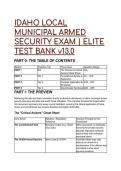
IDAHO LOCAL
MUNICIPAL ARMED
SECURITY EXAM | ELITE
TEST BANK v13.0
PART 0: THE TABLE OF CONTENTS
Section Cognitive Tier Focus Area Question Range
PART I N/A The Preview & Critical N/A
Axioms Cheat Sheet
PART II Tier 1 Foundational Syntax & Q1 – Q18
Application
PART II Tier 2 Complex Application & Q19 – Q37
Simulation
PART II Tier 3 Grandmaster Synthesis Q38 – Q55
PART I: THE PREVIEW
Mastering this elite test bank translates directly to absolute dominance in Idaho municipal armed
security licensure and elite real-world threat mitigation. The cognitive frameworks forged within
this document rigorously strip away novice hesitation, ensuring the clinical application of force,
arrest, and jurisdictional law remains flawless and legally defensible.
The "Critical Axioms" Cheat Sheet
Core Axiom Statutory / Regulatory Absolute Principle for the
Reference Practitioner
The Jurisdictional Void Municipal Codes (e.g., Boise Idaho possesses no statewide
City Code) licensing for private security;
absolute regulatory authority
rests entirely with individual
municipal clerks.
The 19-604 Arrest Doctrine Idaho Code § 19-604 A private citizen may only
execute an arrest for a
misdemeanor if the offense was
committed in their direct
physical presence.
,Core Axiom Statutory / Regulatory Absolute Principle for the
Reference Practitioner
The 18-4009 Lethal Threshold Idaho Code § 18-4009 & § Deadly force is strictly justified
19-202A to resist an imminent threat of
murder, great bodily injury, or a
violent felony. Idaho explicitly
mandates no duty to retreat.
The Enhanced CWL Idaho Code § 18-3302K & § Only Enhanced Concealed
Paradigm 18-3309 Weapons License holders may
carry on public college
campuses, explicitly excluding
student dormitories and
stadiums exceeding 1,000
seats.
The 18-2407 Theft Metric Idaho Code § 18-2407 Property theft elevates from
petit (misdemeanor) to grand
(felony) when the value
exceeds $1,000, or when the
stolen property is a firearm,
livestock, or obtained via
extortion.
PART II: THE ELITE TEST BANK
TIER 1: Foundational Syntax & Application
Q1: Regarding private security guard licensing within the state of Idaho, based on current
regulatory frameworks, which statement is the MOST ACCURATE? A) The Idaho State Police
issues a mandatory statewide armed security credential for all private contractors. B) Security
personnel are licensed exclusively through the Idaho Peace Officer Standards and Training
(POST) council. C) Idaho does not license security guards statewide; individual municipalities
maintain exclusive regulatory and licensing authority. D) All armed security personnel must
obtain a federal homeland security credential before operating within Idaho state lines.
● Answer: C (Idaho does not license security guards statewide; individual municipalities
maintain exclusive regulatory and licensing authority.)
● Distractor Analysis:
○ A is incorrect: The state of Idaho explicitly lacks a statewide private security
licensing mechanism, leaving the jurisdiction entirely to local cities.
○ B is incorrect: The POST council certifies sworn law enforcement officers, not
private security personnel.
○ D is incorrect: There is no overarching federal mandate overriding local municipal
licensing for standard private security operations.
The Mentor's Analysis: State law defers entirely to local jurisdictions for private security
regulation. When establishing operational authority, the immediate priority is verifying
compliance with the specific city clerk (e.g., Boise or Lewiston). By consulting local municipal
codes, the practitioner bypasses the common novice trap of assuming statewide uniformity.
Professional/Academic Intuition: Jurisdictional authority and licensing mandates in the
Idaho private security sector are strictly municipal.
, Q2: An armed guard operating in Boise must comply with Boise City Code requirements. Based
on these local licensing mandates, what is FIRST required before an individual Security
Personnel License application will be processed by the city? A) Completion of an 80-hour
state-mandated tactical firearms course. B) Fingerprinting and a background check conducted
in person at City Hall. C) Proof of a $500,000 personal liability insurance policy held by the
guard. D) Graduation from an approved Idaho POST patrol academy.
● Answer: B (Fingerprinting and a background check conducted in person at City Hall.)
● Distractor Analysis:
○ A is incorrect: Boise does not mandate an 80-hour tactical course for the baseline
personnel license, focusing instead on background verification.
○ C is incorrect: The $500,000 liability insurance is a stringent requirement for the
Security Company License, whereas the individual Personnel License requires a
$2,500 surety bond.
○ D is incorrect: POST academy graduation is for sworn peace officers, completely
separate from private licensing.
The Mentor's Analysis: Licensing requirements bifurcate strictly between the corporate entity
and the individual operator. When applying for a personnel license, the immediate priority is
clearing the background check via fingerprinting. By acknowledging the correct procedural
sequence, the applicant bypasses the common error of confusing corporate insurance
requirements with individual bond mandates. Professional/Academic Intuition: Individual
guards in Boise require a $2,500 bond and fingerprinting; security companies require a
$500,000 liability policy and a $10,000 bond.
Q3: Under Idaho Code § 19-604 (When Private Person May Arrest), a security guard may
legally execute a citizen's arrest for a misdemeanor ONLY under which specific condition? A)
When the guard possesses reasonable suspicion that the suspect will flee the property. B)
When the public offense is committed or attempted in the guard's direct physical presence. C)
When a sworn peace officer directs the guard to detain a subject over a radio transmission. D)
When the guard possesses high-definition video evidence of the crime occurring earlier that day.
● Answer: B (When the public offense is committed or attempted in the guard's direct
physical presence.)
● Distractor Analysis:
○ A is incorrect: Reasonable suspicion of flight does not grant misdemeanor arrest
powers to private citizens.
○ C is incorrect: While police can assist, the statutory trigger for the private person is
their own sensory observation of the misdemeanor.
○ D is incorrect: Reviewing a video after the fact fails to meet the strict "in his
presence" requirement for a misdemeanor under 19-604(1).
The Mentor's Analysis: Misdemeanor private arrests require absolute, immediate sensory
confirmation. When facing a potential misdemeanor offense, the immediate priority is confirming
the act was directly witnessed. By adhering to the "in presence" standard, the professional
bypasses the severe liability of an unlawful detention based on delayed discovery.
Professional/Academic Intuition: For misdemeanors, a private person's arrest power is
absolutely restricted to offenses committed or attempted in their immediate presence.
Q4: A security officer detains a shoplifter. According to Idaho Code § 19-614, what is the private
person's IMMEDIATE statutory duty upon making an arrest? A) Conduct a full custodial
interrogation to secure a written confession. B) Transport the arrestee in a personal or company
vehicle to the nearest county jail facility. C) Without delay, take the person before a magistrate
or deliver them to a peace officer. D) Hold the suspect in a locked room until store management
MUNICIPAL ARMED
SECURITY EXAM | ELITE
TEST BANK v13.0
PART 0: THE TABLE OF CONTENTS
Section Cognitive Tier Focus Area Question Range
PART I N/A The Preview & Critical N/A
Axioms Cheat Sheet
PART II Tier 1 Foundational Syntax & Q1 – Q18
Application
PART II Tier 2 Complex Application & Q19 – Q37
Simulation
PART II Tier 3 Grandmaster Synthesis Q38 – Q55
PART I: THE PREVIEW
Mastering this elite test bank translates directly to absolute dominance in Idaho municipal armed
security licensure and elite real-world threat mitigation. The cognitive frameworks forged within
this document rigorously strip away novice hesitation, ensuring the clinical application of force,
arrest, and jurisdictional law remains flawless and legally defensible.
The "Critical Axioms" Cheat Sheet
Core Axiom Statutory / Regulatory Absolute Principle for the
Reference Practitioner
The Jurisdictional Void Municipal Codes (e.g., Boise Idaho possesses no statewide
City Code) licensing for private security;
absolute regulatory authority
rests entirely with individual
municipal clerks.
The 19-604 Arrest Doctrine Idaho Code § 19-604 A private citizen may only
execute an arrest for a
misdemeanor if the offense was
committed in their direct
physical presence.
,Core Axiom Statutory / Regulatory Absolute Principle for the
Reference Practitioner
The 18-4009 Lethal Threshold Idaho Code § 18-4009 & § Deadly force is strictly justified
19-202A to resist an imminent threat of
murder, great bodily injury, or a
violent felony. Idaho explicitly
mandates no duty to retreat.
The Enhanced CWL Idaho Code § 18-3302K & § Only Enhanced Concealed
Paradigm 18-3309 Weapons License holders may
carry on public college
campuses, explicitly excluding
student dormitories and
stadiums exceeding 1,000
seats.
The 18-2407 Theft Metric Idaho Code § 18-2407 Property theft elevates from
petit (misdemeanor) to grand
(felony) when the value
exceeds $1,000, or when the
stolen property is a firearm,
livestock, or obtained via
extortion.
PART II: THE ELITE TEST BANK
TIER 1: Foundational Syntax & Application
Q1: Regarding private security guard licensing within the state of Idaho, based on current
regulatory frameworks, which statement is the MOST ACCURATE? A) The Idaho State Police
issues a mandatory statewide armed security credential for all private contractors. B) Security
personnel are licensed exclusively through the Idaho Peace Officer Standards and Training
(POST) council. C) Idaho does not license security guards statewide; individual municipalities
maintain exclusive regulatory and licensing authority. D) All armed security personnel must
obtain a federal homeland security credential before operating within Idaho state lines.
● Answer: C (Idaho does not license security guards statewide; individual municipalities
maintain exclusive regulatory and licensing authority.)
● Distractor Analysis:
○ A is incorrect: The state of Idaho explicitly lacks a statewide private security
licensing mechanism, leaving the jurisdiction entirely to local cities.
○ B is incorrect: The POST council certifies sworn law enforcement officers, not
private security personnel.
○ D is incorrect: There is no overarching federal mandate overriding local municipal
licensing for standard private security operations.
The Mentor's Analysis: State law defers entirely to local jurisdictions for private security
regulation. When establishing operational authority, the immediate priority is verifying
compliance with the specific city clerk (e.g., Boise or Lewiston). By consulting local municipal
codes, the practitioner bypasses the common novice trap of assuming statewide uniformity.
Professional/Academic Intuition: Jurisdictional authority and licensing mandates in the
Idaho private security sector are strictly municipal.
, Q2: An armed guard operating in Boise must comply with Boise City Code requirements. Based
on these local licensing mandates, what is FIRST required before an individual Security
Personnel License application will be processed by the city? A) Completion of an 80-hour
state-mandated tactical firearms course. B) Fingerprinting and a background check conducted
in person at City Hall. C) Proof of a $500,000 personal liability insurance policy held by the
guard. D) Graduation from an approved Idaho POST patrol academy.
● Answer: B (Fingerprinting and a background check conducted in person at City Hall.)
● Distractor Analysis:
○ A is incorrect: Boise does not mandate an 80-hour tactical course for the baseline
personnel license, focusing instead on background verification.
○ C is incorrect: The $500,000 liability insurance is a stringent requirement for the
Security Company License, whereas the individual Personnel License requires a
$2,500 surety bond.
○ D is incorrect: POST academy graduation is for sworn peace officers, completely
separate from private licensing.
The Mentor's Analysis: Licensing requirements bifurcate strictly between the corporate entity
and the individual operator. When applying for a personnel license, the immediate priority is
clearing the background check via fingerprinting. By acknowledging the correct procedural
sequence, the applicant bypasses the common error of confusing corporate insurance
requirements with individual bond mandates. Professional/Academic Intuition: Individual
guards in Boise require a $2,500 bond and fingerprinting; security companies require a
$500,000 liability policy and a $10,000 bond.
Q3: Under Idaho Code § 19-604 (When Private Person May Arrest), a security guard may
legally execute a citizen's arrest for a misdemeanor ONLY under which specific condition? A)
When the guard possesses reasonable suspicion that the suspect will flee the property. B)
When the public offense is committed or attempted in the guard's direct physical presence. C)
When a sworn peace officer directs the guard to detain a subject over a radio transmission. D)
When the guard possesses high-definition video evidence of the crime occurring earlier that day.
● Answer: B (When the public offense is committed or attempted in the guard's direct
physical presence.)
● Distractor Analysis:
○ A is incorrect: Reasonable suspicion of flight does not grant misdemeanor arrest
powers to private citizens.
○ C is incorrect: While police can assist, the statutory trigger for the private person is
their own sensory observation of the misdemeanor.
○ D is incorrect: Reviewing a video after the fact fails to meet the strict "in his
presence" requirement for a misdemeanor under 19-604(1).
The Mentor's Analysis: Misdemeanor private arrests require absolute, immediate sensory
confirmation. When facing a potential misdemeanor offense, the immediate priority is confirming
the act was directly witnessed. By adhering to the "in presence" standard, the professional
bypasses the severe liability of an unlawful detention based on delayed discovery.
Professional/Academic Intuition: For misdemeanors, a private person's arrest power is
absolutely restricted to offenses committed or attempted in their immediate presence.
Q4: A security officer detains a shoplifter. According to Idaho Code § 19-614, what is the private
person's IMMEDIATE statutory duty upon making an arrest? A) Conduct a full custodial
interrogation to secure a written confession. B) Transport the arrestee in a personal or company
vehicle to the nearest county jail facility. C) Without delay, take the person before a magistrate
or deliver them to a peace officer. D) Hold the suspect in a locked room until store management


