Culture-Specific Generalizations
Give this one a try later!
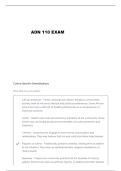
African American - Family networks are valued. Religious communities
actively seek to influence lifestyle and political preferences. Some African
Americans have a distrust of health professionals as a consequence of
historical injustices.
Amish - Health care costs are shared by members of the community. Some
Amish may use herbal products and remedies, for both prevention and
treatment.
Chinese - Some tend to engage in more formal conversation and
relationships. They may believe that hot and cold food items treat disease.
Hispanic or Latino - Traditionally present-oriented, viewing time as relative
to the situation. They may use spiritual amulets, religious medallions, or
rosary beads.
Japanese - Prayers are commonly practiced at the bedside of a dying
patient. Doctors are seen as authority figures, so patients and their families
, may hesitate to ask questions.
Muslim - Some may demonstrate passivity in the presence of an authority
figure. Same-gender caregivers are preferred for most personal care.
Russian - Bad news is traditionally not given to patients. Patients and
families may ask for new treatments or procedures.
Collaborative Prevention
No worries, learning is a process!
Patients should be asked if Counseling
they read food labels when Interdisciplinary Team Support
shopping for groceries or (nutrition, spiritual, etc.,)
food products. Evaluate their Pharmacological Therapy
understanding of the main (discussed in Anxiety PPT)
elements of a nutrient label
(calories, fats, carbohydrates,
sugar, serving size).
Assess patient understanding
of the percentages of
recommended daily
allowances of fats, proteins,
and carbohydrates listed on
food labels.
Assist patients with planning
strategies for eating a well-
balanced diet based on
knowledge of caloric intake
and nutrient content - consult
with dietitian
,Functional Assessment: Conclusions
Give this one a try later!
Level of assistance or dependency
No assistance
Partial assistance
Total assistance
Level of difficulty
No difficulty
Some difficulty
Unable to perform
8th Concept: Functional Ability
Give this one a try later!
cognitive, social, physical, and emotional ability to carry out the normal
activities of life.
Human Factors to consider
Give this one a try later!
Study of the interrelationships among people, technology, and the work
environment.
Consider the ability or inability to perform tasks while attending to multiple
things at once.
Work of nurses in acute care environment is very complex.
, Focus is on supporting health professionals and eliminating hazards.
Nursing Standards
Give this one a try later!
Nursing standards are a minimum set of criteria of practice to provide
quality care.
Definitions (Cont.)
Give this one a try later!
Safe care "involve[s] making evidence-based clinical decisions to maximize
the health outcomes of an individual to minimize the potential for harm."
(Keeping Patients Safe, 2004)
Patient safety is the "prevention of healthcare errors, and the elimination or
mitigation of patient injury caused by healthcare errors." (National Patient
Safety Foundation (NPSF)
Registered Nurse
Give this one a try later!
Give this one a try later!
African American - Family networks are valued. Religious communities
actively seek to influence lifestyle and political preferences. Some African
Americans have a distrust of health professionals as a consequence of
historical injustices.
Amish - Health care costs are shared by members of the community. Some
Amish may use herbal products and remedies, for both prevention and
treatment.
Chinese - Some tend to engage in more formal conversation and
relationships. They may believe that hot and cold food items treat disease.
Hispanic or Latino - Traditionally present-oriented, viewing time as relative
to the situation. They may use spiritual amulets, religious medallions, or
rosary beads.
Japanese - Prayers are commonly practiced at the bedside of a dying
patient. Doctors are seen as authority figures, so patients and their families
, may hesitate to ask questions.
Muslim - Some may demonstrate passivity in the presence of an authority
figure. Same-gender caregivers are preferred for most personal care.
Russian - Bad news is traditionally not given to patients. Patients and
families may ask for new treatments or procedures.
Collaborative Prevention
No worries, learning is a process!
Patients should be asked if Counseling
they read food labels when Interdisciplinary Team Support
shopping for groceries or (nutrition, spiritual, etc.,)
food products. Evaluate their Pharmacological Therapy
understanding of the main (discussed in Anxiety PPT)
elements of a nutrient label
(calories, fats, carbohydrates,
sugar, serving size).
Assess patient understanding
of the percentages of
recommended daily
allowances of fats, proteins,
and carbohydrates listed on
food labels.
Assist patients with planning
strategies for eating a well-
balanced diet based on
knowledge of caloric intake
and nutrient content - consult
with dietitian
,Functional Assessment: Conclusions
Give this one a try later!
Level of assistance or dependency
No assistance
Partial assistance
Total assistance
Level of difficulty
No difficulty
Some difficulty
Unable to perform
8th Concept: Functional Ability
Give this one a try later!
cognitive, social, physical, and emotional ability to carry out the normal
activities of life.
Human Factors to consider
Give this one a try later!
Study of the interrelationships among people, technology, and the work
environment.
Consider the ability or inability to perform tasks while attending to multiple
things at once.
Work of nurses in acute care environment is very complex.
, Focus is on supporting health professionals and eliminating hazards.
Nursing Standards
Give this one a try later!
Nursing standards are a minimum set of criteria of practice to provide
quality care.
Definitions (Cont.)
Give this one a try later!
Safe care "involve[s] making evidence-based clinical decisions to maximize
the health outcomes of an individual to minimize the potential for harm."
(Keeping Patients Safe, 2004)
Patient safety is the "prevention of healthcare errors, and the elimination or
mitigation of patient injury caused by healthcare errors." (National Patient
Safety Foundation (NPSF)
Registered Nurse
Give this one a try later!