

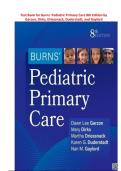
Test Bank for Burns’ Pediatric Primary Care, 8th Edition, edited by Dawn Lee Garzon, Mary Dirks, Martha Driessnack, Karen G. Duderstadt, and Nan M. Gaylord.
Prepare for pediatric primary care coursework, quizzes, examinations, clinical assignments, and advanced nursing assessments with a comprehensive Test Bank for Burns’ Pediatric Primary Care, 8th Edition, edited by Dawn Lee Garzon, Mary Dirks, Martha Driessnack, Karen G. Duderstadt, and Nan M. Gaylord. The 8th edition provides an evidence-based foundation for assessing, managing, and preventing health problems in children from infancy through adolescence. Elsevier identifies it as the latest edition and notes that it was published in 2024; the print edition is listed with ISBN 9780323882316 and approximately 1,024 pages. This product is intended as an independent educational study resource for practicing pediatric primary care concepts. It should not be represented as containing confidential instructor materials, leaked examination questions, or guaranteed questions from an active examination. Comprehensive Pediatric Primary Care Review Pediatric primary care requires healthcare professionals to understand normal growth and development while recognizing deviations that may indicate illness or developmental concerns. Students must combine assessment findings, developmental knowledge, preventive care, health promotion, pharmacology, family education, clinical judgment, and evidence-based management. A question-based study resource can help learners reinforce these concepts and practice applying pediatric knowledge to realistic clinical situations. The 8th edition covers the spectrum of pediatric primary care from newborns through adolescents, with emphasis on both prevention and management. Major Topics for Review The resource can support review of important areas represented in the 8th edition, including: Pediatric primary care principles Global and national influences on child health Environmental influences on pediatric health Justice, equity, inclusion, and diversity Pediatric and family assessment Behavioral and mental health promotion Sexuality and gender identity Developmental principles and theories Newborn and neonatal care Infant development Early childhood development Middle childhood development Adolescent development Pediatric nutrition Breastfeeding Sleep Elimination Physical activity and sports Immunizations Dental and oral health Pediatric injury prevention Child maltreatment Traditional and complementary therapies Pediatric pain and fever management Pediatric injuries and toxic exposures Pediatric palliative care Congenital and inherited disorders Neonatal disorders Neurodivergence Behavioral and mental health disorders Eye and vision disorders Ear and hearing disorders Respiratory disorders Cardiovascular disorders Gastrointestinal disorders Infectious diseases Inflammatory disorders Dermatologic disorders Hematologic disorders Endocrine and metabolic disorders Musculoskeletal disorders Neurologic disorders Genitourinary disorders Gynecology and reproductive health These subjects correspond to the published table of contents for the 8th edition. Pediatric Assessment and Clinical Judgment Effective pediatric assessment differs from adult assessment. Students need to understand age-appropriate communication, developmental expectations, physical assessment, family dynamics, vital-sign interpretation, growth patterns, and signs of acute or chronic illness. Practice questions can help students develop skills such as: Identifying abnormal assessment findings Recognizing developmental variations Determining appropriate follow-up Prioritizing pediatric concerns Selecting appropriate nursing or provider interventions Identifying situations requiring referral Evaluating treatment responses Recognizing urgent or potentially life-threatening findings Communicating effectively with children and caregivers Applying family-centered care The textbook includes highlights identifying circumstances requiring urgent action, consultation, or referral, making prioritization an important part of pediatric primary care preparation. Growth and Development Growth and development are central components of pediatric practice. Students can use question-based review to reinforce expected developmental milestones and understand how developmental principles influence assessment and health education. Study areas include newborns, infants, toddlers and preschool children, school-age children, and adolescents. Questions can encourage learners to connect developmental stages with nutrition, sleep, behavior, communication, safety, physical activity, and family guidance. Preventive Pediatric Care Primary care focuses heavily on prevention. Students can review preventive services such as immunization, injury prevention, dental care, nutrition counseling, physical activity, screening, anticipatory guidance, and health promotion. The 8th edition also aligns content with Bright Futures guidelines, providing a useful framework for students reviewing contemporary pediatric preventive care. Pediatric Nutrition and Breastfeeding Nutrition is an important component of healthy childhood development. Practice questions can reinforce concepts involving infant feeding, breastfeeding, nutritional requirements, healthy eating, growth patterns, and age-appropriate dietary guidance. Students can use these questions to strengthen their ability to identify nutritional concerns and provide appropriate education to parents and caregivers. Immunization Review Immunization knowledge is essential for pediatric primary care. Questions can help students review vaccine-related concepts, preventive care, contraindications and precautions, patient education, and appropriate follow-up. Because immunization recommendations can change, students should always verify current schedules and clinical recommendations using current authoritative guidance. Pediatric Respiratory and Infectious Disorders Respiratory and infectious conditions are common concerns in pediatric primary care. Practice scenarios can help learners distinguish expected findings from signs of respiratory distress or serious infection. Potential study areas include respiratory assessment, common pediatric respiratory conditions, infectious diseases, fever management, prevention, and indications for additional evaluation. Cardiovascular, Gastrointestinal, and Neurological Conditions The resource can also support review of pediatric cardiovascular, gastrointestinal, and neurological disorders. Students can practice recognizing signs and symptoms, interpreting assessment information, identifying appropriate interventions, and determining when referral or urgent evaluation is necessary. Behavioral and Mental Health Pediatric primary care increasingly involves behavioral and mental health promotion. Students can review developmental and behavioral concerns, neurodivergence, mental health assessment, family support, and appropriate referral. The 8th edition specifically includes a chapter addressing neurodivergence and behavioral and mental health disorders. Child Maltreatment and Injury Prevention Safety is a major component of pediatric care. Students can use question-based practice to review injury prevention, recognition of potential maltreatment, appropriate assessment, documentation, reporting responsibilities, and protection of vulnerable children. The 8th edition added a dedicated chapter on Child Maltreatment, along with new coverage addressing pediatric palliative care and inclusivity, equity, diversity, and justice. Pediatric Pain, Fever, and Toxic Exposures Pain and fever management are common pediatric primary-care concerns. Questions can help students practice age-appropriate assessment, medication considerations, caregiver education, safety measures, and recognition of concerning symptoms. The book also addresses pediatric injuries and toxic exposures, providing opportunities to review emergency assessment and appropriate management considerations. Evidence-Based Primary Care The 8th edition emphasizes updated research evidence, national and international protocols, and standardized guidelines. It also provides algorithms that offer concise approaches to evaluating and managing common pediatric disorders. A test-bank-style resource can complement this material by giving students opportunities to apply evidence-based concepts through clinical scenarios. Clinical Case-Based Learning Pediatric questions are most effective when they require students to interpret a complete clinical picture rather than memorize isolated facts. Case-based practice can involve a child's age, developmental stage, symptoms, physical findings, medical history, family concerns, medications, and environmental factors. Students can practice determining: What information should be assessed first Which finding requires immediate action What additional information is needed Which intervention is appropriate What education should be provided When referral is necessary Which finding indicates improvement What follow-up is appropriate Useful for Nurse Practitioner Students Because Burns’ Pediatric Primary Care is written from a nurse-practitioner perspective, the material is particularly relevant to students preparing for pediatric primary-care roles. Elsevier describes the book as providing comprehensive guidance for assessing, managing, and preventing pediatric health problems from infancy through adolescence. The resource may be useful for: Pediatric Nurse Practitioner students Family Nurse Practitioner students Advanced practice nursing students BSN students MSN students DNP students Pediatric nursing students Primary care students Pediatric clinical rotations Nursing examination preparation Effective Study Strategy Students can maximize the value of practice questions by attempting each question before reviewing the answer. After completing a section, missed concepts can be organized into a personalized remediation list. For example, a student struggling with developmental milestones can focus on developmental questions, while another student needing additional practice with pediatric respiratory conditions can review those topics separately. Students can also combine question-based practice with textbook reading, clinical guidelines, instructor materials, and case studies. Important Notice This is an independent educational study resource and is not affiliated with, sponsored by, or endorsed by Elsevier, Dawn Lee Garzon, Mary Dirks, Martha Driessnack, Karen G. Duderstadt, or Nan M. Gaylord. It should not be marketed as an official publisher test bank unless the seller has appropriate authorization. Claims such as “100% verified,” “actual exam questions,” “guaranteed A+,” or “real examination questions” should only be used when they can be independently substantiated. Examination content may be proprietary and can change between administrations. For accurate pediatric clinical information, students should consult the current textbook, official course materials, current pediatric guidelines, instructor guidance, and applicable clinical policies.
Document information
- Uploaded on
- August 26, 2026
- Number of pages
- 135
- Written in
- 2026/2027
- Type
- Exam (elaborations)
- Contains
- Questions & answers


