

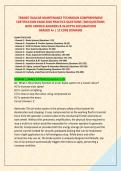
TRANSIT RAILCAR MAINTENANCE TECHNICIAN COMPREHENSIVE
CERTIFICATION EXAM 2026 PRACTICE QUESTIONS |300 QUESTIONS
WITH VERIFIED ANSWERS & IN-DEPTH EXPLANATIONS
GRADED A+ | 12 CORE DOMAINS
EXAM STRUCTURE
- Domain 1: Brake Systems (Questions 1-25)
- Domain 2: Propulsion & Traction Systems (Questions 26-50)
- Domain 3: HVAC & Climate Control Systems (Questions 51-75)
- Domain 4: Door Systems (Questions 76-100)
- Domain 5: Couplers & Draft Gear (Questions 101-125)
- Domain 6: Truck, Suspension & Wheels (Questions 126-150)
- Domain 7: Electrical & Electronic Systems (Questions 151-175)
- Domain 8: Pneumatic & Air Systems (Questions 176-200)
- Domain 9: Inspection Intervals & Preventive Maintenance (Questions 201-225)
- Domain 10: Safety, Lockout/Tagout & Hazardous Materials (Questions 226-250)
- Domain 11: Diagnostic Troubleshooting (Questions 251-275)
- Domain 12: Carbody, Underframe & Structural Systems (Questions 276-300)
DOMAIN 1: BRAKE SYSTEMS (Questions 1-25)
Q1. What is the primary function of an air brake system on a transit railcar?
A) To increase train speed
B) To control car lighting
C) To slow or stop the railcar using compressed air
D) To operate the doors
Correct Answer: C
Rationale: The air brake system is the primary safety-critical system for
deceleration and stopping. It uses compressed air as the working fluid to transmit
force from the operator's control valve to the mechanical friction elements at
each wheel. Without this pneumatic amplification, the physical force required to
stop a multi-ton railcar would be impossible for a human operator to generate
directly. Compressed air provides both the energy storage (in reservoirs) and the
precise control needed for smooth, graduated braking that can be modulated
from a light application to a full emergency stop. While doors and other
accessories may use air, the brake system is uniquely designed and failsafe; any
loss of air pressure automatically triggers the brakes to apply, preventing a
runaway condition.
1
,Q2. Which component stores compressed air in a railcar brake system?
A) Brake cylinder
B) Air compressor
C) Main reservoir (air tank)
D) Triple valve
Correct Answer: C
Rationale: The main reservoir acts as the system's "battery" for pneumatic
energy. It is a heavy-duty steel tank that stores air at high pressure—typically
between 120 and 140 psi—delivered by the compressor. This storage capacity is
critical because the compressor cannot run continuously; the reservoir provides a
reserve volume that can supply multiple brake applications without the
compressor having to cycle on for every single actuation. The reservoir also serves
as a settling chamber where moisture and oil entrained in the compressed air can
condense and be drained off, preventing corrosion and contamination of
downstream sensitive components like the brake valves and cylinders.
Q3. In a railcar brake system, what is the function of the brake cylinder?
A) To generate compressed air
B) To convert air pressure into mechanical force to apply brakes
C) To store air for emergency use
D) To control the flow of air to the doors
Correct Answer: B
Rationale: The brake cylinder is the final actuator in the pneumatic chain. It
consists of a piston inside a sealed housing; when air pressure is admitted, it
pushes the piston outward against a return spring. That linear mechanical force is
then transmitted through a system of levers, rods, and slack adjusters to push the
brake shoes against the wheel tread (or pads against a disc). The cylinder's size
and stroke length are carefully engineered so that the air pressure available
(typically 50-70 psi in service applications) produces enough thrust to overcome
the rolling momentum of the car. If the cylinder diaphragm leaks or the piston
seals wear out, the mechanical force drops off, leading to weak or uneven
braking.
2
,Q4. What does "dynamic braking" refer to in railcar propulsion?
A) Using the air brake system
B) Using the traction motors as generators to slow the train
C) Applying hand brakes
D) Using emergency brakes only
Correct Answer: B
Rationale: Dynamic braking is an electrical braking method that exploits the
reversibility of traction motors. When the operator commands deceleration, the
motor control system reconfigures the windings so that the rotating wheels drive
the motor shafts, effectively turning the motors into electrical generators. This
generation creates a counter-torque that resists rotation, slowing the train. The
electrical energy produced must be dissipated; it is either fed back into the power
grid (regenerative braking) or converted to heat in large resistor grids mounted on
the roof or underframe (rheostatic braking). This system is highly effective at high
speeds but loses efficiency as the train slows, which is why friction brakes are still
needed to bring the train to a complete stop and hold it there.
Q5. What is the purpose of the "triple valve" in a conventional air brake system?
A) To control the flow of air for door operation
B) To automatically apply and release brakes based on brake pipe pressure
changes
C) To regulate air pressure to the suspension
D) To operate the horn
Correct Answer: B
Rationale: The triple valve (or its modern electronic equivalent, the distributor
valve) is the "brain" of the conventional air brake. It continuously monitors the
pressure in the brake pipe—the long train-line that runs the length of the consist.
When the engineer reduces brake pipe pressure, the triple valve senses this drop
and routes air from the auxiliary reservoir into the brake cylinder, applying the
brakes. Conversely, when the engineer increases brake pipe pressure, the triple
3
, valve exhausts air from the brake cylinder and recharges the auxiliary reservoir.
This design is inherently failsafe: any unintended loss of brake pipe pressure (due
to a parted hose or broken pipe) causes a full emergency brake application.
Q6. What is the condemning limit for brake block (shoe) thickness?
A) 5 mm
B) 10 mm
C) 15 mm
D) Varies by manufacturer and railcar type
Correct Answer: D
Rationale: Condemning limits are not universal; they are specifically engineered
for each brake block material and application. The limit represents the minimum
safe thickness below which the shoe can no longer dissipate heat effectively, may
crack under thermal stress, or could allow the metal backing plate to contact the
wheel tread—causing severe damage to the wheel. Technicians must consult the
specific car builder's manual and the brake shoe manufacturer's data sheet to find
the exact condemning dimension, which is often marked directly on the shoe
itself. Replacing shoes before they reach the condemning limit is standard
preventive practice, as running them to the absolute minimum invites
unpredictable failure.
Q7. Which of the following is a critical component of a railcar's friction brake
system?
A) Traction motor
B) Brake shoe or pad
C) Pantograph
D) Coupler
Correct Answer: B
Rationale: The brake shoe (for tread braking) or brake pad (for disc braking) is the
actual consumable friction element that converts kinetic energy into thermal
energy through sliding contact. The material is a carefully formulated composite
4
CERTIFICATION EXAM 2026 PRACTICE QUESTIONS |300 QUESTIONS
WITH VERIFIED ANSWERS & IN-DEPTH EXPLANATIONS
GRADED A+ | 12 CORE DOMAINS
EXAM STRUCTURE
- Domain 1: Brake Systems (Questions 1-25)
- Domain 2: Propulsion & Traction Systems (Questions 26-50)
- Domain 3: HVAC & Climate Control Systems (Questions 51-75)
- Domain 4: Door Systems (Questions 76-100)
- Domain 5: Couplers & Draft Gear (Questions 101-125)
- Domain 6: Truck, Suspension & Wheels (Questions 126-150)
- Domain 7: Electrical & Electronic Systems (Questions 151-175)
- Domain 8: Pneumatic & Air Systems (Questions 176-200)
- Domain 9: Inspection Intervals & Preventive Maintenance (Questions 201-225)
- Domain 10: Safety, Lockout/Tagout & Hazardous Materials (Questions 226-250)
- Domain 11: Diagnostic Troubleshooting (Questions 251-275)
- Domain 12: Carbody, Underframe & Structural Systems (Questions 276-300)
DOMAIN 1: BRAKE SYSTEMS (Questions 1-25)
Q1. What is the primary function of an air brake system on a transit railcar?
A) To increase train speed
B) To control car lighting
C) To slow or stop the railcar using compressed air
D) To operate the doors
Correct Answer: C
Rationale: The air brake system is the primary safety-critical system for
deceleration and stopping. It uses compressed air as the working fluid to transmit
force from the operator's control valve to the mechanical friction elements at
each wheel. Without this pneumatic amplification, the physical force required to
stop a multi-ton railcar would be impossible for a human operator to generate
directly. Compressed air provides both the energy storage (in reservoirs) and the
precise control needed for smooth, graduated braking that can be modulated
from a light application to a full emergency stop. While doors and other
accessories may use air, the brake system is uniquely designed and failsafe; any
loss of air pressure automatically triggers the brakes to apply, preventing a
runaway condition.
1
,Q2. Which component stores compressed air in a railcar brake system?
A) Brake cylinder
B) Air compressor
C) Main reservoir (air tank)
D) Triple valve
Correct Answer: C
Rationale: The main reservoir acts as the system's "battery" for pneumatic
energy. It is a heavy-duty steel tank that stores air at high pressure—typically
between 120 and 140 psi—delivered by the compressor. This storage capacity is
critical because the compressor cannot run continuously; the reservoir provides a
reserve volume that can supply multiple brake applications without the
compressor having to cycle on for every single actuation. The reservoir also serves
as a settling chamber where moisture and oil entrained in the compressed air can
condense and be drained off, preventing corrosion and contamination of
downstream sensitive components like the brake valves and cylinders.
Q3. In a railcar brake system, what is the function of the brake cylinder?
A) To generate compressed air
B) To convert air pressure into mechanical force to apply brakes
C) To store air for emergency use
D) To control the flow of air to the doors
Correct Answer: B
Rationale: The brake cylinder is the final actuator in the pneumatic chain. It
consists of a piston inside a sealed housing; when air pressure is admitted, it
pushes the piston outward against a return spring. That linear mechanical force is
then transmitted through a system of levers, rods, and slack adjusters to push the
brake shoes against the wheel tread (or pads against a disc). The cylinder's size
and stroke length are carefully engineered so that the air pressure available
(typically 50-70 psi in service applications) produces enough thrust to overcome
the rolling momentum of the car. If the cylinder diaphragm leaks or the piston
seals wear out, the mechanical force drops off, leading to weak or uneven
braking.
2
,Q4. What does "dynamic braking" refer to in railcar propulsion?
A) Using the air brake system
B) Using the traction motors as generators to slow the train
C) Applying hand brakes
D) Using emergency brakes only
Correct Answer: B
Rationale: Dynamic braking is an electrical braking method that exploits the
reversibility of traction motors. When the operator commands deceleration, the
motor control system reconfigures the windings so that the rotating wheels drive
the motor shafts, effectively turning the motors into electrical generators. This
generation creates a counter-torque that resists rotation, slowing the train. The
electrical energy produced must be dissipated; it is either fed back into the power
grid (regenerative braking) or converted to heat in large resistor grids mounted on
the roof or underframe (rheostatic braking). This system is highly effective at high
speeds but loses efficiency as the train slows, which is why friction brakes are still
needed to bring the train to a complete stop and hold it there.
Q5. What is the purpose of the "triple valve" in a conventional air brake system?
A) To control the flow of air for door operation
B) To automatically apply and release brakes based on brake pipe pressure
changes
C) To regulate air pressure to the suspension
D) To operate the horn
Correct Answer: B
Rationale: The triple valve (or its modern electronic equivalent, the distributor
valve) is the "brain" of the conventional air brake. It continuously monitors the
pressure in the brake pipe—the long train-line that runs the length of the consist.
When the engineer reduces brake pipe pressure, the triple valve senses this drop
and routes air from the auxiliary reservoir into the brake cylinder, applying the
brakes. Conversely, when the engineer increases brake pipe pressure, the triple
3
, valve exhausts air from the brake cylinder and recharges the auxiliary reservoir.
This design is inherently failsafe: any unintended loss of brake pipe pressure (due
to a parted hose or broken pipe) causes a full emergency brake application.
Q6. What is the condemning limit for brake block (shoe) thickness?
A) 5 mm
B) 10 mm
C) 15 mm
D) Varies by manufacturer and railcar type
Correct Answer: D
Rationale: Condemning limits are not universal; they are specifically engineered
for each brake block material and application. The limit represents the minimum
safe thickness below which the shoe can no longer dissipate heat effectively, may
crack under thermal stress, or could allow the metal backing plate to contact the
wheel tread—causing severe damage to the wheel. Technicians must consult the
specific car builder's manual and the brake shoe manufacturer's data sheet to find
the exact condemning dimension, which is often marked directly on the shoe
itself. Replacing shoes before they reach the condemning limit is standard
preventive practice, as running them to the absolute minimum invites
unpredictable failure.
Q7. Which of the following is a critical component of a railcar's friction brake
system?
A) Traction motor
B) Brake shoe or pad
C) Pantograph
D) Coupler
Correct Answer: B
Rationale: The brake shoe (for tread braking) or brake pad (for disc braking) is the
actual consumable friction element that converts kinetic energy into thermal
energy through sliding contact. The material is a carefully formulated composite
4


