

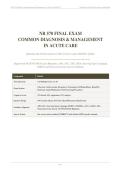
NR 570 Final Exam: Common Diagnosis & Management in Acute Care (2026/2027) 120 Questions with Verified Answers and Rationales
NR 570 FINAL EXAM
COMMON DIAGNOSIS & MANAGEMENT
IN ACUTE CARE
Questions and Verified Answers | 100% Correct | Latest 2026/2027 Update
Aligned with NCCPA/PANCE Exam Blueprints, AHA, ACC, CDC, IDSA, Surviving Sepsis Campaign,
KDIGO, and Neurocritical Care Society Guidelines
Component Details
Total Questions 120 Multiple Choice (A-D)
8 Sections: Cardiovascular, Respiratory, Neurological, GI/Hepatobiliary, Renal/GU,
Exam Sections
Endocrine, Sepsis/Multisystem, Pain/Toxicology/Procedures
Cognitive Levels 25% Recall, 50% Application, 25% Analysis
Question Design 80% Scenario-Based, 20% Direct Recall/Parameter Identification
AHA/ACC, Surviving Sepsis Campaign, KDIGO, ATS/IDSA, ACG, AASLD, ADA,
Guideline Alignment
Neurocritical Care Society, NCCPA/PANCE Blueprints
Answer Format One correct answer marked [CORRECT] with detailed APRN-specific rationale
Page 1
,NR 570 Final Exam: Common Diagnosis & Management in Acute Care (2026/2027) 120 Questions with Verified Answers and Rationales
Section 1: Acute Cardiovascular Disorders
Acute Coronary Syndrome, Heart Failure, Dysrhythmias, Hypertensive Crisis, Aortic Dissection, and Cardiac Tamponade
(Q1-Q25)
Q1: A 62-year-old male presents to the emergency department with substernal chest pain that began 45
minutes ago. The 12-lead ECG reveals ST-segment elevation in leads II, III, and aVF. Troponin I is pending.
Which of the following is the most appropriate next intervention?
A. Administer aspirin 325 mg, initiate heparin, and arrange for PCI within 90 minutes **[CORRECT]**
B. Obtain a CT angiogram of the chest to rule out aortic dissection before any intervention
C. Prescribe sublingual nitroglycerin and observe for 6 hours before deciding on reperfusion
D. Start broad-spectrum antibiotics and await troponin results before treatment decisions
Correct Answer: A
Rationale: This patient presents with an acute ST-elevation myocardial infarction (STEMI) involving the inferior wall based on ST
elevation in leads II, III, and aVF. The 2024 AHA/ACC guidelines for STEMI management mandate immediate aspirin (162-325 mg
chewed), anticoagulation with heparin, and emergent reperfusion therapy. Primary PCI is the preferred reperfusion strategy when it
can be performed within 90 minutes of first medical contact, as it offers superior outcomes compared to fibrinolytic therapy. The
door-to-balloon time target of 90 minutes is a critical quality metric. Obtaining a CT angiogram would cause dangerous delays in a
classic STEMI presentation, nitroglycerin alone is insufficient for reperfusion, and antibiotics are not indicated for acute coronary
syndrome.
Q2: A 58-year-old female with a history of hypertension and type 2 diabetes presents with chest pain at rest.
Her ECG shows ST-segment depression and T-wave inversion in the lateral leads. Initial troponin I is elevated
at 0.08 ng/mL (reference < 0.04). Which pharmacologic regimen is most appropriate for this patient based on
current AHA/ACC guidelines?
A. Aspirin, ticagrelor, unfractionated heparin, and high-intensity statin therapy **[CORRECT]**
B. Aspirin, clopidogrel 75 mg, and warfarin with a target INR of 2.5-3.0
C. Morphine for pain, diltiazem for rate control, and enoxaparin at prophylactic dose
D. Nitroglycerin only, with repeat troponin in 6 hours to determine further management
Correct Answer: A
Rationale: This patient has a non-ST-elevation myocardial infarction (NSTEMI) based on elevated troponin with ST depression and
T-wave inversion on ECG. Current AHA/ACC guidelines for NSTEMI/unstable angina recommend dual antiplatelet therapy with
aspirin plus a P2Y12 inhibitor (ticagrelor or prasugrel preferred over clopidogrel based on the PLATO and TRITON-TIMI 38 trials),
anticoagulation with unfractionated heparin or enoxaparin at therapeutic doses, and high-intensity statin therapy (atorvastatin 40-80
mg) initiated early. Warfarin is not part of the standard NSTEMI regimen. Prophylactic-dose enoxaparin is insufficient for an acute
coronary syndrome. Delaying treatment pending repeat biomarkers is inappropriate when troponin is already elevated with ischemic
ECG changes.
Q3: A 72-year-old male is admitted with acute decompensated heart failure. He presents with dyspnea at rest,
JVD, bilateral crackles, and 3+ pitting edema. His BNP is 1,200 pg/mL. Blood pressure is 90/60 mmHg with a
heart rate of 110 bpm. Which of the following is the most appropriate initial management strategy?
A. Initiate high-dose loop diuretic therapy with close hemodynamic monitoring and cautious inotropic
support **[CORRECT]**
B. Administer ACE inhibitor immediately and titrate to target dose before any other intervention
C. Provide aggressive IV normal saline bolus to improve renal perfusion and blood pressure
D. Start beta-blocker therapy immediately to reduce heart rate and improve cardiac output
Page 2
,NR 570 Final Exam: Common Diagnosis & Management in Acute Care (2026/2027) 120 Questions with Verified Answers and Rationales
Correct Answer: A
Rationale: This patient presents with acute decompensated heart failure (ADHF) with signs of both volume overload (JVD, crackles,
edema, elevated BNP) and low cardiac output (hypotension, tachycardia), suggesting cardiogenic shock. The initial management
should focus on diuresis with IV loop diuretics (furosemide) to relieve volume overload, while simultaneously addressing the
compromised perfusion. In patients with hypotension and signs of low output, cautious inotropic support (such as dobutamine or
milrinone) may be necessary. ACE inhibitors should not be initiated in hemodynamically unstable patients due to the risk of worsening
hypotension. IV fluid boluses would worsen pulmonary congestion. Beta-blockers are contraindicated in acute decompensation with
hypotension and should be deferred until the patient is euvolemic and hemodynamically stable.
Q4: A 45-year-old male with no significant medical history presents with sudden-onset severe tearing chest
pain radiating to his back. Blood pressure is 180/110 mmHg in the right arm and 140/80 mmHg in the left
arm. A CT angiogram confirms a Stanford Type A aortic dissection. Which of the following is the definitive
management for this condition?
A. Emergent surgical repair of the ascending aorta **[CORRECT]**
B. Medical management with IV nitroprusside and beta-blockers alone
C. Endovascular stent graft placement as the primary intervention
D. Anticoagulation with heparin to prevent thrombus propagation in the false lumen
Correct Answer: A
Rationale: Stanford Type A aortic dissections involve the ascending aorta and carry a mortality rate of 1-2% per hour without
surgical intervention, making emergent surgical repair the definitive treatment. The 2022 AHA/ACC and European Society of
Cardiology guidelines strongly recommend immediate surgical consultation and operative intervention for all Type A dissections
regardless of the patient's hemodynamic stability. Medical management with IV beta-blockers (esmolol) followed by vasodilators
(nitroprusside) is an important adjunct to reduce shear stress and limit dissection progression, but it is not definitive therapy for Type
A dissections. Endovascular stent grafting may be considered for select Type B (descending aorta) dissections with complications, but
is not the primary treatment for Type A. Anticoagulation is contraindicated in aortic dissection as it may increase the risk of
hemorrhagic complications.
Q5: A 55-year-old female presents with hypotension (BP 80/50 mmHg), distended neck veins, and muffled
heart sounds on auscultation. A bedside echocardiogram reveals a large pericardial effusion with right
ventricular diastolic collapse. Which of the following findings would most strongly support the diagnosis of
cardiac tamponade on physical examination?
A. Pulsus paradoxus with a systolic blood pressure decrease of more than 12 mmHg during inspiration
**[CORRECT]**
B. Wide pulse pressure with bounding peripheral pulses and a hyperdynamic precordium
C. Kussmaul sign with jugular venous distension that fails to decrease during inspiration
D. Water-hammer pulse with a rapidly collapsing arterial pressure waveform
Correct Answer: A
Rationale: Cardiac tamponade is characterized by Beck's triad (hypotension, muffled heart sounds, and JVD), and the most specific
physical examination finding is pulsus paradoxus, defined as a drop in systolic blood pressure of more than 10-12 mmHg during
inspiration. This occurs because the increased negative intrathoracic pressure during inspiration increases venous return to the right
heart, further compressing the left ventricle within the tamponading pericardial fluid. The echocardiographic findings of pericardial
effusion with right ventricular diastolic collapse are highly specific for tamponade. Wide pulse pressure with bounding pulses suggests
aortic regurgitation or hyperdynamic states, not tamponade. Kussmaul sign (failure of JVD to decrease with inspiration) is associated
with constrictive pericarditis and right ventricular infarction. Water-hammer pulse is seen in aortic insufficiency. Emergency
pericardiocentesis is the definitive treatment.
Page 3
, NR 570 Final Exam: Common Diagnosis & Management in Acute Care (2026/2027) 120 Questions with Verified Answers and Rationales
Q6: A 68-year-old male presents to the emergency department with a blood pressure of 230/130 mmHg, severe
headache, altered mental status, and a new-onset left hemiparesis. A non-contrast head CT shows no
intracranial hemorrhage. Which of the following best describes the appropriate blood pressure management
for this patient?
A. This is a hypertensive emergency with neurological deficits; reduce mean arterial pressure by no more than
25% in the first hour using IV nicardipine or labetalol **[CORRECT]**
B. This is hypertensive urgency; prescribe oral clonidine and amlodipine and discharge with outpatient follow-up
C. Administer IV sodium nitroprusside to rapidly reduce blood pressure to below 140/90 mmHg within 30 minutes
D. Obtain a brain MRI before initiating any antihypertensive therapy to determine the underlying etiology
Correct Answer: A
Rationale: This patient has a hypertensive emergency defined by severe hypertension with acute target organ damage (altered mental
status and hemiparesis indicating encephalopathy and possible evolving stroke). The 2023 AHA/ACC guidelines for hypertensive
emergencies recommend reducing the mean arterial pressure by no more than 25% within the first hour to avoid precipitating cerebral
or myocardial ischemia from too rapid a reduction. IV nicardipine (a calcium channel blocker) or labetalol (a combined
alpha/beta-blocker) are first-line agents for hypertensive emergencies with neurological involvement. Sodium nitroprusside, while
potent, carries risks of cyanide toxicity and may increase intracranial pressure, making it less preferred for neurologic emergencies.
This is not hypertensive urgency, which by definition lacks acute target organ damage. Waiting for an MRI before treating a
hypertensive emergency with neurological deficits would be dangerous.
Q7: A 50-year-old male presents with sudden cardiac arrest. The initial rhythm is ventricular fibrillation.
After the first defibrillation attempt, the patient remains in VF. According to the 2020 AHA ACLS guidelines,
which of the following is the correct sequence of interventions?
A. Resume chest compressions immediately for 2 minutes, then administer epinephrine 1 mg IV after the
second shock **[CORRECT]**
B. Administer epinephrine 1 mg IV immediately, then perform a second defibrillation attempt
C. Administer amiodarone 300 mg IV immediately, then resume chest compressions for 5 minutes
D. Perform a second immediate defibrillation, then start chest compressions for 1 minute before medications
Correct Answer: A
Rationale: The 2020 AHA ACLS guidelines for refractory ventricular fibrillation/pulseless ventricular tachycardia emphasize
minimizing interruptions to chest compressions. After an initial defibrillation attempt, chest compressions should resume immediately
for a full 2-minute cycle of CPR before any rhythm recheck or additional intervention. Epinephrine 1 mg IV should be administered
after the second defibrillation attempt (or as soon as possible during CPR), and amiodarone 300 mg IV (or lidocaine 1-1.5 mg/kg)
should be given after the third shock. The critical principle is prioritizing high-quality chest compressions over immediate medication
administration. Administering medications between shocks without resuming compressions first is incorrect, as is performing multiple
consecutive shocks without intervening CPR.
Q8: A 65-year-old female with a history of heart failure presents to the clinic with weight gain of 8 pounds
over 1 week, increasing dyspnea on exertion, orthopnea, and bilateral ankle edema. Her current medications
include lisinopril 20 mg daily, carvedilol 25 mg twice daily, and furosemide 40 mg daily. Her ejection fraction
is 35%. BNP is 650 pg/mL. What is the most appropriate next step in management?
A. Increase furosemide to 80 mg daily and counsel on daily weight monitoring and sodium restriction
**[CORRECT]**
B. Discontinue lisinopril and carvedilol due to worsening heart failure and initiate milrinone
C. Add spironolactone 25 mg daily for its anti-aldosterone effect and potassium-sparing benefits
D. Admit to the hospital for IV nesiritide infusion and invasive hemodynamic monitoring
Correct Answer: A
Page 4
NR 570 FINAL EXAM
COMMON DIAGNOSIS & MANAGEMENT
IN ACUTE CARE
Questions and Verified Answers | 100% Correct | Latest 2026/2027 Update
Aligned with NCCPA/PANCE Exam Blueprints, AHA, ACC, CDC, IDSA, Surviving Sepsis Campaign,
KDIGO, and Neurocritical Care Society Guidelines
Component Details
Total Questions 120 Multiple Choice (A-D)
8 Sections: Cardiovascular, Respiratory, Neurological, GI/Hepatobiliary, Renal/GU,
Exam Sections
Endocrine, Sepsis/Multisystem, Pain/Toxicology/Procedures
Cognitive Levels 25% Recall, 50% Application, 25% Analysis
Question Design 80% Scenario-Based, 20% Direct Recall/Parameter Identification
AHA/ACC, Surviving Sepsis Campaign, KDIGO, ATS/IDSA, ACG, AASLD, ADA,
Guideline Alignment
Neurocritical Care Society, NCCPA/PANCE Blueprints
Answer Format One correct answer marked [CORRECT] with detailed APRN-specific rationale
Page 1
,NR 570 Final Exam: Common Diagnosis & Management in Acute Care (2026/2027) 120 Questions with Verified Answers and Rationales
Section 1: Acute Cardiovascular Disorders
Acute Coronary Syndrome, Heart Failure, Dysrhythmias, Hypertensive Crisis, Aortic Dissection, and Cardiac Tamponade
(Q1-Q25)
Q1: A 62-year-old male presents to the emergency department with substernal chest pain that began 45
minutes ago. The 12-lead ECG reveals ST-segment elevation in leads II, III, and aVF. Troponin I is pending.
Which of the following is the most appropriate next intervention?
A. Administer aspirin 325 mg, initiate heparin, and arrange for PCI within 90 minutes **[CORRECT]**
B. Obtain a CT angiogram of the chest to rule out aortic dissection before any intervention
C. Prescribe sublingual nitroglycerin and observe for 6 hours before deciding on reperfusion
D. Start broad-spectrum antibiotics and await troponin results before treatment decisions
Correct Answer: A
Rationale: This patient presents with an acute ST-elevation myocardial infarction (STEMI) involving the inferior wall based on ST
elevation in leads II, III, and aVF. The 2024 AHA/ACC guidelines for STEMI management mandate immediate aspirin (162-325 mg
chewed), anticoagulation with heparin, and emergent reperfusion therapy. Primary PCI is the preferred reperfusion strategy when it
can be performed within 90 minutes of first medical contact, as it offers superior outcomes compared to fibrinolytic therapy. The
door-to-balloon time target of 90 minutes is a critical quality metric. Obtaining a CT angiogram would cause dangerous delays in a
classic STEMI presentation, nitroglycerin alone is insufficient for reperfusion, and antibiotics are not indicated for acute coronary
syndrome.
Q2: A 58-year-old female with a history of hypertension and type 2 diabetes presents with chest pain at rest.
Her ECG shows ST-segment depression and T-wave inversion in the lateral leads. Initial troponin I is elevated
at 0.08 ng/mL (reference < 0.04). Which pharmacologic regimen is most appropriate for this patient based on
current AHA/ACC guidelines?
A. Aspirin, ticagrelor, unfractionated heparin, and high-intensity statin therapy **[CORRECT]**
B. Aspirin, clopidogrel 75 mg, and warfarin with a target INR of 2.5-3.0
C. Morphine for pain, diltiazem for rate control, and enoxaparin at prophylactic dose
D. Nitroglycerin only, with repeat troponin in 6 hours to determine further management
Correct Answer: A
Rationale: This patient has a non-ST-elevation myocardial infarction (NSTEMI) based on elevated troponin with ST depression and
T-wave inversion on ECG. Current AHA/ACC guidelines for NSTEMI/unstable angina recommend dual antiplatelet therapy with
aspirin plus a P2Y12 inhibitor (ticagrelor or prasugrel preferred over clopidogrel based on the PLATO and TRITON-TIMI 38 trials),
anticoagulation with unfractionated heparin or enoxaparin at therapeutic doses, and high-intensity statin therapy (atorvastatin 40-80
mg) initiated early. Warfarin is not part of the standard NSTEMI regimen. Prophylactic-dose enoxaparin is insufficient for an acute
coronary syndrome. Delaying treatment pending repeat biomarkers is inappropriate when troponin is already elevated with ischemic
ECG changes.
Q3: A 72-year-old male is admitted with acute decompensated heart failure. He presents with dyspnea at rest,
JVD, bilateral crackles, and 3+ pitting edema. His BNP is 1,200 pg/mL. Blood pressure is 90/60 mmHg with a
heart rate of 110 bpm. Which of the following is the most appropriate initial management strategy?
A. Initiate high-dose loop diuretic therapy with close hemodynamic monitoring and cautious inotropic
support **[CORRECT]**
B. Administer ACE inhibitor immediately and titrate to target dose before any other intervention
C. Provide aggressive IV normal saline bolus to improve renal perfusion and blood pressure
D. Start beta-blocker therapy immediately to reduce heart rate and improve cardiac output
Page 2
,NR 570 Final Exam: Common Diagnosis & Management in Acute Care (2026/2027) 120 Questions with Verified Answers and Rationales
Correct Answer: A
Rationale: This patient presents with acute decompensated heart failure (ADHF) with signs of both volume overload (JVD, crackles,
edema, elevated BNP) and low cardiac output (hypotension, tachycardia), suggesting cardiogenic shock. The initial management
should focus on diuresis with IV loop diuretics (furosemide) to relieve volume overload, while simultaneously addressing the
compromised perfusion. In patients with hypotension and signs of low output, cautious inotropic support (such as dobutamine or
milrinone) may be necessary. ACE inhibitors should not be initiated in hemodynamically unstable patients due to the risk of worsening
hypotension. IV fluid boluses would worsen pulmonary congestion. Beta-blockers are contraindicated in acute decompensation with
hypotension and should be deferred until the patient is euvolemic and hemodynamically stable.
Q4: A 45-year-old male with no significant medical history presents with sudden-onset severe tearing chest
pain radiating to his back. Blood pressure is 180/110 mmHg in the right arm and 140/80 mmHg in the left
arm. A CT angiogram confirms a Stanford Type A aortic dissection. Which of the following is the definitive
management for this condition?
A. Emergent surgical repair of the ascending aorta **[CORRECT]**
B. Medical management with IV nitroprusside and beta-blockers alone
C. Endovascular stent graft placement as the primary intervention
D. Anticoagulation with heparin to prevent thrombus propagation in the false lumen
Correct Answer: A
Rationale: Stanford Type A aortic dissections involve the ascending aorta and carry a mortality rate of 1-2% per hour without
surgical intervention, making emergent surgical repair the definitive treatment. The 2022 AHA/ACC and European Society of
Cardiology guidelines strongly recommend immediate surgical consultation and operative intervention for all Type A dissections
regardless of the patient's hemodynamic stability. Medical management with IV beta-blockers (esmolol) followed by vasodilators
(nitroprusside) is an important adjunct to reduce shear stress and limit dissection progression, but it is not definitive therapy for Type
A dissections. Endovascular stent grafting may be considered for select Type B (descending aorta) dissections with complications, but
is not the primary treatment for Type A. Anticoagulation is contraindicated in aortic dissection as it may increase the risk of
hemorrhagic complications.
Q5: A 55-year-old female presents with hypotension (BP 80/50 mmHg), distended neck veins, and muffled
heart sounds on auscultation. A bedside echocardiogram reveals a large pericardial effusion with right
ventricular diastolic collapse. Which of the following findings would most strongly support the diagnosis of
cardiac tamponade on physical examination?
A. Pulsus paradoxus with a systolic blood pressure decrease of more than 12 mmHg during inspiration
**[CORRECT]**
B. Wide pulse pressure with bounding peripheral pulses and a hyperdynamic precordium
C. Kussmaul sign with jugular venous distension that fails to decrease during inspiration
D. Water-hammer pulse with a rapidly collapsing arterial pressure waveform
Correct Answer: A
Rationale: Cardiac tamponade is characterized by Beck's triad (hypotension, muffled heart sounds, and JVD), and the most specific
physical examination finding is pulsus paradoxus, defined as a drop in systolic blood pressure of more than 10-12 mmHg during
inspiration. This occurs because the increased negative intrathoracic pressure during inspiration increases venous return to the right
heart, further compressing the left ventricle within the tamponading pericardial fluid. The echocardiographic findings of pericardial
effusion with right ventricular diastolic collapse are highly specific for tamponade. Wide pulse pressure with bounding pulses suggests
aortic regurgitation or hyperdynamic states, not tamponade. Kussmaul sign (failure of JVD to decrease with inspiration) is associated
with constrictive pericarditis and right ventricular infarction. Water-hammer pulse is seen in aortic insufficiency. Emergency
pericardiocentesis is the definitive treatment.
Page 3
, NR 570 Final Exam: Common Diagnosis & Management in Acute Care (2026/2027) 120 Questions with Verified Answers and Rationales
Q6: A 68-year-old male presents to the emergency department with a blood pressure of 230/130 mmHg, severe
headache, altered mental status, and a new-onset left hemiparesis. A non-contrast head CT shows no
intracranial hemorrhage. Which of the following best describes the appropriate blood pressure management
for this patient?
A. This is a hypertensive emergency with neurological deficits; reduce mean arterial pressure by no more than
25% in the first hour using IV nicardipine or labetalol **[CORRECT]**
B. This is hypertensive urgency; prescribe oral clonidine and amlodipine and discharge with outpatient follow-up
C. Administer IV sodium nitroprusside to rapidly reduce blood pressure to below 140/90 mmHg within 30 minutes
D. Obtain a brain MRI before initiating any antihypertensive therapy to determine the underlying etiology
Correct Answer: A
Rationale: This patient has a hypertensive emergency defined by severe hypertension with acute target organ damage (altered mental
status and hemiparesis indicating encephalopathy and possible evolving stroke). The 2023 AHA/ACC guidelines for hypertensive
emergencies recommend reducing the mean arterial pressure by no more than 25% within the first hour to avoid precipitating cerebral
or myocardial ischemia from too rapid a reduction. IV nicardipine (a calcium channel blocker) or labetalol (a combined
alpha/beta-blocker) are first-line agents for hypertensive emergencies with neurological involvement. Sodium nitroprusside, while
potent, carries risks of cyanide toxicity and may increase intracranial pressure, making it less preferred for neurologic emergencies.
This is not hypertensive urgency, which by definition lacks acute target organ damage. Waiting for an MRI before treating a
hypertensive emergency with neurological deficits would be dangerous.
Q7: A 50-year-old male presents with sudden cardiac arrest. The initial rhythm is ventricular fibrillation.
After the first defibrillation attempt, the patient remains in VF. According to the 2020 AHA ACLS guidelines,
which of the following is the correct sequence of interventions?
A. Resume chest compressions immediately for 2 minutes, then administer epinephrine 1 mg IV after the
second shock **[CORRECT]**
B. Administer epinephrine 1 mg IV immediately, then perform a second defibrillation attempt
C. Administer amiodarone 300 mg IV immediately, then resume chest compressions for 5 minutes
D. Perform a second immediate defibrillation, then start chest compressions for 1 minute before medications
Correct Answer: A
Rationale: The 2020 AHA ACLS guidelines for refractory ventricular fibrillation/pulseless ventricular tachycardia emphasize
minimizing interruptions to chest compressions. After an initial defibrillation attempt, chest compressions should resume immediately
for a full 2-minute cycle of CPR before any rhythm recheck or additional intervention. Epinephrine 1 mg IV should be administered
after the second defibrillation attempt (or as soon as possible during CPR), and amiodarone 300 mg IV (or lidocaine 1-1.5 mg/kg)
should be given after the third shock. The critical principle is prioritizing high-quality chest compressions over immediate medication
administration. Administering medications between shocks without resuming compressions first is incorrect, as is performing multiple
consecutive shocks without intervening CPR.
Q8: A 65-year-old female with a history of heart failure presents to the clinic with weight gain of 8 pounds
over 1 week, increasing dyspnea on exertion, orthopnea, and bilateral ankle edema. Her current medications
include lisinopril 20 mg daily, carvedilol 25 mg twice daily, and furosemide 40 mg daily. Her ejection fraction
is 35%. BNP is 650 pg/mL. What is the most appropriate next step in management?
A. Increase furosemide to 80 mg daily and counsel on daily weight monitoring and sodium restriction
**[CORRECT]**
B. Discontinue lisinopril and carvedilol due to worsening heart failure and initiate milrinone
C. Add spironolactone 25 mg daily for its anti-aldosterone effect and potassium-sparing benefits
D. Admit to the hospital for IV nesiritide infusion and invasive hemodynamic monitoring
Correct Answer: A
Page 4


