
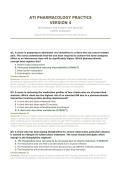
ATI PHARMACOLOGY PRACTICE
VERSION 4
60 Questions and Answers with Rationale
LATEST 2026/2027
Aligned with ATI Pharmacology Proctored Exam Blueprint
Section 1 - Pharmacokinetics and Pharmacodynamics
Q1: A nurse is preparing to administer oral morphine to a client who has cancer-related
pain. The nurse understands that the oral dose required to achieve the same analgesic
effect as an intravenous dose will be significantly higher. Which pharmacokinetic
concept best explains this?
A. Protein binding displacement
B. First-pass metabolism reducing bioavailability [CORRECT]
C. Renal tubular reabsorption
D. Enterohepatic recirculation
Correct Answer: B
Rationale: Morphine undergoes extensive first-pass metabolism in the liver, significantly reducing its oral
bioavailability (approximately 20-40%). As a result, much higher oral doses are needed to achieve equianalgesic
effects compared to IV administration. Protein binding displacement and enterohepatic recirculation do not account
for this dose differential. Renal tubular reabsorption affects excretion, not absorption.
Q2: A nurse is reviewing the medication profiles of four clients who are all prescribed
warfarin. Which client has the highest risk of an elevated INR due to a pharmacokinetic
interaction involving protein binding displacement?
A. A client who also takes omeprazole daily
B. A client who also takes aspirin 81 mg daily
C. A client who also takes sulfamethoxazole-trimethoprim
D. A client who also takes amiodarone [CORRECT]
Correct Answer: D
Rationale: Warfarin is highly protein-bound (approximately 99%). Amiodarone is also highly protein-bound and can
displace warfarin from albumin binding sites, increasing the free (active) fraction of warfarin and raising the INR.
While sulfamethoxazole-trimethoprim affects warfarin through CYP2C9 inhibition (a metabolic interaction), the
question specifically asks about protein binding displacement, making amiodarone the best answer. Omeprazole
inhibits CYP2C19. Aspirin does not displace warfarin from protein binding sites.
Q3: A client who has been taking theophylline for chronic obstructive pulmonary disease
is started on rifampin for tuberculosis treatment. The nurse should anticipate which
change in the theophylline regimen?
A. The theophylline dose will need to be increased due to enzyme induction. [CORRECT]
B. The theophylline dose will need to be decreased due to enzyme inhibition.
C. The theophylline dose will remain the same because they use different metabolic pathways.
D. The theophylline will be discontinued because of a fatal drug interaction.
Correct Answer: A
Rationale: Rifampin is a potent inducer of hepatic cytochrome P450 enzymes, particularly CYP1A2 and CYP3A4,
which metabolize theophylline. Enzyme induction increases the rate of theophylline metabolism, decreasing its
,serum concentration and therapeutic effect. The nurse should anticipate the provider will increase the theophylline
dose to maintain therapeutic serum levels (10-20 mcg/mL). Enzyme inhibition would have the opposite effect,
decreasing the dose requirement.
Q4: A nurse is caring for a client who is receiving vancomycin IV for a
methicillin-resistant Staphylococcus aureus (MRSA) infection. The client's most recent
serum creatinine is 2.0 mg/dL. Which nursing action is most appropriate?
A. Administer the medication over 30 minutes as scheduled.
B. Hold the dose and notify the provider of the creatinine result. [CORRECT]
C. Encourage increased oral fluid intake to promote renal excretion.
D. Monitor for signs of vancomycin-induced hypersensitivity.
Correct Answer: B
Rationale: Vancomycin is primarily eliminated by renal excretion. An elevated serum creatinine of 2.0 mg/dL
indicates decreased renal clearance, which places the client at risk for vancomycin accumulation and toxicity
(nephrotoxicity and ototoxicity). The nurse should hold the dose and notify the provider so a trough level can be
obtained and the dosing interval adjusted. Administering the dose as scheduled could result in toxic serum levels.
Increased fluids alone do not correct the need for dose adjustment.
Q5: A nurse is reviewing the mechanism of action of several medications. Which
medication is classified as a noncompetitive receptor antagonist?
A. Propranolol
B. Phenoxybenzamine [CORRECT]
C. Naloxone
D. Atropine
Correct Answer: B
Rationale: Phenoxybenzamine is a noncompetitive (irreversible) alpha-adrenergic antagonist that binds covalently
to alpha-1 receptors, permanently inactivating them. Unlike competitive antagonists (such as propranolol, naloxone,
and atropine), which can be overcome by increasing agonist concentration, noncompetitive antagonists cannot be
displaced because the binding is irreversible. New receptor synthesis is required to restore receptor function.
Q6: A nurse is caring for a client who is receiving digoxin therapy. The nurse identifies
that digoxin has a narrow therapeutic index. Which statement best describes the clinical
significance of a narrow therapeutic index?
A. The drug has a long half-life and requires once-daily dosing.
B. The difference between a therapeutic dose and a toxic dose is small. [CORRECT]
C. The drug is primarily metabolized by the kidneys rather than the liver.
D. The drug requires therapeutic drug monitoring only during pregnancy.
Correct Answer: B
Rationale: A narrow therapeutic index (TI) means the margin between the effective (therapeutic) dose and the toxic
dose is small. Digoxin has a very narrow TI, with therapeutic serum levels of 0.5-2 ng/mL and toxicity occurring at
levels above 2 ng/mL. This necessitates close monitoring of serum drug levels, renal function, and potassium levels.
Drugs with wide TI (e.g., penicillin) have a large safety margin between therapeutic and toxic doses.
Q7: A client who has been taking morphine for chronic cancer pain for several months
reports that the current dose no longer provides adequate pain relief. The nurse
recognizes that the client has developed pharmacologic tolerance. Which explanation by
the nurse is most accurate?
A. "Your body has developed antibodies against the morphine, making it less effective."
B. "Your liver is metabolizing the morphine more slowly, causing it to accumulate."
C. "Your receptors have become less responsive to the drug, requiring a higher dose for
the same effect." [CORRECT]
D. "The morphine is being excreted more rapidly by your kidneys than before."
Correct Answer: C
, Rationale: Pharmacologic tolerance occurs when repeated drug exposure leads to decreased receptor sensitivity or
downregulation of receptors, requiring progressively higher doses to achieve the same therapeutic effect. This is a
cellular adaptation, not an immune response (antibodies). It is distinct from physical dependence, which involves
withdrawal symptoms upon abrupt discontinuation, and from pharmacokinetic changes. Tolerance to opioid
analgesia develops more rapidly than tolerance to respiratory depression, which is a key safety consideration.
Q8: A client who takes sertraline, a CYP2D6 substrate, is prescribed erythromycin for a
pneumonia infection. The nurse should monitor the client for which adverse effects
related to this drug interaction?
A. Decreased therapeutic effect of sertraline due to enzyme induction
B. Increased risk of bleeding due to protein binding displacement
C. Serotonin syndrome due to elevated sertraline levels from CYP3A4 inhibition
[CORRECT]
D. Hypertensive crisis due to tyramine accumulation
Correct Answer: C
Rationale: Erythromycin is a strong inhibitor of CYP3A4. While sertraline is primarily metabolized by CYP2D6, it
also has CYP3A4-mediated metabolism. Inhibition of CYP3A4 can increase sertraline serum levels, raising the risk of
serotonin syndrome (symptoms include hyperthermia, agitation, tremor, hyperreflexia, and diaphoresis). Enzyme
induction would decrease drug levels, not increase them. Bleeding risk and hypertensive crisis are not associated
with this interaction.
Section 2 - Cardiovascular and Renal Pharmacology
Q9: A nurse is preparing to administer metoprolol to a client who has hypertension and a
history of asthma. Which nursing action is most appropriate?
A. Administer the medication as prescribed and monitor respiratory rate.
B. Hold the medication and notify the provider of the client's asthma history. [CORRECT]
C. Administer the medication with a bronchodilator to prevent bronchospasm.
D. Request that the provider switch to a nonselective beta-blocker for better cardiac effect.
Correct Answer: B
Rationale: Although metoprolol is a cardioselective (beta-1 selective) blocker, it can lose selectivity at higher doses
and block beta-2 receptors in the lungs, potentially causing bronchospasm in clients with asthma or COPD. The
nurse should hold the medication and notify the provider. A cardioselective beta-blocker at low dose may still be
appropriate, but the provider must make this clinical decision. Nonselective beta-blockers (e.g., propranolol) would
be even more contraindicated.
Q10: A client who has been taking lisinopril for 3 months reports a persistent dry,
nonproductive cough that is interfering with sleep. The nurse should anticipate which
intervention?
A. Recommend an over-the-counter antitussive to manage the cough.
B. Advise the client that the cough is harmless and will resolve on its own.
C. Expect the provider to switch the medication to an ARB such as losartan. [CORRECT]
D. Instruct the client to take lisinopril with food to reduce the cough.
Correct Answer: C
Rationale: A persistent dry cough occurs in approximately 10-20% of clients taking ACE inhibitors due to
accumulation of bradykinin and substance P, which are normally degraded by ACE. The cough is not dose-dependent
and does not resolve with continued use. Switching to an ARB (angiotensin II receptor blocker) such as losartan is
the appropriate intervention because ARBs do not affect bradykinin metabolism. Taking lisinopril with food does not
reduce the cough. Antitussives are not the primary solution.
Q11: A nurse is comparing ACE inhibitors and angiotensin II receptor blockers (ARBs) for
a client who has hypertension and a history of angioedema. Which statement accurately
VERSION 4
60 Questions and Answers with Rationale
LATEST 2026/2027
Aligned with ATI Pharmacology Proctored Exam Blueprint
Section 1 - Pharmacokinetics and Pharmacodynamics
Q1: A nurse is preparing to administer oral morphine to a client who has cancer-related
pain. The nurse understands that the oral dose required to achieve the same analgesic
effect as an intravenous dose will be significantly higher. Which pharmacokinetic
concept best explains this?
A. Protein binding displacement
B. First-pass metabolism reducing bioavailability [CORRECT]
C. Renal tubular reabsorption
D. Enterohepatic recirculation
Correct Answer: B
Rationale: Morphine undergoes extensive first-pass metabolism in the liver, significantly reducing its oral
bioavailability (approximately 20-40%). As a result, much higher oral doses are needed to achieve equianalgesic
effects compared to IV administration. Protein binding displacement and enterohepatic recirculation do not account
for this dose differential. Renal tubular reabsorption affects excretion, not absorption.
Q2: A nurse is reviewing the medication profiles of four clients who are all prescribed
warfarin. Which client has the highest risk of an elevated INR due to a pharmacokinetic
interaction involving protein binding displacement?
A. A client who also takes omeprazole daily
B. A client who also takes aspirin 81 mg daily
C. A client who also takes sulfamethoxazole-trimethoprim
D. A client who also takes amiodarone [CORRECT]
Correct Answer: D
Rationale: Warfarin is highly protein-bound (approximately 99%). Amiodarone is also highly protein-bound and can
displace warfarin from albumin binding sites, increasing the free (active) fraction of warfarin and raising the INR.
While sulfamethoxazole-trimethoprim affects warfarin through CYP2C9 inhibition (a metabolic interaction), the
question specifically asks about protein binding displacement, making amiodarone the best answer. Omeprazole
inhibits CYP2C19. Aspirin does not displace warfarin from protein binding sites.
Q3: A client who has been taking theophylline for chronic obstructive pulmonary disease
is started on rifampin for tuberculosis treatment. The nurse should anticipate which
change in the theophylline regimen?
A. The theophylline dose will need to be increased due to enzyme induction. [CORRECT]
B. The theophylline dose will need to be decreased due to enzyme inhibition.
C. The theophylline dose will remain the same because they use different metabolic pathways.
D. The theophylline will be discontinued because of a fatal drug interaction.
Correct Answer: A
Rationale: Rifampin is a potent inducer of hepatic cytochrome P450 enzymes, particularly CYP1A2 and CYP3A4,
which metabolize theophylline. Enzyme induction increases the rate of theophylline metabolism, decreasing its
,serum concentration and therapeutic effect. The nurse should anticipate the provider will increase the theophylline
dose to maintain therapeutic serum levels (10-20 mcg/mL). Enzyme inhibition would have the opposite effect,
decreasing the dose requirement.
Q4: A nurse is caring for a client who is receiving vancomycin IV for a
methicillin-resistant Staphylococcus aureus (MRSA) infection. The client's most recent
serum creatinine is 2.0 mg/dL. Which nursing action is most appropriate?
A. Administer the medication over 30 minutes as scheduled.
B. Hold the dose and notify the provider of the creatinine result. [CORRECT]
C. Encourage increased oral fluid intake to promote renal excretion.
D. Monitor for signs of vancomycin-induced hypersensitivity.
Correct Answer: B
Rationale: Vancomycin is primarily eliminated by renal excretion. An elevated serum creatinine of 2.0 mg/dL
indicates decreased renal clearance, which places the client at risk for vancomycin accumulation and toxicity
(nephrotoxicity and ototoxicity). The nurse should hold the dose and notify the provider so a trough level can be
obtained and the dosing interval adjusted. Administering the dose as scheduled could result in toxic serum levels.
Increased fluids alone do not correct the need for dose adjustment.
Q5: A nurse is reviewing the mechanism of action of several medications. Which
medication is classified as a noncompetitive receptor antagonist?
A. Propranolol
B. Phenoxybenzamine [CORRECT]
C. Naloxone
D. Atropine
Correct Answer: B
Rationale: Phenoxybenzamine is a noncompetitive (irreversible) alpha-adrenergic antagonist that binds covalently
to alpha-1 receptors, permanently inactivating them. Unlike competitive antagonists (such as propranolol, naloxone,
and atropine), which can be overcome by increasing agonist concentration, noncompetitive antagonists cannot be
displaced because the binding is irreversible. New receptor synthesis is required to restore receptor function.
Q6: A nurse is caring for a client who is receiving digoxin therapy. The nurse identifies
that digoxin has a narrow therapeutic index. Which statement best describes the clinical
significance of a narrow therapeutic index?
A. The drug has a long half-life and requires once-daily dosing.
B. The difference between a therapeutic dose and a toxic dose is small. [CORRECT]
C. The drug is primarily metabolized by the kidneys rather than the liver.
D. The drug requires therapeutic drug monitoring only during pregnancy.
Correct Answer: B
Rationale: A narrow therapeutic index (TI) means the margin between the effective (therapeutic) dose and the toxic
dose is small. Digoxin has a very narrow TI, with therapeutic serum levels of 0.5-2 ng/mL and toxicity occurring at
levels above 2 ng/mL. This necessitates close monitoring of serum drug levels, renal function, and potassium levels.
Drugs with wide TI (e.g., penicillin) have a large safety margin between therapeutic and toxic doses.
Q7: A client who has been taking morphine for chronic cancer pain for several months
reports that the current dose no longer provides adequate pain relief. The nurse
recognizes that the client has developed pharmacologic tolerance. Which explanation by
the nurse is most accurate?
A. "Your body has developed antibodies against the morphine, making it less effective."
B. "Your liver is metabolizing the morphine more slowly, causing it to accumulate."
C. "Your receptors have become less responsive to the drug, requiring a higher dose for
the same effect." [CORRECT]
D. "The morphine is being excreted more rapidly by your kidneys than before."
Correct Answer: C
, Rationale: Pharmacologic tolerance occurs when repeated drug exposure leads to decreased receptor sensitivity or
downregulation of receptors, requiring progressively higher doses to achieve the same therapeutic effect. This is a
cellular adaptation, not an immune response (antibodies). It is distinct from physical dependence, which involves
withdrawal symptoms upon abrupt discontinuation, and from pharmacokinetic changes. Tolerance to opioid
analgesia develops more rapidly than tolerance to respiratory depression, which is a key safety consideration.
Q8: A client who takes sertraline, a CYP2D6 substrate, is prescribed erythromycin for a
pneumonia infection. The nurse should monitor the client for which adverse effects
related to this drug interaction?
A. Decreased therapeutic effect of sertraline due to enzyme induction
B. Increased risk of bleeding due to protein binding displacement
C. Serotonin syndrome due to elevated sertraline levels from CYP3A4 inhibition
[CORRECT]
D. Hypertensive crisis due to tyramine accumulation
Correct Answer: C
Rationale: Erythromycin is a strong inhibitor of CYP3A4. While sertraline is primarily metabolized by CYP2D6, it
also has CYP3A4-mediated metabolism. Inhibition of CYP3A4 can increase sertraline serum levels, raising the risk of
serotonin syndrome (symptoms include hyperthermia, agitation, tremor, hyperreflexia, and diaphoresis). Enzyme
induction would decrease drug levels, not increase them. Bleeding risk and hypertensive crisis are not associated
with this interaction.
Section 2 - Cardiovascular and Renal Pharmacology
Q9: A nurse is preparing to administer metoprolol to a client who has hypertension and a
history of asthma. Which nursing action is most appropriate?
A. Administer the medication as prescribed and monitor respiratory rate.
B. Hold the medication and notify the provider of the client's asthma history. [CORRECT]
C. Administer the medication with a bronchodilator to prevent bronchospasm.
D. Request that the provider switch to a nonselective beta-blocker for better cardiac effect.
Correct Answer: B
Rationale: Although metoprolol is a cardioselective (beta-1 selective) blocker, it can lose selectivity at higher doses
and block beta-2 receptors in the lungs, potentially causing bronchospasm in clients with asthma or COPD. The
nurse should hold the medication and notify the provider. A cardioselective beta-blocker at low dose may still be
appropriate, but the provider must make this clinical decision. Nonselective beta-blockers (e.g., propranolol) would
be even more contraindicated.
Q10: A client who has been taking lisinopril for 3 months reports a persistent dry,
nonproductive cough that is interfering with sleep. The nurse should anticipate which
intervention?
A. Recommend an over-the-counter antitussive to manage the cough.
B. Advise the client that the cough is harmless and will resolve on its own.
C. Expect the provider to switch the medication to an ARB such as losartan. [CORRECT]
D. Instruct the client to take lisinopril with food to reduce the cough.
Correct Answer: C
Rationale: A persistent dry cough occurs in approximately 10-20% of clients taking ACE inhibitors due to
accumulation of bradykinin and substance P, which are normally degraded by ACE. The cough is not dose-dependent
and does not resolve with continued use. Switching to an ARB (angiotensin II receptor blocker) such as losartan is
the appropriate intervention because ARBs do not affect bradykinin metabolism. Taking lisinopril with food does not
reduce the cough. Antitussives are not the primary solution.
Q11: A nurse is comparing ACE inhibitors and angiotensin II receptor blockers (ARBs) for
a client who has hypertension and a history of angioedema. Which statement accurately


