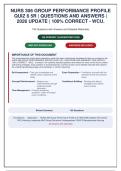
NURS 306 GROUP PERFORMANCE PROFILE
QUIZ 6 5R | QUESTIONS AND ANSWERS |
2026 UPDATE | 100% CORRECT - WCU.
150 Questions with Answers and Detailed Rationales
100 PERCENT GUARANTEED PASS
INSTANT DOWNLOAD ANSWERS INCLUDED
IMPORTANCE OF THIS DOCUMENT
This comprehensive examination preparation guide has been meticulously developed to help you succeed in the
NURS 306 GROUP PERFORMANCE PROFILE QUIZ 6 5R | QUESTIONS AND ANSWERS | 2026 UPDATE |
100% CORRECT - WCU.. It contains 150 carefully selected questions that reflect the most current exam content
and testing strategies. Each question is accompanied by a correct answer and a detailed rationale that explains
the underlying pathophysiology, pharmacology, or clinical reasoning.
Self-Assessment – Test your knowledge and Exam Preparation – Familiarize yourself with the
identify areas requiring further question format and content
study areas
Concept Reinforcement – Deepen your Confidence Building – Develop test-taking
understanding through strategies and reduce
evidence-based exam anxiety
rationales
Time Management – Practice answering
questions under simulated
exam conditions
Review Summary 150 Questions
Foundations - Application - NURS 306 Group Performance Profile 6 5r AND 2026 Update 100 Correct -
WCU Nursing Leadership AND Group Dynamics Undergraduate YEAR 3 Baccalaureate Nursing
All answers with rationales
,Table of Contents
Content Area Questions Key Topics
Management OF CARE 1-25 Manager, Intervention, Critical, Shared, Effective
Safety AND Infection Control 26-50 Appropriate, Medication, Finding, Intervention, Health
Health Promotion AND 51-75 Group, Appropriate, Leader, Improvement, Performance
Maintenance
Psychosocial Integrity 76-100 Group, Leader, Intervention, Laboratory, Fluid
Basic CARE AND Comfort 101-125 Improvement, Group, Likely, Quality, Safety
Pharmacological Therapies 126-150 Principle, Group, Leader, Intervention, Directly
TOTAL 150 All questions include answers and detailed rationales
,Section A - Management OF CARE
Q1.
A newly formed interprofessional quality improvement team is struggling to agree on a
shared vision for a fall prevention initiative. The team is in the 'storming' stage of
development. Which leadership intervention is most effective in moving the team toward
'norming'?
A. Reassign team members to different B. Facilitate a structured meeting where
roles to reduce interpersonal conflict. each member articulates their concerns and
the team collaboratively defines measurable
goals.
C. Impose a decision from upper D. Encourage the team to proceed with the
management to end the conflict and initial plan without further discussion to
establish clear directives. maintain momentum.
Correct: B - Facilitate a structured meeting where each member articulates their concerns
and the team collaboratively defines measurable goals.
Rationale:In the storming stage, conflict arises from differing perspectives. Facilitating open
communication and collaborative goal-setting helps build trust and consensus, moving the
team to norming. Reassigning roles avoids addressing underlying issues, imposing decisions
undermines team ownership, and proceeding without discussion perpetuates unresolved
conflict.
Q2.
In a high-reliability organization, a nurse leader is reviewing a near-miss medication error.
Which response best reflects the principles of a 'just culture'?
A. Disciplining the nurse to reinforce B. Conducting a thorough analysis focusing
accountability and deter future errors. on system factors while acknowledging the
nurse's role without punitive action.
C. Documenting the error in the nurse's D. Encouraging the nurse to keep the error
personnel file with a formal written warning. confidential to avoid reputational damage.
Correct: B - Conducting a thorough analysis focusing on system factors while
acknowledging the nurse's role without punitive action.
Rationale:A just culture balances accountability with system improvement; it investigates
errors to identify system weaknesses while not punishing human error. Disciplining or
documenting punitively discourages reporting, and confidentiality undermines transparency
and learning.
Page 3
, Section A - Management OF CARE
Q3.
A nurse manager is leading a team that has become 'groupthink' during a critical policy
revision. Which strategy is most effective in preventing groupthink and fostering critical
evaluation?
A. Encourage the team to reach consensus B. Assign a 'devil's advocate' role to
quickly to maintain harmony. challenge assumptions and invite external
experts to review the draft.
C. Limit discussion to only the most senior D. Reinforce the team's cohesion by
members to ensure efficiency. emphasizing their shared values and past
successes.
Correct: B - Assign a 'devil's advocate' role to challenge assumptions and invite external
experts to review the draft.
Rationale:Groupthink is countered by encouraging dissent and outside perspectives. A
devil's advocate forces critical analysis, and external review brings fresh insights.
Consensus-seeking, senior-only input, and overemphasizing cohesion suppress dissenting
views.
Q4.
During a shift handoff, a nurse uses the SBAR framework. Which component is correctly
exemplified?
A. Situation: 'The patient has a history of B. Background: 'I think the patient might be
hypertension and diabetes.' having a stroke.'
C. Assessment: 'Blood pressure is 180/100, D. Recommendation: 'I suggest we monitor
heart rate 110, and the patient has left-sided the patient and reassess in an hour.'
weakness.'
Correct: C - Assessment: 'Blood pressure is 180/100, heart rate 110, and the patient has
left-sided weakness.'
Rationale:SBAR: Situation is a concise statement of the current problem; Background is
relevant history; Assessment is the nurse's evaluation based on data; Recommendation is the
action needed. Option C provides assessment data (vitals and findings). Option A is
background, B is assessment, D is a weak recommendation lacking urgency.
Q5.
A nurse on a busy unit notices that a colleague frequently arrives late and misses team
meetings. According to the TeamSTEPPS framework, which action by the nurse best
demonstrates 'mutual support'?
Page 4
QUIZ 6 5R | QUESTIONS AND ANSWERS |
2026 UPDATE | 100% CORRECT - WCU.
150 Questions with Answers and Detailed Rationales
100 PERCENT GUARANTEED PASS
INSTANT DOWNLOAD ANSWERS INCLUDED
IMPORTANCE OF THIS DOCUMENT
This comprehensive examination preparation guide has been meticulously developed to help you succeed in the
NURS 306 GROUP PERFORMANCE PROFILE QUIZ 6 5R | QUESTIONS AND ANSWERS | 2026 UPDATE |
100% CORRECT - WCU.. It contains 150 carefully selected questions that reflect the most current exam content
and testing strategies. Each question is accompanied by a correct answer and a detailed rationale that explains
the underlying pathophysiology, pharmacology, or clinical reasoning.
Self-Assessment – Test your knowledge and Exam Preparation – Familiarize yourself with the
identify areas requiring further question format and content
study areas
Concept Reinforcement – Deepen your Confidence Building – Develop test-taking
understanding through strategies and reduce
evidence-based exam anxiety
rationales
Time Management – Practice answering
questions under simulated
exam conditions
Review Summary 150 Questions
Foundations - Application - NURS 306 Group Performance Profile 6 5r AND 2026 Update 100 Correct -
WCU Nursing Leadership AND Group Dynamics Undergraduate YEAR 3 Baccalaureate Nursing
All answers with rationales
,Table of Contents
Content Area Questions Key Topics
Management OF CARE 1-25 Manager, Intervention, Critical, Shared, Effective
Safety AND Infection Control 26-50 Appropriate, Medication, Finding, Intervention, Health
Health Promotion AND 51-75 Group, Appropriate, Leader, Improvement, Performance
Maintenance
Psychosocial Integrity 76-100 Group, Leader, Intervention, Laboratory, Fluid
Basic CARE AND Comfort 101-125 Improvement, Group, Likely, Quality, Safety
Pharmacological Therapies 126-150 Principle, Group, Leader, Intervention, Directly
TOTAL 150 All questions include answers and detailed rationales
,Section A - Management OF CARE
Q1.
A newly formed interprofessional quality improvement team is struggling to agree on a
shared vision for a fall prevention initiative. The team is in the 'storming' stage of
development. Which leadership intervention is most effective in moving the team toward
'norming'?
A. Reassign team members to different B. Facilitate a structured meeting where
roles to reduce interpersonal conflict. each member articulates their concerns and
the team collaboratively defines measurable
goals.
C. Impose a decision from upper D. Encourage the team to proceed with the
management to end the conflict and initial plan without further discussion to
establish clear directives. maintain momentum.
Correct: B - Facilitate a structured meeting where each member articulates their concerns
and the team collaboratively defines measurable goals.
Rationale:In the storming stage, conflict arises from differing perspectives. Facilitating open
communication and collaborative goal-setting helps build trust and consensus, moving the
team to norming. Reassigning roles avoids addressing underlying issues, imposing decisions
undermines team ownership, and proceeding without discussion perpetuates unresolved
conflict.
Q2.
In a high-reliability organization, a nurse leader is reviewing a near-miss medication error.
Which response best reflects the principles of a 'just culture'?
A. Disciplining the nurse to reinforce B. Conducting a thorough analysis focusing
accountability and deter future errors. on system factors while acknowledging the
nurse's role without punitive action.
C. Documenting the error in the nurse's D. Encouraging the nurse to keep the error
personnel file with a formal written warning. confidential to avoid reputational damage.
Correct: B - Conducting a thorough analysis focusing on system factors while
acknowledging the nurse's role without punitive action.
Rationale:A just culture balances accountability with system improvement; it investigates
errors to identify system weaknesses while not punishing human error. Disciplining or
documenting punitively discourages reporting, and confidentiality undermines transparency
and learning.
Page 3
, Section A - Management OF CARE
Q3.
A nurse manager is leading a team that has become 'groupthink' during a critical policy
revision. Which strategy is most effective in preventing groupthink and fostering critical
evaluation?
A. Encourage the team to reach consensus B. Assign a 'devil's advocate' role to
quickly to maintain harmony. challenge assumptions and invite external
experts to review the draft.
C. Limit discussion to only the most senior D. Reinforce the team's cohesion by
members to ensure efficiency. emphasizing their shared values and past
successes.
Correct: B - Assign a 'devil's advocate' role to challenge assumptions and invite external
experts to review the draft.
Rationale:Groupthink is countered by encouraging dissent and outside perspectives. A
devil's advocate forces critical analysis, and external review brings fresh insights.
Consensus-seeking, senior-only input, and overemphasizing cohesion suppress dissenting
views.
Q4.
During a shift handoff, a nurse uses the SBAR framework. Which component is correctly
exemplified?
A. Situation: 'The patient has a history of B. Background: 'I think the patient might be
hypertension and diabetes.' having a stroke.'
C. Assessment: 'Blood pressure is 180/100, D. Recommendation: 'I suggest we monitor
heart rate 110, and the patient has left-sided the patient and reassess in an hour.'
weakness.'
Correct: C - Assessment: 'Blood pressure is 180/100, heart rate 110, and the patient has
left-sided weakness.'
Rationale:SBAR: Situation is a concise statement of the current problem; Background is
relevant history; Assessment is the nurse's evaluation based on data; Recommendation is the
action needed. Option C provides assessment data (vitals and findings). Option A is
background, B is assessment, D is a weak recommendation lacking urgency.
Q5.
A nurse on a busy unit notices that a colleague frequently arrives late and misses team
meetings. According to the TeamSTEPPS framework, which action by the nurse best
demonstrates 'mutual support'?
Page 4