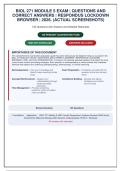
BIOL 271 MODULE 5 EXAM | QUESTIONS AND
CORRECT ANSWERS | RESPONDUS LOCKDOWN
BROWSER | 2026. (ACTUAL SCREENSHOTS)
120 Questions with Answers and Detailed Rationales
100 PERCENT GUARANTEED PASS
INSTANT DOWNLOAD ANSWERS INCLUDED
IMPORTANCE OF THIS DOCUMENT
This comprehensive examination preparation guide has been meticulously developed to help you succeed in the
BIOL 271 MODULE 5 EXAM | QUESTIONS AND CORRECT ANSWERS | RESPONDUS LOCKDOWN
BROWSER | 2026. (ACTUAL SCREENSHOTS). It contains 120 carefully selected questions that reflect the most
current exam content and testing strategies. Each question is accompanied by a correct answer and a detailed
rationale that explains the underlying pathophysiology, pharmacology, or clinical reasoning.
Self-Assessment – Test your knowledge and Exam Preparation – Familiarize yourself with the
identify areas requiring further question format and content
study areas
Concept Reinforcement – Deepen your Confidence Building – Develop test-taking
understanding through strategies and reduce
evidence-based exam anxiety
rationales
Time Management – Practice answering
questions under simulated
exam conditions
Review Summary 120 Questions
Foundations - Application - BIOL 271 Module 5 AND Correct Respondus Lockdown Browser 2026 Actual
Screenshots Molecular Biology AND Genetics Undergraduate YEAR 3 / Graduate
All answers with rationales
,Table of Contents
Content Area Questions Key Topics
CELL Biology AND 1-20 Likely, Protein, Chromatin, Binding, Promoter
Membrane Transport
Metabolism AND Enzymes 21-40 Species, Population, Likely, Outcome, Study
DNA Structure AND 41-60 Protein, Observe, Likely, Researcher, Cells
Replication
Transcription AND 61-80 Mutation, Likely, Operon, Consequence, Directly
Translation
CELL Division AND 81-100 Likely, Mutation, Researcher, Protein, Pathway
Mitosis/meiosis
Genetics AND Inheritance 101-120 Virus, Resistance, Likely, Viral, Bacterial
TOTAL 120 All questions include answers and detailed rationales
,Section A - CELL Biology AND Membrane Transport
Q1.
In a novel eukaryotic gene, a mutation in the promoter region eliminates a binding site for
an insulator-binding protein. Which of the following is the most likely direct
consequence?
A. Decreased transcriptional elongation due B. Spread of heterochromatin into the gene,
to increased RNA polymerase pausing leading to variegated silencing
C. Loss of enhancer-promoter looping, D. Increased recruitment of histone
causing reduced transcription acetyltransferases, causing ectopic
activation
Correct: B - Spread of heterochromatin into the gene, leading to variegated silencing
Rationale:Insulator-binding proteins often demarcate chromatin domains and prevent the
spread of heterochromatin. Loss of the insulator allows heterochromatin to encroach, causing
position effect variegation. Option A is unrelated to insulator function; C describes a different
mechanism (enhancer blocking); D is opposite of the expected effect.
Q2.
During DNA replication, a DNA polymerase misincorporates an 8-oxo-guanine opposite
adenine. Which repair pathway is most likely to correct this lesion before the next round
of replication?
A. Nucleotide excision repair (NER) B. Base excision repair (BER) involving
OGG1 and APE1
C. Mismatch repair (MMR) recognizing the D. Homologous recombination (HR) using
A-8-oxoG mispair the sister chromatid
Correct: B - Base excision repair (BER) involving OGG1 and APE1
Rationale:8-oxo-guanine is a base lesion repaired by BER; OGG1 excises the oxidized base,
and APE1 processes the abasic site. NER handles bulky adducts, not small base
modifications. MMR can recognize some mismatches but not efficiently this lesion. HR is not
the primary pathway for this oxidative damage.
Q3.
A researcher identifies a small RNA that binds to the 3' UTR of a target mRNA and recruits
AGO2. However, unlike canonical miRNA targeting, the seed region has perfect
complementarity. Which outcome is most likely?
A. Translational repression without mRNA B. mRNA cleavage by the RNA-induced
degradation silencing complex (RISC)
Page 3
, Section A - CELL Biology AND Membrane Transport
C. Enhanced mRNA stability through D. Splicing alteration via exon junction
recruitment of HuR complex recruitment
Correct: B - mRNA cleavage by the RNA-induced silencing complex (RISC)
Rationale:Perfect complementarity between the small RNA and mRNA triggers
endonucleolytic cleavage by AGO2, a hallmark of siRNA-mediated silencing. In contrast,
partial complementarity leads to translational repression and deadenylation. Options C and D
are not typical outcomes of AGO2 recruitment.
Q4.
A cell line exhibits hypersensitivity to ionizing radiation and defective V(D)J
recombination. Which protein is most likely mutated?
A. Ku70 B. ATM
C. Artemis D. DNA-PKcs
Correct: C - Artemis
Rationale:Artemis is an endonuclease required for opening hairpin intermediates during
V(D)J recombination and for repairing a subset of DSBs. Its deficiency causes SCID and
radiation sensitivity. Ku70 and DNA-PKcs are part of NHEJ but their loss also impairs V(D)J;
however, the specific hairpin-opening defect is classic for Artemis. ATM mutations cause
ataxia-telangiectasia but not defective V(D)J recombination.
Q5.
In a chromatin immunoprecipitation (ChIP) experiment, you find that a histone
methyltransferase (HMT) is enriched at the promoter of a gene that is transcriptionally
active. Which histone modification is most likely catalyzed by this HMT?
A. H3K9me3 B. H3K27me3
C. H3K4me3 D. H4K20me3
Correct: C - H3K4me3
Rationale:H3K4me3 is a hallmark of active promoters. H3K9me3 and H3K27me3 are
repressive marks associated with heterochromatin and Polycomb silencing, respectively.
H4K20me3 is also repressive and found in constitutive heterochromatin.
Q6.
A bacterial culture is treated with a new antibiotic that inhibits DNA gyrase. Which of the
following is the most immediate effect on DNA replication?
Page 4
CORRECT ANSWERS | RESPONDUS LOCKDOWN
BROWSER | 2026. (ACTUAL SCREENSHOTS)
120 Questions with Answers and Detailed Rationales
100 PERCENT GUARANTEED PASS
INSTANT DOWNLOAD ANSWERS INCLUDED
IMPORTANCE OF THIS DOCUMENT
This comprehensive examination preparation guide has been meticulously developed to help you succeed in the
BIOL 271 MODULE 5 EXAM | QUESTIONS AND CORRECT ANSWERS | RESPONDUS LOCKDOWN
BROWSER | 2026. (ACTUAL SCREENSHOTS). It contains 120 carefully selected questions that reflect the most
current exam content and testing strategies. Each question is accompanied by a correct answer and a detailed
rationale that explains the underlying pathophysiology, pharmacology, or clinical reasoning.
Self-Assessment – Test your knowledge and Exam Preparation – Familiarize yourself with the
identify areas requiring further question format and content
study areas
Concept Reinforcement – Deepen your Confidence Building – Develop test-taking
understanding through strategies and reduce
evidence-based exam anxiety
rationales
Time Management – Practice answering
questions under simulated
exam conditions
Review Summary 120 Questions
Foundations - Application - BIOL 271 Module 5 AND Correct Respondus Lockdown Browser 2026 Actual
Screenshots Molecular Biology AND Genetics Undergraduate YEAR 3 / Graduate
All answers with rationales
,Table of Contents
Content Area Questions Key Topics
CELL Biology AND 1-20 Likely, Protein, Chromatin, Binding, Promoter
Membrane Transport
Metabolism AND Enzymes 21-40 Species, Population, Likely, Outcome, Study
DNA Structure AND 41-60 Protein, Observe, Likely, Researcher, Cells
Replication
Transcription AND 61-80 Mutation, Likely, Operon, Consequence, Directly
Translation
CELL Division AND 81-100 Likely, Mutation, Researcher, Protein, Pathway
Mitosis/meiosis
Genetics AND Inheritance 101-120 Virus, Resistance, Likely, Viral, Bacterial
TOTAL 120 All questions include answers and detailed rationales
,Section A - CELL Biology AND Membrane Transport
Q1.
In a novel eukaryotic gene, a mutation in the promoter region eliminates a binding site for
an insulator-binding protein. Which of the following is the most likely direct
consequence?
A. Decreased transcriptional elongation due B. Spread of heterochromatin into the gene,
to increased RNA polymerase pausing leading to variegated silencing
C. Loss of enhancer-promoter looping, D. Increased recruitment of histone
causing reduced transcription acetyltransferases, causing ectopic
activation
Correct: B - Spread of heterochromatin into the gene, leading to variegated silencing
Rationale:Insulator-binding proteins often demarcate chromatin domains and prevent the
spread of heterochromatin. Loss of the insulator allows heterochromatin to encroach, causing
position effect variegation. Option A is unrelated to insulator function; C describes a different
mechanism (enhancer blocking); D is opposite of the expected effect.
Q2.
During DNA replication, a DNA polymerase misincorporates an 8-oxo-guanine opposite
adenine. Which repair pathway is most likely to correct this lesion before the next round
of replication?
A. Nucleotide excision repair (NER) B. Base excision repair (BER) involving
OGG1 and APE1
C. Mismatch repair (MMR) recognizing the D. Homologous recombination (HR) using
A-8-oxoG mispair the sister chromatid
Correct: B - Base excision repair (BER) involving OGG1 and APE1
Rationale:8-oxo-guanine is a base lesion repaired by BER; OGG1 excises the oxidized base,
and APE1 processes the abasic site. NER handles bulky adducts, not small base
modifications. MMR can recognize some mismatches but not efficiently this lesion. HR is not
the primary pathway for this oxidative damage.
Q3.
A researcher identifies a small RNA that binds to the 3' UTR of a target mRNA and recruits
AGO2. However, unlike canonical miRNA targeting, the seed region has perfect
complementarity. Which outcome is most likely?
A. Translational repression without mRNA B. mRNA cleavage by the RNA-induced
degradation silencing complex (RISC)
Page 3
, Section A - CELL Biology AND Membrane Transport
C. Enhanced mRNA stability through D. Splicing alteration via exon junction
recruitment of HuR complex recruitment
Correct: B - mRNA cleavage by the RNA-induced silencing complex (RISC)
Rationale:Perfect complementarity between the small RNA and mRNA triggers
endonucleolytic cleavage by AGO2, a hallmark of siRNA-mediated silencing. In contrast,
partial complementarity leads to translational repression and deadenylation. Options C and D
are not typical outcomes of AGO2 recruitment.
Q4.
A cell line exhibits hypersensitivity to ionizing radiation and defective V(D)J
recombination. Which protein is most likely mutated?
A. Ku70 B. ATM
C. Artemis D. DNA-PKcs
Correct: C - Artemis
Rationale:Artemis is an endonuclease required for opening hairpin intermediates during
V(D)J recombination and for repairing a subset of DSBs. Its deficiency causes SCID and
radiation sensitivity. Ku70 and DNA-PKcs are part of NHEJ but their loss also impairs V(D)J;
however, the specific hairpin-opening defect is classic for Artemis. ATM mutations cause
ataxia-telangiectasia but not defective V(D)J recombination.
Q5.
In a chromatin immunoprecipitation (ChIP) experiment, you find that a histone
methyltransferase (HMT) is enriched at the promoter of a gene that is transcriptionally
active. Which histone modification is most likely catalyzed by this HMT?
A. H3K9me3 B. H3K27me3
C. H3K4me3 D. H4K20me3
Correct: C - H3K4me3
Rationale:H3K4me3 is a hallmark of active promoters. H3K9me3 and H3K27me3 are
repressive marks associated with heterochromatin and Polycomb silencing, respectively.
H4K20me3 is also repressive and found in constitutive heterochromatin.
Q6.
A bacterial culture is treated with a new antibiotic that inhibits DNA gyrase. Which of the
following is the most immediate effect on DNA replication?
Page 4