

WTCC SP19 NUR 111 Theory Exam 1
WTCC SP19 NUR 111 Theory Exam 1
Study online at https://quizlet.com/_5yc3oa
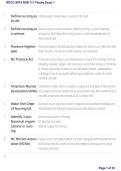
1. Define nursing as Individualized, creative ways in caring for the client.
an art.
2. Define nursing as Based on policies and procedures. Lifelong learning: current knowledge
a science. and practice that follows the nursing process; current knowledge with evi-
dence-based care.
3. Florence Nightin- Putting the patient the best possible condition for nature to act. Meet the client
gale where they are. Focused on health mutinous and restoration.
4. NC Practice Act The practice of nursing as an art dedicated to caring and to assisting clients by
providing sustained, vigilant and continuous care to those acutely or chronically
ill. Nurses assist clients to attain or maintain optimal health. Implementing
a strategy of care to accomplish defined goals within the context of a client
centered care plan
5. American Nurses Established a Code of Ethics as well as a Scopes and Standards of Nursing Prac-
Association (ANA) tice; Largest and most powerful nursing association today. With membership to
only RNs & represents the interests of all 3.4 million RNs
6. Wake Tech Dept Nursing is an art and science, which integrates and assimilate knowledge and
of Nursing Ed. skills derived from biological, physical social and behavioral sciences.
7. Identify 3 pro- American Association of Nursing
fessional organi- NC Nursing Association
zations in nurs- National League for Nursing
ing.
8. NC Nurses Associ- Equips nurses at all stages to thrive in an ever-changing healthcare environment.
ation (NCNA) NCNA helps keep NC nurses on the cutting edge of nursing practice, policy,
education and more.
9.
Page 1 of 33
, WTCC SP19 NUR 111 Theory Exam 1
WTCC SP19 NUR 111 Theory Exam 1
Study online at https://quizlet.com/_5yc3oa
National League Promotes excellence in nursing education to build a strong and diverse nursing
for Nursing (NLN) workforce to advance the health of our nation and the global community. They
support nursing research grants and other education programs.
10. Basic Nursing Ed- Hospital Based Diploma Programs, ADN, BSN
ucation
11. Advanced Nurs- Masters, DNP
ing Education
12. Describe the com- The Martha Mann Smith School of Nursing faculty supports the College's core
ponents of the values of Respect, Responsibility, Critical Thinking, Communication, Collabora-
philosophy and tion and Accountability as well as the seven core values of the National League for
the conceptual Nursing (NLN) Education Competencies Model. The NLN values include: Caring,
module of the Diversity, Ethics, Excellence, Holism, Integrity and Client-Centeredness.
Wake Tech Nurs-
ing Program (lo-
cated in your Stu-
dent Policy Hand-
book)
13. Describe the nurs- The nursing process is a dynamic continuous client-centered, problem solving
ing process as and decision-making framework that is foundational to nursing practice. It is a
a foundation to critical thinking process that consists of five steps to follow in a purposeful, goal
determine patient directed, systematic way to achieve optimal client outcomes. The five sequential
needs and deliver but overlapping steps are called: ADPIE: Assessment, Diagnosis, Planning, Im-
nursing care. plementation and Evaluation. The nursing process is a variation of scientific rea-
soning that helps nurses organize nursing care and apply the optimal available
evidence to deliver care.
The nursing process provides a framework through which nurses can apply
knowledge, experience, judgment and skills as well as established standards of
Page 2 of 33
, WTCC SP19 NUR 111 Theory Exam 1
WTCC SP19 NUR 111 Theory Exam 1
Study online at https://quizlet.com/_5yc3oa
nursing practice to the formulation of a plan of nursing care. It promotes the
professionalism of nursing while differentiating the practice of nursing.
14. Patricia Benner Novice, Advanced Beginner, Competent, Proficient, Expert
there are 5 levels
of proficiency for
nurses.
15. Benner's Novice No experience and relies on policies, procedures and guidelines and theory
16. Benner's Ad- Begins to gain experience. Focus is on tasks and guidelines. Does not have
vanced Beginner experience to consider complexity.
17. Benner's Compe- Has been on the job for 2 -3 years with the same or similar situations. Begins to
tent master some tasks, does not yet possess the speed and flexibility of a proficient
nurse.
18. Benner's Profi- Perceives the situation as wholes rather than in terms of chopped up parts or
cient aspects.
19. Benner's Expert Possess and intuitive understanding of most situations and is able to quickly
determine a course of action without much problem solving. Has high a analytical
skills ability that is needed for most all situations.
20. Identify the Establish trusting relationship with patient/family. EFFECTIVE communication is
nurse-client rela- key. Verbal and nonverbal 10/90 split, needs to have congruity.
tionship as a ba- Intent of comm. Is to elicit a response
sis for communi- Better Communication = Stronger relationships = More Trust= Better Care
cation.
21. Identify commu- Active Listener, assist patient to identify feelings, follow through w/ promises
nication skills and don't make unrealistic promises, be truthful, focus on patients well-being.
needed in devel- Developed by Hildegard Peplau
Page 3 of 33
, WTCC SP19 NUR 111 Theory Exam 1
WTCC SP19 NUR 111 Theory Exam 1
Study online at https://quizlet.com/_5yc3oa
oping therapeutic
relationships.
22. Define the four Pre-interaction, Introductory, Working, Termination Phases.
phases of a
nurse-client rela-
tionship.
23. Pre-interaction Similar to planning stage before an interview. The nurse has information about
Phase the patient before face-to-face meeting (name, address, age, health problem).
The nurse will get anxious before the visit. This phrase process may cause
feelings of anxiety within the nurse; these can be reduced by identifying specific
topics to discuss before meeting the client.
24. Introductory Also called the orientation or pre-therapeutic phase, the introductory phase sets
Phase the tone for the therapeutic relationship. During this phase, the nurse and client
closely examine each other to form an opinion of judgement about each other's
behavior. The goal of the introductory phase is to develop trust and security
within the relationship.
25. Working Phase This phase has two stages; exploring and understanding and facilitating and
taking action. The purpose of the working phase is to help client meet identified
goals. During this phase, the client may express or demonstrate feelings such
as anger, shame, or self- consciousness. Nurses help clients work through these
feelings by helping the client make decisions; providing support and offering
options and information.
26. Termination The termination phase can be difficult and filled with ambivalence however, if
Phase the relationship has evolved through the other phases, the client will have an
improved outlook and be prepared to handle challenges related to his or her
health alteration. There will be a sense of loss when the relationship terminates,
and the nurse and client both have to use an approach that is comfortable when
Page 4 of 33
WTCC SP19 NUR 111 Theory Exam 1
Study online at https://quizlet.com/_5yc3oa
1. Define nursing as Individualized, creative ways in caring for the client.
an art.
2. Define nursing as Based on policies and procedures. Lifelong learning: current knowledge
a science. and practice that follows the nursing process; current knowledge with evi-
dence-based care.
3. Florence Nightin- Putting the patient the best possible condition for nature to act. Meet the client
gale where they are. Focused on health mutinous and restoration.
4. NC Practice Act The practice of nursing as an art dedicated to caring and to assisting clients by
providing sustained, vigilant and continuous care to those acutely or chronically
ill. Nurses assist clients to attain or maintain optimal health. Implementing
a strategy of care to accomplish defined goals within the context of a client
centered care plan
5. American Nurses Established a Code of Ethics as well as a Scopes and Standards of Nursing Prac-
Association (ANA) tice; Largest and most powerful nursing association today. With membership to
only RNs & represents the interests of all 3.4 million RNs
6. Wake Tech Dept Nursing is an art and science, which integrates and assimilate knowledge and
of Nursing Ed. skills derived from biological, physical social and behavioral sciences.
7. Identify 3 pro- American Association of Nursing
fessional organi- NC Nursing Association
zations in nurs- National League for Nursing
ing.
8. NC Nurses Associ- Equips nurses at all stages to thrive in an ever-changing healthcare environment.
ation (NCNA) NCNA helps keep NC nurses on the cutting edge of nursing practice, policy,
education and more.
9.
Page 1 of 33
, WTCC SP19 NUR 111 Theory Exam 1
WTCC SP19 NUR 111 Theory Exam 1
Study online at https://quizlet.com/_5yc3oa
National League Promotes excellence in nursing education to build a strong and diverse nursing
for Nursing (NLN) workforce to advance the health of our nation and the global community. They
support nursing research grants and other education programs.
10. Basic Nursing Ed- Hospital Based Diploma Programs, ADN, BSN
ucation
11. Advanced Nurs- Masters, DNP
ing Education
12. Describe the com- The Martha Mann Smith School of Nursing faculty supports the College's core
ponents of the values of Respect, Responsibility, Critical Thinking, Communication, Collabora-
philosophy and tion and Accountability as well as the seven core values of the National League for
the conceptual Nursing (NLN) Education Competencies Model. The NLN values include: Caring,
module of the Diversity, Ethics, Excellence, Holism, Integrity and Client-Centeredness.
Wake Tech Nurs-
ing Program (lo-
cated in your Stu-
dent Policy Hand-
book)
13. Describe the nurs- The nursing process is a dynamic continuous client-centered, problem solving
ing process as and decision-making framework that is foundational to nursing practice. It is a
a foundation to critical thinking process that consists of five steps to follow in a purposeful, goal
determine patient directed, systematic way to achieve optimal client outcomes. The five sequential
needs and deliver but overlapping steps are called: ADPIE: Assessment, Diagnosis, Planning, Im-
nursing care. plementation and Evaluation. The nursing process is a variation of scientific rea-
soning that helps nurses organize nursing care and apply the optimal available
evidence to deliver care.
The nursing process provides a framework through which nurses can apply
knowledge, experience, judgment and skills as well as established standards of
Page 2 of 33
, WTCC SP19 NUR 111 Theory Exam 1
WTCC SP19 NUR 111 Theory Exam 1
Study online at https://quizlet.com/_5yc3oa
nursing practice to the formulation of a plan of nursing care. It promotes the
professionalism of nursing while differentiating the practice of nursing.
14. Patricia Benner Novice, Advanced Beginner, Competent, Proficient, Expert
there are 5 levels
of proficiency for
nurses.
15. Benner's Novice No experience and relies on policies, procedures and guidelines and theory
16. Benner's Ad- Begins to gain experience. Focus is on tasks and guidelines. Does not have
vanced Beginner experience to consider complexity.
17. Benner's Compe- Has been on the job for 2 -3 years with the same or similar situations. Begins to
tent master some tasks, does not yet possess the speed and flexibility of a proficient
nurse.
18. Benner's Profi- Perceives the situation as wholes rather than in terms of chopped up parts or
cient aspects.
19. Benner's Expert Possess and intuitive understanding of most situations and is able to quickly
determine a course of action without much problem solving. Has high a analytical
skills ability that is needed for most all situations.
20. Identify the Establish trusting relationship with patient/family. EFFECTIVE communication is
nurse-client rela- key. Verbal and nonverbal 10/90 split, needs to have congruity.
tionship as a ba- Intent of comm. Is to elicit a response
sis for communi- Better Communication = Stronger relationships = More Trust= Better Care
cation.
21. Identify commu- Active Listener, assist patient to identify feelings, follow through w/ promises
nication skills and don't make unrealistic promises, be truthful, focus on patients well-being.
needed in devel- Developed by Hildegard Peplau
Page 3 of 33
, WTCC SP19 NUR 111 Theory Exam 1
WTCC SP19 NUR 111 Theory Exam 1
Study online at https://quizlet.com/_5yc3oa
oping therapeutic
relationships.
22. Define the four Pre-interaction, Introductory, Working, Termination Phases.
phases of a
nurse-client rela-
tionship.
23. Pre-interaction Similar to planning stage before an interview. The nurse has information about
Phase the patient before face-to-face meeting (name, address, age, health problem).
The nurse will get anxious before the visit. This phrase process may cause
feelings of anxiety within the nurse; these can be reduced by identifying specific
topics to discuss before meeting the client.
24. Introductory Also called the orientation or pre-therapeutic phase, the introductory phase sets
Phase the tone for the therapeutic relationship. During this phase, the nurse and client
closely examine each other to form an opinion of judgement about each other's
behavior. The goal of the introductory phase is to develop trust and security
within the relationship.
25. Working Phase This phase has two stages; exploring and understanding and facilitating and
taking action. The purpose of the working phase is to help client meet identified
goals. During this phase, the client may express or demonstrate feelings such
as anger, shame, or self- consciousness. Nurses help clients work through these
feelings by helping the client make decisions; providing support and offering
options and information.
26. Termination The termination phase can be difficult and filled with ambivalence however, if
Phase the relationship has evolved through the other phases, the client will have an
improved outlook and be prepared to handle challenges related to his or her
health alteration. There will be a sense of loss when the relationship terminates,
and the nurse and client both have to use an approach that is comfortable when
Page 4 of 33


