

WGU D184 Standards-Based Assessment , D184 OA
WGU D184 Standards-Based Assessment , D184 OA
Study online at https://quizlet.com/_igx3al
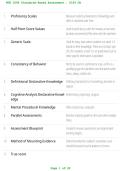
1. Proficiency Scales Measure student achievement of knowledge and
skills in standards over time.
2. Half Point Score Values Used in proficiency scales for mastery at one level,
but does not meet all of the criteria for the next level.
3. Generic Scale Used for every topic where students are rated 1-4
based on their knowledge. These are not topic-spe-
cific; for example, a level 3 is on grade level, but no
other specific information is provided.
4. Consistency of Behavior Not to be used on a proficiency scale, as this is a
qualifying type of scale which uses the words some-
times, always, seldom etc.
5. Definitional Declarative Knowledge Defining characteristics of something, describe or
explain
6. Cognitive Analysis Declarative Knowl- Determining, organizing, analysis
edge
7. Mental Procedural Knowledge Skills or processes, evaluates
8. Parallel Assessments Monitor students growth on the same skills multiple
times.
9. Assessment Blueprint Created to ensure assessments are aligned with
learning targets.
10. Method of Mounting Evidence Determine what the students' summative score
should be based on prior patterns of scores.
11. True score
Page 1 of 22
, WGU D184 Standards-Based Assessment , D184 OA
WGU D184 Standards-Based Assessment , D184 OA
Study online at https://quizlet.com/_igx3al
Recognizes that there is some inherent error on a
test, its' an estimation, the true level of understand-
ing
12. Observed Score = True Score + Error Score
13. Aberrant pattenrs you need to determine if the pattern is reliable or if
the student was having a bad day etc.
14. Standards Referenced Grading Sys- students demonstrate learning outcomes based on
tems standards.
15. Standards-Based Grading one standard is assessed at a time
16. Standards-Based Grading Assessment results do not contain content outside
of the stated standard.
17. Measurement Topics They help identify content and skills to be tested.
18. Measurement Topics Concepts
19. Declarative Knowledge Understanding concepts without application
20. Procedural Knowledge Demonstration is a method of illustrating procedur-
al knowledge
21. Parallel Assessments given to measure student progress on one standard
over time
22. Unidimensionality Parallel Assessments
23. Parallel Assessments remove much of the error from student scores to
provide a true score
24. Point Scoring Method
Page 2 of 22
, WGU D184 Standards-Based Assessment , D184 OA
WGU D184 Standards-Based Assessment , D184 OA
Study online at https://quizlet.com/_igx3al
It is used to determine the percentage of available
points a student earned on sections of a test, which
is translated into a score on a proficiency scale
25. Response Code Scoring Each student answer is marked with labels, and the
pattern of labels is then examined to determine the
student's level of proficiency.
26. method of mounting evidence It estimates summative scores over time based on
observed patterns
27. method of mathematical models uses technology to estimate a student's true sum-
mative score that occurs at any point in timeUses
28. best-fit model It is determined by comparing error rates between
the true scores predicted and the actual scores ob-
served
29. Marzano Growth Calculator uses the linear, curvilinear, and average mathemat-
ical models
30. Marzano Growth Calculator It calculates true summative scores using three
mathematical models to determine the best-fit
model
31. observed score includes the true score, which indicates the stu-
dent's true understanding of a measurement topic,
and the error score, which is based on factors ex-
cluding the student's understanding
32. observed score true score + error score
33. Response Code Scoring
Page 3 of 22
WGU D184 Standards-Based Assessment , D184 OA
Study online at https://quizlet.com/_igx3al
1. Proficiency Scales Measure student achievement of knowledge and
skills in standards over time.
2. Half Point Score Values Used in proficiency scales for mastery at one level,
but does not meet all of the criteria for the next level.
3. Generic Scale Used for every topic where students are rated 1-4
based on their knowledge. These are not topic-spe-
cific; for example, a level 3 is on grade level, but no
other specific information is provided.
4. Consistency of Behavior Not to be used on a proficiency scale, as this is a
qualifying type of scale which uses the words some-
times, always, seldom etc.
5. Definitional Declarative Knowledge Defining characteristics of something, describe or
explain
6. Cognitive Analysis Declarative Knowl- Determining, organizing, analysis
edge
7. Mental Procedural Knowledge Skills or processes, evaluates
8. Parallel Assessments Monitor students growth on the same skills multiple
times.
9. Assessment Blueprint Created to ensure assessments are aligned with
learning targets.
10. Method of Mounting Evidence Determine what the students' summative score
should be based on prior patterns of scores.
11. True score
Page 1 of 22
, WGU D184 Standards-Based Assessment , D184 OA
WGU D184 Standards-Based Assessment , D184 OA
Study online at https://quizlet.com/_igx3al
Recognizes that there is some inherent error on a
test, its' an estimation, the true level of understand-
ing
12. Observed Score = True Score + Error Score
13. Aberrant pattenrs you need to determine if the pattern is reliable or if
the student was having a bad day etc.
14. Standards Referenced Grading Sys- students demonstrate learning outcomes based on
tems standards.
15. Standards-Based Grading one standard is assessed at a time
16. Standards-Based Grading Assessment results do not contain content outside
of the stated standard.
17. Measurement Topics They help identify content and skills to be tested.
18. Measurement Topics Concepts
19. Declarative Knowledge Understanding concepts without application
20. Procedural Knowledge Demonstration is a method of illustrating procedur-
al knowledge
21. Parallel Assessments given to measure student progress on one standard
over time
22. Unidimensionality Parallel Assessments
23. Parallel Assessments remove much of the error from student scores to
provide a true score
24. Point Scoring Method
Page 2 of 22
, WGU D184 Standards-Based Assessment , D184 OA
WGU D184 Standards-Based Assessment , D184 OA
Study online at https://quizlet.com/_igx3al
It is used to determine the percentage of available
points a student earned on sections of a test, which
is translated into a score on a proficiency scale
25. Response Code Scoring Each student answer is marked with labels, and the
pattern of labels is then examined to determine the
student's level of proficiency.
26. method of mounting evidence It estimates summative scores over time based on
observed patterns
27. method of mathematical models uses technology to estimate a student's true sum-
mative score that occurs at any point in timeUses
28. best-fit model It is determined by comparing error rates between
the true scores predicted and the actual scores ob-
served
29. Marzano Growth Calculator uses the linear, curvilinear, and average mathemat-
ical models
30. Marzano Growth Calculator It calculates true summative scores using three
mathematical models to determine the best-fit
model
31. observed score includes the true score, which indicates the stu-
dent's true understanding of a measurement topic,
and the error score, which is based on factors ex-
cluding the student's understanding
32. observed score true score + error score
33. Response Code Scoring
Page 3 of 22


