

D184 WGU Standard-Based Assessment OA
D184 WGU Standard-Based Assessment
Study online at https://quizlet.com/_gzjsku
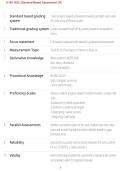
1. Standard based grading Tracks progress toward achievement towards standards and acade-
system mic skills using proficiency scales.
2. Traditional grading system Grades calculated based off %, partially based on nonacademic
factors.
3. Focus statement Full standard statement with detail for guidance and assessment.
4. Measurement Topic Small set of critical topics or themes to focus on
5. Declarative Knowledge What students UNDERSTAND
facts, ideas, information
(name and explain)
6. Procedural Knowledge BE ABLE TO DO
Skills, strategies, processes
( act or perform tasks)
7. Proficiency Scales Measure student progress towards standard mastery. Usually a 4pt
scale
4=advanced ( in depth application)
3=proficient ( understands target)
2=developing ( partial success)
1=beginning ( with help)
8. Parallel Assessments Multiple assessments given to the same students over time. Mea-
sures and records leaning over time to identify growth or gaps.
Eliminates error.
9. Reliability Assessment accurately and constantly measures the same content
for ALL STUDENTS. ( same outcome )
10. Validity Refers to the degree which the assessment is relevant to the content
and measures what it's supposed measure.
1
, D184 WGU Standard-Based Assessment OA
D184 WGU Standard-Based Assessment
Study online at https://quizlet.com/_gzjsku
11. Unidemensionality One aspect ( standard) measured at a time
12. Assessment Blueprint Specifies assessment
skills, assessment types, # of assessments
13. Proved Proper coverage on % of times and difficulty level for each topic
blueprint
14. Increases blueprint com- Item types ( m.c, essay, matching )
plexity
15. Response code scoring CC ( completely correct)
I ( incorrect)
HP ( high partial accuracy)
LP ( low partial accuracy)
No points, just codes/ letters to label proficiency
16. Point scoring Assign points to each item, proficiency determine by %
17. Mounting Evidence Use multiple indicators to find patterns of student achievement and
determine summative scores
18. Linear trend Math model in which it's assumed there is a steady and equal
increase in learning over time.
19. Curvilinear Trend Assumption that when initially learning something, students
demonstrate rather large jumps but over time. Increase flattens out
20. Average The assumption that no learning occurs from assessment to assess-
ment
( looks like a straight line on a bar graph)
Students scores are combined and averaged
2
D184 WGU Standard-Based Assessment
Study online at https://quizlet.com/_gzjsku
1. Standard based grading Tracks progress toward achievement towards standards and acade-
system mic skills using proficiency scales.
2. Traditional grading system Grades calculated based off %, partially based on nonacademic
factors.
3. Focus statement Full standard statement with detail for guidance and assessment.
4. Measurement Topic Small set of critical topics or themes to focus on
5. Declarative Knowledge What students UNDERSTAND
facts, ideas, information
(name and explain)
6. Procedural Knowledge BE ABLE TO DO
Skills, strategies, processes
( act or perform tasks)
7. Proficiency Scales Measure student progress towards standard mastery. Usually a 4pt
scale
4=advanced ( in depth application)
3=proficient ( understands target)
2=developing ( partial success)
1=beginning ( with help)
8. Parallel Assessments Multiple assessments given to the same students over time. Mea-
sures and records leaning over time to identify growth or gaps.
Eliminates error.
9. Reliability Assessment accurately and constantly measures the same content
for ALL STUDENTS. ( same outcome )
10. Validity Refers to the degree which the assessment is relevant to the content
and measures what it's supposed measure.
1
, D184 WGU Standard-Based Assessment OA
D184 WGU Standard-Based Assessment
Study online at https://quizlet.com/_gzjsku
11. Unidemensionality One aspect ( standard) measured at a time
12. Assessment Blueprint Specifies assessment
skills, assessment types, # of assessments
13. Proved Proper coverage on % of times and difficulty level for each topic
blueprint
14. Increases blueprint com- Item types ( m.c, essay, matching )
plexity
15. Response code scoring CC ( completely correct)
I ( incorrect)
HP ( high partial accuracy)
LP ( low partial accuracy)
No points, just codes/ letters to label proficiency
16. Point scoring Assign points to each item, proficiency determine by %
17. Mounting Evidence Use multiple indicators to find patterns of student achievement and
determine summative scores
18. Linear trend Math model in which it's assumed there is a steady and equal
increase in learning over time.
19. Curvilinear Trend Assumption that when initially learning something, students
demonstrate rather large jumps but over time. Increase flattens out
20. Average The assumption that no learning occurs from assessment to assess-
ment
( looks like a straight line on a bar graph)
Students scores are combined and averaged
2


