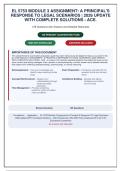
EL 5753 MODULE 3 ASSIGNMENT: A PRINCIPAL'S
RESPONSE TO LEGAL SCENARIOS | 2026 UPDATE
WITH COMPLETE SOLUTIONS - ACE.
129 Questions with Answers and Detailed Rationales
100 PERCENT GUARANTEED PASS
INSTANT DOWNLOAD ANSWERS INCLUDED
IMPORTANCE OF THIS DOCUMENT
This comprehensive examination preparation guide has been meticulously developed to help you succeed in the
EL 5753 MODULE 3 ASSIGNMENT: A PRINCIPAL'S RESPONSE TO LEGAL SCENARIOS | 2026 UPDATE
WITH COMPLETE SOLUTIONS - ACE.. It contains 129 carefully selected questions that reflect the most current
exam content and testing strategies. Each question is accompanied by a correct answer and a detailed rationale
that explains the underlying pathophysiology, pharmacology, or clinical reasoning.
Self-Assessment – Test your knowledge and Exam Preparation – Familiarize yourself with the
identify areas requiring further question format and content
study areas
Concept Reinforcement – Deepen your Confidence Building – Develop test-taking
understanding through strategies and reduce
evidence-based exam anxiety
rationales
Time Management – Practice answering
questions under simulated
exam conditions
Review Summary 129 Questions
Foundations - Application - EL 5753 Module 3 Assignment A Principal S Response TO Legal Scenarios
2026 Update WITH Complete Solutions - ACE Educational LAW AND Policy Graduate ED D /ph D IN
Educational Leadership
All answers with rationales
,Table of Contents
Content Area Questions Key Topics
Legal Foundations OF 1-22 Principal, Student, Policy, Legal, Parent
Education
Student Rights AND 23-44 Principal, Student, Parent, Legal, School
Responsibilities
Special Education LAW IDEA 45-66 Student, Principal, School, Legal, Policy
Section 504
Student Discipline AND DUE 67-88 Principal, Student, Teacher, Parent, Legal
Process
Teacher Employment AND 89-110 Principal, Teacher, Student, Legal, School
Tenure
Liability AND RISK 111-129 Principal, Teacher, Legal, Student, Policy
Management
TOTAL 129 All questions include answers and detailed rationales
,Section A - Legal Foundations OF Education
Q1.
A student creates a vulgar social media post targeting a classmate, off-campus, using a
personal device. The post disrupts the school environment when it is shared on campus.
Under the current Supreme Court framework, which standard should a principal apply?
A. Tinker's substantial disruption test B. The true threat doctrine because it
because the post reached campus targeted a specific student
C. The Fraser standard because the post D. The Morse standard because it
was vulgar and lewd concerned illegal activity
Correct: A - Tinker's substantial disruption test because the post reached campus
Rationale:In Mahanoy Area School District v. B.L. (2021), the Court held that off-campus
speech is subject to Tinker's substantial disruption test, but with diminished authority for
schools. The post caused disruption on campus, so Tinker applies, but the school's authority
is lessened. The true threat doctrine is not triggered as the post was not a genuine threat.
Fraser and Morse apply to on-campus school-sponsored speech, not off-campus personal
speech.
Q2.
A principal implements a policy requiring all students to wear RFID badges that track their
location throughout the school day. A parent challenges the policy as a violation of Fourth
Amendment rights. Which legal standard should the principal use to defend the policy?
A. Reasonable suspicion, because the B. Probable cause, because the badges are
badges are a minimally intrusive a full search of the student's person
administrative search
C. The 'special needs' doctrine, because the D. The 'reasonable expectation of privacy'
policy is for school safety and is minimally standard, because students have no privacy
invasive in school
Correct: C - The 'special needs' doctrine, because the policy is for school safety and is
minimally invasive
Rationale:The 'special needs' doctrine allows searches without individualized suspicion when
the search is justified by a non-law-enforcement purpose and is minimally intrusive. RFID
location tracking is a search, but courts balance student privacy against the school's interest
in safety. Reasonable suspicion is required for individualized searches, not blanket policies.
Probable cause is too high a standard. Students do have some privacy rights, though
reduced.
Page 3
, Section A - Legal Foundations OF Education
Q3.
A teacher with a documented disability requests a classroom on the ground floor as a
reasonable accommodation. The principal denies the request, citing the need to keep the
teacher near the science lab. The teacher files an OCR complaint. Which legal principle is
most relevant?
A. The interactive process requires the B. The principal may deny the
principal to engage in a good-faith dialogue accommodation if it imposes an undue
and consider alternatives hardship
C. The teacher has no right to a specific D. The ADA only requires accommodations
accommodation, only to an effective one for students, not employees
Correct: A - The interactive process requires the principal to engage in a good-faith
dialogue and consider alternatives
Rationale:Under the ADA, the employer must engage in the interactive process to identify
reasonable accommodations. Denying without discussion violates this duty. While the
principal may argue undue hardship, that defense requires evidence of significant difficulty or
expense. The teacher is entitled to an effective accommodation, but the interactive process is
mandatory. The ADA covers employees as well.
Q4.
A principal learns that a student has been receiving failing grades due to excessive
absences. The parent claims the absences are due to a disability and requests a Section
504 plan. The student has never been evaluated. What is the principal's most appropriate
action?
A. Immediately create a 504 plan to provide B. Convene a 504 team to determine if the
accommodations for the absences student has a disability and needs
accommodations
C. Refer the student for a special education D. Deny the request because the student
evaluation under IDEA has no formal diagnosis
Correct: B - Convene a 504 team to determine if the student has a disability and needs
accommodations
Rationale:Under Section 504, a school must conduct an evaluation to determine eligibility if
there is reason to believe the student has a disability. The principal cannot deny without
evaluation. A 504 plan is only appropriate after eligibility determination. An IDEA referral may
be considered, but the immediate step is a 504 evaluation. A formal diagnosis is not required
for evaluation.
Page 4
RESPONSE TO LEGAL SCENARIOS | 2026 UPDATE
WITH COMPLETE SOLUTIONS - ACE.
129 Questions with Answers and Detailed Rationales
100 PERCENT GUARANTEED PASS
INSTANT DOWNLOAD ANSWERS INCLUDED
IMPORTANCE OF THIS DOCUMENT
This comprehensive examination preparation guide has been meticulously developed to help you succeed in the
EL 5753 MODULE 3 ASSIGNMENT: A PRINCIPAL'S RESPONSE TO LEGAL SCENARIOS | 2026 UPDATE
WITH COMPLETE SOLUTIONS - ACE.. It contains 129 carefully selected questions that reflect the most current
exam content and testing strategies. Each question is accompanied by a correct answer and a detailed rationale
that explains the underlying pathophysiology, pharmacology, or clinical reasoning.
Self-Assessment – Test your knowledge and Exam Preparation – Familiarize yourself with the
identify areas requiring further question format and content
study areas
Concept Reinforcement – Deepen your Confidence Building – Develop test-taking
understanding through strategies and reduce
evidence-based exam anxiety
rationales
Time Management – Practice answering
questions under simulated
exam conditions
Review Summary 129 Questions
Foundations - Application - EL 5753 Module 3 Assignment A Principal S Response TO Legal Scenarios
2026 Update WITH Complete Solutions - ACE Educational LAW AND Policy Graduate ED D /ph D IN
Educational Leadership
All answers with rationales
,Table of Contents
Content Area Questions Key Topics
Legal Foundations OF 1-22 Principal, Student, Policy, Legal, Parent
Education
Student Rights AND 23-44 Principal, Student, Parent, Legal, School
Responsibilities
Special Education LAW IDEA 45-66 Student, Principal, School, Legal, Policy
Section 504
Student Discipline AND DUE 67-88 Principal, Student, Teacher, Parent, Legal
Process
Teacher Employment AND 89-110 Principal, Teacher, Student, Legal, School
Tenure
Liability AND RISK 111-129 Principal, Teacher, Legal, Student, Policy
Management
TOTAL 129 All questions include answers and detailed rationales
,Section A - Legal Foundations OF Education
Q1.
A student creates a vulgar social media post targeting a classmate, off-campus, using a
personal device. The post disrupts the school environment when it is shared on campus.
Under the current Supreme Court framework, which standard should a principal apply?
A. Tinker's substantial disruption test B. The true threat doctrine because it
because the post reached campus targeted a specific student
C. The Fraser standard because the post D. The Morse standard because it
was vulgar and lewd concerned illegal activity
Correct: A - Tinker's substantial disruption test because the post reached campus
Rationale:In Mahanoy Area School District v. B.L. (2021), the Court held that off-campus
speech is subject to Tinker's substantial disruption test, but with diminished authority for
schools. The post caused disruption on campus, so Tinker applies, but the school's authority
is lessened. The true threat doctrine is not triggered as the post was not a genuine threat.
Fraser and Morse apply to on-campus school-sponsored speech, not off-campus personal
speech.
Q2.
A principal implements a policy requiring all students to wear RFID badges that track their
location throughout the school day. A parent challenges the policy as a violation of Fourth
Amendment rights. Which legal standard should the principal use to defend the policy?
A. Reasonable suspicion, because the B. Probable cause, because the badges are
badges are a minimally intrusive a full search of the student's person
administrative search
C. The 'special needs' doctrine, because the D. The 'reasonable expectation of privacy'
policy is for school safety and is minimally standard, because students have no privacy
invasive in school
Correct: C - The 'special needs' doctrine, because the policy is for school safety and is
minimally invasive
Rationale:The 'special needs' doctrine allows searches without individualized suspicion when
the search is justified by a non-law-enforcement purpose and is minimally intrusive. RFID
location tracking is a search, but courts balance student privacy against the school's interest
in safety. Reasonable suspicion is required for individualized searches, not blanket policies.
Probable cause is too high a standard. Students do have some privacy rights, though
reduced.
Page 3
, Section A - Legal Foundations OF Education
Q3.
A teacher with a documented disability requests a classroom on the ground floor as a
reasonable accommodation. The principal denies the request, citing the need to keep the
teacher near the science lab. The teacher files an OCR complaint. Which legal principle is
most relevant?
A. The interactive process requires the B. The principal may deny the
principal to engage in a good-faith dialogue accommodation if it imposes an undue
and consider alternatives hardship
C. The teacher has no right to a specific D. The ADA only requires accommodations
accommodation, only to an effective one for students, not employees
Correct: A - The interactive process requires the principal to engage in a good-faith
dialogue and consider alternatives
Rationale:Under the ADA, the employer must engage in the interactive process to identify
reasonable accommodations. Denying without discussion violates this duty. While the
principal may argue undue hardship, that defense requires evidence of significant difficulty or
expense. The teacher is entitled to an effective accommodation, but the interactive process is
mandatory. The ADA covers employees as well.
Q4.
A principal learns that a student has been receiving failing grades due to excessive
absences. The parent claims the absences are due to a disability and requests a Section
504 plan. The student has never been evaluated. What is the principal's most appropriate
action?
A. Immediately create a 504 plan to provide B. Convene a 504 team to determine if the
accommodations for the absences student has a disability and needs
accommodations
C. Refer the student for a special education D. Deny the request because the student
evaluation under IDEA has no formal diagnosis
Correct: B - Convene a 504 team to determine if the student has a disability and needs
accommodations
Rationale:Under Section 504, a school must conduct an evaluation to determine eligibility if
there is reason to believe the student has a disability. The principal cannot deny without
evaluation. A 504 plan is only appropriate after eligibility determination. An IDEA referral may
be considered, but the immediate step is a 504 evaluation. A formal diagnosis is not required
for evaluation.
Page 4