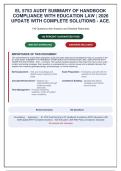
EL 5753 AUDIT SUMMARY OF HANDBOOK
COMPLIANCE WITH EDUCATION LAW | 2026
UPDATE WITH COMPLETE SOLUTIONS - ACE.
140 Questions with Answers and Detailed Rationales
100 PERCENT GUARANTEED PASS
INSTANT DOWNLOAD ANSWERS INCLUDED
IMPORTANCE OF THIS DOCUMENT
This comprehensive examination preparation guide has been meticulously developed to help you succeed in the
EL 5753 AUDIT SUMMARY OF HANDBOOK COMPLIANCE WITH EDUCATION LAW | 2026 UPDATE WITH
COMPLETE SOLUTIONS - ACE.. It contains 140 carefully selected questions that reflect the most current exam
content and testing strategies. Each question is accompanied by a correct answer and a detailed rationale that
explains the underlying pathophysiology, pharmacology, or clinical reasoning.
Self-Assessment – Test your knowledge and Exam Preparation – Familiarize yourself with the
identify areas requiring further question format and content
study areas
Concept Reinforcement – Deepen your Confidence Building – Develop test-taking
understanding through strategies and reduce
evidence-based exam anxiety
rationales
Time Management – Practice answering
questions under simulated
exam conditions
Review Summary 140 Questions
Foundations - Application - EL 5753 Audit Summary OF Handbook Compliance WITH Education LAW
2026 Update WITH Complete Solutions - ACE Education LAW AND Policy Compliance Graduate
All answers with rationales
,Table of Contents
Content Area Questions Key Topics
Legal Framework OF 1-24 District S, School, Handbook, Education, Compliance
Education LAW
Handbook Compliance 25-48 Student, Handbook, School, Policy, States
Standards
Student Rights AND 49-72 Handbook, Student, Compliance, Legal, Policy
Responsibilities
Special Education AND 73-96 Handbook, Audit, Policy, Students, District S
Accommodations
Teacher AND Staff 97-120 Student, Handbook, School, District S, Policy
Requirements
School Safety AND Discipline 121-140 Handbook, School, Student, Policy, District S
Policies
TOTAL 140 All questions include answers and detailed rationales
,Section A - Legal Framework OF Education LAW
Q1.
Under the 2026 FERPA amendments, which of the following directory information
disclosures requires prior written consent from an eligible student?
A. Releasing student ID numbers to a B. Sharing a student's major field of study
university-affiliated research institute for with a military recruiter during a campus
longitudinal studies career fair
C. Posting a student's name and email D. Providing a student's enrollment status to
address on the official dean's list a parent who claims the student as a
dependent on tax returns
Correct: A - Releasing student ID numbers to a university-affiliated research institute for
longitudinal studies
Rationale:Under FERPA, directory information typically includes name, address, phone,
email, major, and enrollment status, but student ID numbers are not directory information
when used for purposes other than directory listing. Sharing ID numbers with a research
institute is a non-directory disclosure requiring consent. Military recruiters have special
access under Solomon Amendment, dean's list is directory, and dependent status allows
parental access without consent.
Q2.
A university's 2026 handbook states that 'students with disabilities are provided
reasonable accommodations as determined by the Disability Services Office.' Which
provision is MOST legally problematic under the ADA Amendments Act (ADAAA) and
Section 504?
A. The phrase 'reasonable accommodations' B. The handbook does not specify the
is not defined in the handbook documentation required for disability
verification
C. The provision implies the Disability D. The handbook fails to mention the
Services Office has sole discretion to deny grievance procedure for accommodation
accommodations denials
Correct: C - The provision implies the Disability Services Office has sole discretion to
deny accommodations
Rationale:Under the ADAAA and Section 504, the determination of accommodations must be
an interactive process involving the student, not unilateral discretion by a single office. Sole
discretion violates the requirement to consider individual needs and engage in a collaborative
assessment. While defining terms and documenting procedures are important, the core legal
issue is the absence of an interactive process.
Page 3
, Section A - Legal Framework OF Education LAW
Q3.
In auditing a K-12 district's compliance with the 2026 IDEA updates, which of the following
practices would be considered a substantive violation of the 'least restrictive environment'
(LRE) mandate?
A. Placing a student with an intellectual B. Providing related services such as
disability in a self-contained classroom for speech therapy in a separate room once a
all academic instruction without considering week
supplementary aids in general education
C. Using a resource room for math support D. Assigning a paraprofessional to assist a
while the student participates in general student in the general education classroom
education for other subjects
Correct: A - Placing a student with an intellectual disability in a self-contained classroom
for all academic instruction without considering supplementary aids in general education
Rationale:LRE requires that students with disabilities be educated with non-disabled peers to
the maximum extent appropriate, with supplementary aids and services considered. A blanket
placement in self-contained classrooms without individualized consideration violates LRE.
Resource rooms, related services in separate settings, and paraprofessional support are
permissible when necessary to meet the student's needs.
Q4.
A university is revising its Title IX grievance procedures to comply with the 2026
regulations. Which of the following provisions is MOST likely to be invalidated as
inconsistent with current Title IX rules?
A. A requirement that the complainant and B. A provision allowing a single investigator
respondent be provided with simultaneous to serve as both the investigator and
written notice of the outcome decision-maker in a case involving a faculty
respondent
C. An option for a live hearing with D. A requirement that the parties be
cross-examination conducted by the parties' informed of the evidence collected and
advisors given an opportunity to respond before a
determination is made
Correct: B - A provision allowing a single investigator to serve as both the investigator
and decision-maker in a case involving a faculty respondent
Rationale:The 2026 Title IX regulations emphasize separation of roles to ensure impartiality,
requiring that the decision-maker not be the same person as the investigator or the Title IX
coordinator. Allowing one person to investigate and decide creates a conflict of interest and
violates due process expectations. The other provisions align with current regulations.
Page 4
COMPLIANCE WITH EDUCATION LAW | 2026
UPDATE WITH COMPLETE SOLUTIONS - ACE.
140 Questions with Answers and Detailed Rationales
100 PERCENT GUARANTEED PASS
INSTANT DOWNLOAD ANSWERS INCLUDED
IMPORTANCE OF THIS DOCUMENT
This comprehensive examination preparation guide has been meticulously developed to help you succeed in the
EL 5753 AUDIT SUMMARY OF HANDBOOK COMPLIANCE WITH EDUCATION LAW | 2026 UPDATE WITH
COMPLETE SOLUTIONS - ACE.. It contains 140 carefully selected questions that reflect the most current exam
content and testing strategies. Each question is accompanied by a correct answer and a detailed rationale that
explains the underlying pathophysiology, pharmacology, or clinical reasoning.
Self-Assessment – Test your knowledge and Exam Preparation – Familiarize yourself with the
identify areas requiring further question format and content
study areas
Concept Reinforcement – Deepen your Confidence Building – Develop test-taking
understanding through strategies and reduce
evidence-based exam anxiety
rationales
Time Management – Practice answering
questions under simulated
exam conditions
Review Summary 140 Questions
Foundations - Application - EL 5753 Audit Summary OF Handbook Compliance WITH Education LAW
2026 Update WITH Complete Solutions - ACE Education LAW AND Policy Compliance Graduate
All answers with rationales
,Table of Contents
Content Area Questions Key Topics
Legal Framework OF 1-24 District S, School, Handbook, Education, Compliance
Education LAW
Handbook Compliance 25-48 Student, Handbook, School, Policy, States
Standards
Student Rights AND 49-72 Handbook, Student, Compliance, Legal, Policy
Responsibilities
Special Education AND 73-96 Handbook, Audit, Policy, Students, District S
Accommodations
Teacher AND Staff 97-120 Student, Handbook, School, District S, Policy
Requirements
School Safety AND Discipline 121-140 Handbook, School, Student, Policy, District S
Policies
TOTAL 140 All questions include answers and detailed rationales
,Section A - Legal Framework OF Education LAW
Q1.
Under the 2026 FERPA amendments, which of the following directory information
disclosures requires prior written consent from an eligible student?
A. Releasing student ID numbers to a B. Sharing a student's major field of study
university-affiliated research institute for with a military recruiter during a campus
longitudinal studies career fair
C. Posting a student's name and email D. Providing a student's enrollment status to
address on the official dean's list a parent who claims the student as a
dependent on tax returns
Correct: A - Releasing student ID numbers to a university-affiliated research institute for
longitudinal studies
Rationale:Under FERPA, directory information typically includes name, address, phone,
email, major, and enrollment status, but student ID numbers are not directory information
when used for purposes other than directory listing. Sharing ID numbers with a research
institute is a non-directory disclosure requiring consent. Military recruiters have special
access under Solomon Amendment, dean's list is directory, and dependent status allows
parental access without consent.
Q2.
A university's 2026 handbook states that 'students with disabilities are provided
reasonable accommodations as determined by the Disability Services Office.' Which
provision is MOST legally problematic under the ADA Amendments Act (ADAAA) and
Section 504?
A. The phrase 'reasonable accommodations' B. The handbook does not specify the
is not defined in the handbook documentation required for disability
verification
C. The provision implies the Disability D. The handbook fails to mention the
Services Office has sole discretion to deny grievance procedure for accommodation
accommodations denials
Correct: C - The provision implies the Disability Services Office has sole discretion to
deny accommodations
Rationale:Under the ADAAA and Section 504, the determination of accommodations must be
an interactive process involving the student, not unilateral discretion by a single office. Sole
discretion violates the requirement to consider individual needs and engage in a collaborative
assessment. While defining terms and documenting procedures are important, the core legal
issue is the absence of an interactive process.
Page 3
, Section A - Legal Framework OF Education LAW
Q3.
In auditing a K-12 district's compliance with the 2026 IDEA updates, which of the following
practices would be considered a substantive violation of the 'least restrictive environment'
(LRE) mandate?
A. Placing a student with an intellectual B. Providing related services such as
disability in a self-contained classroom for speech therapy in a separate room once a
all academic instruction without considering week
supplementary aids in general education
C. Using a resource room for math support D. Assigning a paraprofessional to assist a
while the student participates in general student in the general education classroom
education for other subjects
Correct: A - Placing a student with an intellectual disability in a self-contained classroom
for all academic instruction without considering supplementary aids in general education
Rationale:LRE requires that students with disabilities be educated with non-disabled peers to
the maximum extent appropriate, with supplementary aids and services considered. A blanket
placement in self-contained classrooms without individualized consideration violates LRE.
Resource rooms, related services in separate settings, and paraprofessional support are
permissible when necessary to meet the student's needs.
Q4.
A university is revising its Title IX grievance procedures to comply with the 2026
regulations. Which of the following provisions is MOST likely to be invalidated as
inconsistent with current Title IX rules?
A. A requirement that the complainant and B. A provision allowing a single investigator
respondent be provided with simultaneous to serve as both the investigator and
written notice of the outcome decision-maker in a case involving a faculty
respondent
C. An option for a live hearing with D. A requirement that the parties be
cross-examination conducted by the parties' informed of the evidence collected and
advisors given an opportunity to respond before a
determination is made
Correct: B - A provision allowing a single investigator to serve as both the investigator
and decision-maker in a case involving a faculty respondent
Rationale:The 2026 Title IX regulations emphasize separation of roles to ensure impartiality,
requiring that the decision-maker not be the same person as the investigator or the Title IX
coordinator. Allowing one person to investigate and decide creates a conflict of interest and
violates due process expectations. The other provisions align with current regulations.
Page 4