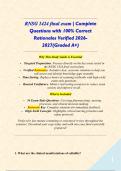
2027(Graded A+)
Why This Study Guide is Essential
• Targeted Preparation: Focuses directly on the key areas tested in
the RNSG 1424 final curriculum.
• Verified Rationales: Includes clear, accurate solutions to help you
self-assess and identify knowledge gaps instantly.
• Time-Saving: Replaces hours of scanning textbooks with high-yield,
exam-style questions.
• Boosted Confidence: Mimics real testing scenarios to reduce exam
anxiety and improve recall.
What is Included
• 54 Exam-Style Questions: Covering pharmacology, nursing
processes, and clinical decision-making.
• Rationale Key: Complete solutions for immediate feedback.
• High-Yield Concepts: Highlights critical nursing priorities and
safety protocols.
Perfect for last-minute cramming or structured review throughout the
semester. Download your copy today and walk into your final exam fully
prepared!
1. What are the clinical manifestations of cellulitis?
1
, Rationale: Erythema, pain, edema, and warmth at the site of skin disruption.
Rationale: Cellulitis is an acute bacterial infection of the deep dermis and subcutaneous
tissue. The classic signs of localized inflammation (redness, heat, swelling, and pain) occur as
the immune system increases blood flow and sends white blood cells to destroy the invading
pathogens.
2. What are the clinical manifestations of bacterial pneumonia in a
child?
Rationale: Wheezing, yellow sputum, increased respiratory rate (RR), nasal flaring, and
retractions.
Rationale: Bacterial infections cause fluid and exudate (yellow sputum) to fill the alveoli. To
compensate for decreased oxygen exchange, children increase their breathing rate. Signs of
increased respiratory effort and distress include nasal flaring and the use of accessory
muscles (retractions).
3. What makes smoking a high risk for COPD?
Rationale: It irritates goblet cells and mucous glands, causing increased mucus accumulation.
Rationale: Cigarette smoke contains toxins that paralyze the cilia (hair-like structures that
clear airways) and cause hypertrophy of mucus-secreting goblet cells. This leads to chronic
mucus hypersecretion and chronic airway obstruction.
4. What is involved in the prevention of asthma in children?
Rationale: Identifying and avoiding triggers: pets, dust, and mold.
Rationale: Asthma is a chronic inflammatory airway disease hypersensitive to environmental
allergens. Avoiding known triggers prevents the IgE-mediated immune response that leads to
bronchospasms and airway inflammation.
5. What are the precautions for Clostridium difficile (C. diff)?
Rationale: Contact precautions: Gown and gloves.
Rationale: C. diff is highly contagious and spread via the fecal-oral route through bacterial
spores. Healthcare workers must wear gloves and gowns to prevent carrying the spores on
clothes or skin. Hands must be washed with soap and water because alcohol-based sanitizers
do not kill C. diff spores.
6. What are the nursing interventions for phantom limb pain?
Rationale: Administer opioid analgesics.
Rationale: Phantom limb pain is a real, neuropathic pain originating from central nervous
system signaling after an amputation. It should be acknowledged and medicated with
2
Why This Study Guide is Essential
• Targeted Preparation: Focuses directly on the key areas tested in
the RNSG 1424 final curriculum.
• Verified Rationales: Includes clear, accurate solutions to help you
self-assess and identify knowledge gaps instantly.
• Time-Saving: Replaces hours of scanning textbooks with high-yield,
exam-style questions.
• Boosted Confidence: Mimics real testing scenarios to reduce exam
anxiety and improve recall.
What is Included
• 54 Exam-Style Questions: Covering pharmacology, nursing
processes, and clinical decision-making.
• Rationale Key: Complete solutions for immediate feedback.
• High-Yield Concepts: Highlights critical nursing priorities and
safety protocols.
Perfect for last-minute cramming or structured review throughout the
semester. Download your copy today and walk into your final exam fully
prepared!
1. What are the clinical manifestations of cellulitis?
1
, Rationale: Erythema, pain, edema, and warmth at the site of skin disruption.
Rationale: Cellulitis is an acute bacterial infection of the deep dermis and subcutaneous
tissue. The classic signs of localized inflammation (redness, heat, swelling, and pain) occur as
the immune system increases blood flow and sends white blood cells to destroy the invading
pathogens.
2. What are the clinical manifestations of bacterial pneumonia in a
child?
Rationale: Wheezing, yellow sputum, increased respiratory rate (RR), nasal flaring, and
retractions.
Rationale: Bacterial infections cause fluid and exudate (yellow sputum) to fill the alveoli. To
compensate for decreased oxygen exchange, children increase their breathing rate. Signs of
increased respiratory effort and distress include nasal flaring and the use of accessory
muscles (retractions).
3. What makes smoking a high risk for COPD?
Rationale: It irritates goblet cells and mucous glands, causing increased mucus accumulation.
Rationale: Cigarette smoke contains toxins that paralyze the cilia (hair-like structures that
clear airways) and cause hypertrophy of mucus-secreting goblet cells. This leads to chronic
mucus hypersecretion and chronic airway obstruction.
4. What is involved in the prevention of asthma in children?
Rationale: Identifying and avoiding triggers: pets, dust, and mold.
Rationale: Asthma is a chronic inflammatory airway disease hypersensitive to environmental
allergens. Avoiding known triggers prevents the IgE-mediated immune response that leads to
bronchospasms and airway inflammation.
5. What are the precautions for Clostridium difficile (C. diff)?
Rationale: Contact precautions: Gown and gloves.
Rationale: C. diff is highly contagious and spread via the fecal-oral route through bacterial
spores. Healthcare workers must wear gloves and gowns to prevent carrying the spores on
clothes or skin. Hands must be washed with soap and water because alcohol-based sanitizers
do not kill C. diff spores.
6. What are the nursing interventions for phantom limb pain?
Rationale: Administer opioid analgesics.
Rationale: Phantom limb pain is a real, neuropathic pain originating from central nervous
system signaling after an amputation. It should be acknowledged and medicated with
2