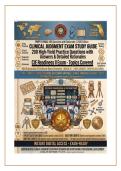
,COMSAE Phase 1 Form 115 Real Exam 2026
200 High-Yield Practice Questions with Answers & Detailed Rationales
SECTION 1: CARDIOVASCULAR SYSTEM (Questions 1-35)
Question 1
A 65-year-old male with a history of hypertension and type 2 diabetes presents with substernal chest
pressure radiating to the left arm, associated with diaphoresis and nausea for the past 2 hours. ECG
shows ST-segment elevation in leads V1-V4. Which of the following is the most appropriate immediate
intervention?
A) Administer aspirin and sublingual nitroglycerin
B) Immediate reperfusion therapy (PCI or fibrinolysis)
C) Obtain a troponin level before treatment
D) Start intravenous beta-blocker
E) Administer oxygen at 4 L/min
Answer: B) Immediate reperfusion therapy (PCI or fibrinolysis)
Rationale: ST-segment elevation myocardial infarction (STEMI) requires immediate reperfusion
therapy, either percutaneous coronary intervention (PCI) or fibrinolysis, to restore blood flow to the
ischemic myocardium. "Time is muscle"—delays increase mortality. Aspirin and nitroglycerin are
temporizing measures but not definitive treatment. Beta-blockers are not first-line in acute STEMI.
Question 2
A 68-year-old male with chronic atrial fibrillation on warfarin presents with acute-onset severe left leg
pain, pallor, and pulselessness. His INR is 2.5. What is the definitive management?
A) Intravenous heparin bolus
B) Catheter-directed thrombolysis
C) Surgical embolectomy
D) Increase warfarin dose
E) Aspirin and clopidogrel
Answer: C) Surgical embolectomy
Rationale: Acute limb ischemia from cardioembolism requires emergent surgical embolectomy to
restore perfusion. The presence of a pulseless, pale, painful limb indicates a surgical emergency, as delay
leads to irreversible ischemia and potential limb loss.
,Question 3
A 65-year-old male presents with acute onset of severe, tearing chest pain radiating to the back. Blood
pressure is 160/100 mmHg in the right arm and 110/70 mmHg in the left arm. What is the most
appropriate diagnostic test?
A) CT angiography of the chest
B) Transthoracic echocardiogram
C) Chest X-ray
D) ECG
E) MRI of the chest
Answer: A) CT angiography of the chest
Rationale: This presentation—acute tearing chest pain radiating to the back with pulse differential—is
classic for aortic dissection. CT angiography is the definitive imaging modality, providing rapid
assessment of the aorta and branch vessels.
Question 4
What ECG finding is characteristic of hyperkalemia?
A) Flattened T waves
B) Peaked, tented T waves
C) Prolonged QT interval
D) U waves
E) ST-segment depression
Answer: B) Peaked, tented T waves
Rationale: Hyperkalemia produces peaked ("tented") T waves on ECG, which are an early and
characteristic finding. Hypokalemia causes flattened T waves and U waves. Hypercalcemia shortens the
QT interval, while hypocalcemia prolongs it.
Question 5
A 72-year-old male with heart failure with reduced ejection fraction (HFrEF) is on carvedilol, lisinopril,
spironolactone, and furosemide. He presents with a serum potassium of 5.9 mEq/L. Which medication is
most likely responsible?
A) Furosemide
B) Lisinopril
C) Carvedilol
D) Spironolactone
E) Digoxin
Answer: D) Spironolactone
, Rationale: Spironolactone is a potassium-sparing diuretic and a common cause of hyperkalemia,
especially when combined with an ACE inhibitor. Furosemide causes hypokalemia. Carvedilol does not
significantly affect potassium levels.
Question 6
A patient on warfarin has an INR of 10.0 without bleeding. What is the best management?
A) Give vitamin K orally and hold warfarin
B) Give IV vitamin K and prothrombin complex concentrate
C) Continue warfarin and recheck INR
D) Administer fresh frozen plasma
E) Administer vitamin K and restart warfarin
Answer: A) Give vitamin K orally and hold warfarin
Rationale: For a very high INR without bleeding, the appropriate management is to hold warfarin and
administer oral vitamin K. IV vitamin K and prothrombin complex concentrate are reserved for patients
with active bleeding.
Question 7
A patient is on warfarin and has an INR of 10.0 with active bleeding. What is the best management?
A) Give vitamin K orally and hold warfarin
B) Give IV vitamin K and prothrombin complex concentrate
C) Continue warfarin and recheck INR
D) Administer fresh frozen plasma
E) Administer vitamin K only
Answer: B) Give IV vitamin K and prothrombin complex concentrate
Rationale: For patients with elevated INR and active bleeding, the appropriate management is to
administer IV vitamin K and prothrombin complex concentrate (PCC) or fresh frozen plasma. This
rapidly reverses anticoagulation and controls bleeding.
Question 8
A patient with known coronary artery disease presents with unstable angina. What is the most
appropriate initial medical management?
A) Aspirin only
B) Nitroglycerin only
C) Aspirin, nitroglycerin, and heparin
200 High-Yield Practice Questions with Answers & Detailed Rationales
SECTION 1: CARDIOVASCULAR SYSTEM (Questions 1-35)
Question 1
A 65-year-old male with a history of hypertension and type 2 diabetes presents with substernal chest
pressure radiating to the left arm, associated with diaphoresis and nausea for the past 2 hours. ECG
shows ST-segment elevation in leads V1-V4. Which of the following is the most appropriate immediate
intervention?
A) Administer aspirin and sublingual nitroglycerin
B) Immediate reperfusion therapy (PCI or fibrinolysis)
C) Obtain a troponin level before treatment
D) Start intravenous beta-blocker
E) Administer oxygen at 4 L/min
Answer: B) Immediate reperfusion therapy (PCI or fibrinolysis)
Rationale: ST-segment elevation myocardial infarction (STEMI) requires immediate reperfusion
therapy, either percutaneous coronary intervention (PCI) or fibrinolysis, to restore blood flow to the
ischemic myocardium. "Time is muscle"—delays increase mortality. Aspirin and nitroglycerin are
temporizing measures but not definitive treatment. Beta-blockers are not first-line in acute STEMI.
Question 2
A 68-year-old male with chronic atrial fibrillation on warfarin presents with acute-onset severe left leg
pain, pallor, and pulselessness. His INR is 2.5. What is the definitive management?
A) Intravenous heparin bolus
B) Catheter-directed thrombolysis
C) Surgical embolectomy
D) Increase warfarin dose
E) Aspirin and clopidogrel
Answer: C) Surgical embolectomy
Rationale: Acute limb ischemia from cardioembolism requires emergent surgical embolectomy to
restore perfusion. The presence of a pulseless, pale, painful limb indicates a surgical emergency, as delay
leads to irreversible ischemia and potential limb loss.
,Question 3
A 65-year-old male presents with acute onset of severe, tearing chest pain radiating to the back. Blood
pressure is 160/100 mmHg in the right arm and 110/70 mmHg in the left arm. What is the most
appropriate diagnostic test?
A) CT angiography of the chest
B) Transthoracic echocardiogram
C) Chest X-ray
D) ECG
E) MRI of the chest
Answer: A) CT angiography of the chest
Rationale: This presentation—acute tearing chest pain radiating to the back with pulse differential—is
classic for aortic dissection. CT angiography is the definitive imaging modality, providing rapid
assessment of the aorta and branch vessels.
Question 4
What ECG finding is characteristic of hyperkalemia?
A) Flattened T waves
B) Peaked, tented T waves
C) Prolonged QT interval
D) U waves
E) ST-segment depression
Answer: B) Peaked, tented T waves
Rationale: Hyperkalemia produces peaked ("tented") T waves on ECG, which are an early and
characteristic finding. Hypokalemia causes flattened T waves and U waves. Hypercalcemia shortens the
QT interval, while hypocalcemia prolongs it.
Question 5
A 72-year-old male with heart failure with reduced ejection fraction (HFrEF) is on carvedilol, lisinopril,
spironolactone, and furosemide. He presents with a serum potassium of 5.9 mEq/L. Which medication is
most likely responsible?
A) Furosemide
B) Lisinopril
C) Carvedilol
D) Spironolactone
E) Digoxin
Answer: D) Spironolactone
, Rationale: Spironolactone is a potassium-sparing diuretic and a common cause of hyperkalemia,
especially when combined with an ACE inhibitor. Furosemide causes hypokalemia. Carvedilol does not
significantly affect potassium levels.
Question 6
A patient on warfarin has an INR of 10.0 without bleeding. What is the best management?
A) Give vitamin K orally and hold warfarin
B) Give IV vitamin K and prothrombin complex concentrate
C) Continue warfarin and recheck INR
D) Administer fresh frozen plasma
E) Administer vitamin K and restart warfarin
Answer: A) Give vitamin K orally and hold warfarin
Rationale: For a very high INR without bleeding, the appropriate management is to hold warfarin and
administer oral vitamin K. IV vitamin K and prothrombin complex concentrate are reserved for patients
with active bleeding.
Question 7
A patient is on warfarin and has an INR of 10.0 with active bleeding. What is the best management?
A) Give vitamin K orally and hold warfarin
B) Give IV vitamin K and prothrombin complex concentrate
C) Continue warfarin and recheck INR
D) Administer fresh frozen plasma
E) Administer vitamin K only
Answer: B) Give IV vitamin K and prothrombin complex concentrate
Rationale: For patients with elevated INR and active bleeding, the appropriate management is to
administer IV vitamin K and prothrombin complex concentrate (PCC) or fresh frozen plasma. This
rapidly reverses anticoagulation and controls bleeding.
Question 8
A patient with known coronary artery disease presents with unstable angina. What is the most
appropriate initial medical management?
A) Aspirin only
B) Nitroglycerin only
C) Aspirin, nitroglycerin, and heparin