
PATH370 QUIZ 1
PATH370: NAKSHBANDI QUIZ 1
Study online at https://quizlet.com/_jrzamd
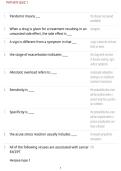
1. Pandemic means ___ the disease has spread
worldwide
2. When a drug is given for a treatment resulting in an iatrogenic
unwanted side effect, the side effect is ___
3. A sign is different from a symptom in that ___ a sign is what the clinician
finds on exam
4. the stage of exacerbation indicates ____ the stage with increase
in disease severity, signs
and/or symptoms
5. Allostatic overload refers to ____ inadequate adaptation
leading to an inability to
maintain homeostasis
6. Sensitivity is ____ the probability that a test
will be positive when a
person truly has a particu-
lar condition
7. Specificity is ____ the probability that a test
will be negative when a
person actually does not
have a disease
8. the acute stress reaction usually includes ____ increased sympathetic
stimulation
9. All of the following viruses are associated with cancer HIV
EXCEPT
Herpes-type 1
1/6
1
, PATH370 QUIZ 1
PATH370: NAKSHBANDI QUIZ 1
Study online at https://quizlet.com/_jrzamd
Human T-cell leukemia virus
Epstein Barr virus
HIV
10. Which of the following is usually NOT released in re- insulin
sponse to stress?
insulin
norepinephrine
cortisol
epinephrine
11. aging will lead to all of the above
decline in cell proliferation ability
decline in cell reparative capacity
inability to adapt to environmental demands
all of the above
12. Gas gangrene is ____ the necrotic tissue infect-
ed by anaerobic bacteria
Clostridium
13. Which of the following is the most common type of coagulative
necrosis?
14. A decrease in cell size, when is NOT used, it is known atrophy
as
15. Endemic means ____ the disease is native to the
local region
16. Norepinephrine and epinephrine will cause all of the the dilation of cardiovas-
following EXCEPT cular smooth muscles
2/6
2
PATH370: NAKSHBANDI QUIZ 1
Study online at https://quizlet.com/_jrzamd
1. Pandemic means ___ the disease has spread
worldwide
2. When a drug is given for a treatment resulting in an iatrogenic
unwanted side effect, the side effect is ___
3. A sign is different from a symptom in that ___ a sign is what the clinician
finds on exam
4. the stage of exacerbation indicates ____ the stage with increase
in disease severity, signs
and/or symptoms
5. Allostatic overload refers to ____ inadequate adaptation
leading to an inability to
maintain homeostasis
6. Sensitivity is ____ the probability that a test
will be positive when a
person truly has a particu-
lar condition
7. Specificity is ____ the probability that a test
will be negative when a
person actually does not
have a disease
8. the acute stress reaction usually includes ____ increased sympathetic
stimulation
9. All of the following viruses are associated with cancer HIV
EXCEPT
Herpes-type 1
1/6
1
, PATH370 QUIZ 1
PATH370: NAKSHBANDI QUIZ 1
Study online at https://quizlet.com/_jrzamd
Human T-cell leukemia virus
Epstein Barr virus
HIV
10. Which of the following is usually NOT released in re- insulin
sponse to stress?
insulin
norepinephrine
cortisol
epinephrine
11. aging will lead to all of the above
decline in cell proliferation ability
decline in cell reparative capacity
inability to adapt to environmental demands
all of the above
12. Gas gangrene is ____ the necrotic tissue infect-
ed by anaerobic bacteria
Clostridium
13. Which of the following is the most common type of coagulative
necrosis?
14. A decrease in cell size, when is NOT used, it is known atrophy
as
15. Endemic means ____ the disease is native to the
local region
16. Norepinephrine and epinephrine will cause all of the the dilation of cardiovas-
following EXCEPT cular smooth muscles
2/6
2


