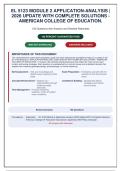
EL 5123 MODULE 2 APPLICATION-ANALYSIS |
2026 UPDATE WITH COMPLETE SOLUTIONS -
AMERICAN COLLEGE OF EDUCATION.
150 Questions with Answers and Detailed Rationales
100 PERCENT GUARANTEED PASS
INSTANT DOWNLOAD ANSWERS INCLUDED
IMPORTANCE OF THIS DOCUMENT
This comprehensive examination preparation guide has been meticulously developed to help you succeed in the
EL 5123 MODULE 2 APPLICATION-ANALYSIS | 2026 UPDATE WITH COMPLETE SOLUTIONS - AMERICAN
COLLEGE OF EDUCATION.. It contains 150 carefully selected questions that reflect the most current exam
content and testing strategies. Each question is accompanied by a correct answer and a detailed rationale that
explains the underlying pathophysiology, pharmacology, or clinical reasoning.
Self-Assessment – Test your knowledge and Exam Preparation – Familiarize yourself with the
identify areas requiring further question format and content
study areas
Concept Reinforcement – Deepen your Confidence Building – Develop test-taking
understanding through strategies and reduce
evidence-based exam anxiety
rationales
Time Management – Practice answering
questions under simulated
exam conditions
Review Summary 150 Questions
Foundations - Application - EL 5123 Module 2 Application-analysis 2026 Update WITH Complete Solutions
- American College OF Education Educational Leadership AND Policy Graduate
All answers with rationales
,Table of Contents
Content Area Questions Key Topics
Leadership AND Ethical 1-25 School, Teacher, District, Students, Approach
Decision-making
Curriculum Design AND 26-50 Teacher, School, Student, Implementing, Curriculum
Development
Instructional Strategies AND 51-75 School, Approach, Framework, Critical, Design
BEST Practices
Assessment AND Evaluation 76-100 Student, School, Teacher, Learning, System
Methods
Educational Technology 101-125 School, Student, District, Study, Researcher
Integration
Diversity Equity AND 126-150 Teacher, School, Student, District, Reading
Inclusion IN Education
TOTAL 150 All questions include answers and detailed rationales
,Section A - Leadership AND Ethical Decision-making
Q1.
A district adopts a transformational leadership model to improve teacher morale and
student outcomes. Which combination of leadership behaviors is most critical for
sustainable change in a low-performing school?
A. Setting clear expectations and monitoring B. Providing intellectual stimulation and
compliance individualized support
C. Focusing exclusively on instructional D. Delegating all decisions to teacher teams
leadership
Correct: B - Providing intellectual stimulation and individualized support
Rationale:Transformational leadership emphasizes intellectual stimulation and individualized
support to foster intrinsic motivation and capacity building. Compliance monitoring and
exclusive instructional focus are more aligned with transactional or instructional leadership,
while full delegation lacks strategic direction.
Q2.
A principal disaggregates student achievement data by ethnicity, socioeconomic status,
and English learner classification. Which additional analysis is essential to identify
inequitable access to advanced coursework?
A. Comparing suspension rates across B. Examining enrollment patterns in honors
subgroups and AP classes
C. Calculating average class size per D. Reviewing teacher attendance records
teacher
Correct: B - Examining enrollment patterns in honors and AP classes
Rationale:Enrollment patterns in advanced coursework directly reveal access gaps.
Suspension rates, class size, and teacher attendance are important but do not specifically
address academic opportunity inequities.
Q3.
When a school implements a new technology initiative, which change management
strategy best addresses teacher resistance stemming from fear of obsolescence?
A. Mandating use through evaluative B. Providing ongoing professional
measures development and coaching
C. Offering financial incentives for early D. Phasing out non-digital resources
adopters immediately
Page 3
, Section A - Leadership AND Ethical Decision-making
Correct: B - Providing ongoing professional development and coaching
Rationale:Ongoing professional development and coaching build self-efficacy and reduce
fear. Mandates and incentives may produce compliance but not commitment, and abrupt
removal of resources increases anxiety.
Q4.
A school district is considering a weighted student funding formula to address resource
inequities. Which outcome would best demonstrate the effectiveness of this policy?
A. Equal per-pupil spending across all B. Improved academic growth among
schools historically underserved subgroups
C. Increased overall district graduation rate D. Reduction in administrative overhead
Correct: B - Improved academic growth among historically underserved subgroups
Rationale:Weighted funding aims to allocate more resources to students with greater needs;
therefore, improved outcomes for targeted subgroups validates effectiveness. Equal spending
may not address inequity, and aggregate gains could mask subgroup gaps.
Q5.
A principal discovers that a teacher's grading practices disproportionately penalize
students from certain cultural backgrounds. Which ethical framework should guide the
principal's immediate response?
A. Utilitarian: weigh consequences for the B. Deontological: apply universal rules of
majority of students grading fairness
C. Care ethics: prioritize relationships and D. Virtue ethics: model integrity and fairness
individual student needs
Correct: D - Virtue ethics: model integrity and fairness
Rationale:Virtue ethics focuses on the leader's character and commitment to fairness,
prompting proactive correction. Utilitarian may overlook minority harm, deontological may be
rigid, and care ethics may not address systemic bias directly.
Q6.
A school improvement plan includes goals to increase parent engagement. Which
strategy is most likely to foster authentic partnership with diverse families?
A. Holding evening events with translated B. Creating a parent advisory council with
materials decision-making power
C. Requiring parent signatures on D. Offering childcare during school
homework logs assemblies
Page 4
2026 UPDATE WITH COMPLETE SOLUTIONS -
AMERICAN COLLEGE OF EDUCATION.
150 Questions with Answers and Detailed Rationales
100 PERCENT GUARANTEED PASS
INSTANT DOWNLOAD ANSWERS INCLUDED
IMPORTANCE OF THIS DOCUMENT
This comprehensive examination preparation guide has been meticulously developed to help you succeed in the
EL 5123 MODULE 2 APPLICATION-ANALYSIS | 2026 UPDATE WITH COMPLETE SOLUTIONS - AMERICAN
COLLEGE OF EDUCATION.. It contains 150 carefully selected questions that reflect the most current exam
content and testing strategies. Each question is accompanied by a correct answer and a detailed rationale that
explains the underlying pathophysiology, pharmacology, or clinical reasoning.
Self-Assessment – Test your knowledge and Exam Preparation – Familiarize yourself with the
identify areas requiring further question format and content
study areas
Concept Reinforcement – Deepen your Confidence Building – Develop test-taking
understanding through strategies and reduce
evidence-based exam anxiety
rationales
Time Management – Practice answering
questions under simulated
exam conditions
Review Summary 150 Questions
Foundations - Application - EL 5123 Module 2 Application-analysis 2026 Update WITH Complete Solutions
- American College OF Education Educational Leadership AND Policy Graduate
All answers with rationales
,Table of Contents
Content Area Questions Key Topics
Leadership AND Ethical 1-25 School, Teacher, District, Students, Approach
Decision-making
Curriculum Design AND 26-50 Teacher, School, Student, Implementing, Curriculum
Development
Instructional Strategies AND 51-75 School, Approach, Framework, Critical, Design
BEST Practices
Assessment AND Evaluation 76-100 Student, School, Teacher, Learning, System
Methods
Educational Technology 101-125 School, Student, District, Study, Researcher
Integration
Diversity Equity AND 126-150 Teacher, School, Student, District, Reading
Inclusion IN Education
TOTAL 150 All questions include answers and detailed rationales
,Section A - Leadership AND Ethical Decision-making
Q1.
A district adopts a transformational leadership model to improve teacher morale and
student outcomes. Which combination of leadership behaviors is most critical for
sustainable change in a low-performing school?
A. Setting clear expectations and monitoring B. Providing intellectual stimulation and
compliance individualized support
C. Focusing exclusively on instructional D. Delegating all decisions to teacher teams
leadership
Correct: B - Providing intellectual stimulation and individualized support
Rationale:Transformational leadership emphasizes intellectual stimulation and individualized
support to foster intrinsic motivation and capacity building. Compliance monitoring and
exclusive instructional focus are more aligned with transactional or instructional leadership,
while full delegation lacks strategic direction.
Q2.
A principal disaggregates student achievement data by ethnicity, socioeconomic status,
and English learner classification. Which additional analysis is essential to identify
inequitable access to advanced coursework?
A. Comparing suspension rates across B. Examining enrollment patterns in honors
subgroups and AP classes
C. Calculating average class size per D. Reviewing teacher attendance records
teacher
Correct: B - Examining enrollment patterns in honors and AP classes
Rationale:Enrollment patterns in advanced coursework directly reveal access gaps.
Suspension rates, class size, and teacher attendance are important but do not specifically
address academic opportunity inequities.
Q3.
When a school implements a new technology initiative, which change management
strategy best addresses teacher resistance stemming from fear of obsolescence?
A. Mandating use through evaluative B. Providing ongoing professional
measures development and coaching
C. Offering financial incentives for early D. Phasing out non-digital resources
adopters immediately
Page 3
, Section A - Leadership AND Ethical Decision-making
Correct: B - Providing ongoing professional development and coaching
Rationale:Ongoing professional development and coaching build self-efficacy and reduce
fear. Mandates and incentives may produce compliance but not commitment, and abrupt
removal of resources increases anxiety.
Q4.
A school district is considering a weighted student funding formula to address resource
inequities. Which outcome would best demonstrate the effectiveness of this policy?
A. Equal per-pupil spending across all B. Improved academic growth among
schools historically underserved subgroups
C. Increased overall district graduation rate D. Reduction in administrative overhead
Correct: B - Improved academic growth among historically underserved subgroups
Rationale:Weighted funding aims to allocate more resources to students with greater needs;
therefore, improved outcomes for targeted subgroups validates effectiveness. Equal spending
may not address inequity, and aggregate gains could mask subgroup gaps.
Q5.
A principal discovers that a teacher's grading practices disproportionately penalize
students from certain cultural backgrounds. Which ethical framework should guide the
principal's immediate response?
A. Utilitarian: weigh consequences for the B. Deontological: apply universal rules of
majority of students grading fairness
C. Care ethics: prioritize relationships and D. Virtue ethics: model integrity and fairness
individual student needs
Correct: D - Virtue ethics: model integrity and fairness
Rationale:Virtue ethics focuses on the leader's character and commitment to fairness,
prompting proactive correction. Utilitarian may overlook minority harm, deontological may be
rigid, and care ethics may not address systemic bias directly.
Q6.
A school improvement plan includes goals to increase parent engagement. Which
strategy is most likely to foster authentic partnership with diverse families?
A. Holding evening events with translated B. Creating a parent advisory council with
materials decision-making power
C. Requiring parent signatures on D. Offering childcare during school
homework logs assemblies
Page 4