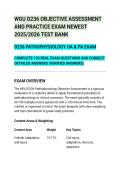
WGU D236 OBJECTIVE ASSESSMENT
AND PRACTICE EXAM NEWEST
2025/2026 TEST BANK
D236 PATHOPHYSIOLOGY OA & PA EXAM
COMPLETE 150 REAL EXAM QUESTIONS AND CORRECT
DETAILED ANSWERS (VERIFIED ANSWERS)
EXAM OVERVIEW
The WGU D236 Pathophysiology Objective Assessment is a rigorous
evaluation of a student's ability to apply foundational principles of
pathophysiology to clinical scenarios. The exam typically consists of
60-100 multiple-choice questions with a 120-minute time limit. The
content is organized to mirror the exam blueprint with clear weighting
and topic distribution to guide study priorities.
Content Areas & Weighting:
Content Area Weight Key Topics
Cellular Adaptation 15-17% Cell injury,
and Injury adaptation, necrosis,
apoptosis
,Inflammation and 15-20% Acute/chronic
Tissue Repair inflammation, wound
healing
Alterations in 10-15% Hypersensitivity
Immunity and reactions,
Infection immunodeficiencies
Fluid, Electrolyte, 10-15% Acidosis, alkalosis,
and Acid-Base compensatory
Balance mechanisms
Genetic and 10-15% Single-gene
Developmental disorders,
Disorders chromosomal
abnormalities
Neoplasia and 15-17% Carcinogenesis,
Cancer Biology tumor classification,
metastasis
Systemic 15-20% Cardiovascular,
Pathophysiology respiratory, renal,
neurological,
endocrine
SECTION 1: CELLULAR ADAPTATION & INJURY
(Questions 1-25)
,Q1. What is the primary mechanism by which cells adapt to chronic
hypoxia in tissues?
A) Atrophy
B) Hypertrophy
C) Hyperplasia
D) Metaplasia
Answer: A) Atrophy
Rationale: Atrophy involves a decrease in cell size and function due to
reduced nutrient or oxygen supply, such as in chronic hypoxia. This
reversible adaptation conserves energy to maintain cell viability.
Hypertrophy increases cell size for workload, hyperplasia increases cell
number, and metaplasia replaces one cell type with another.
Q2. In cellular injury, which process directly results from ATP depletion
leading to sodium-potassium pump failure?
A) Apoptosis
B) Cellular swelling
C) Necrosis
D) Autophagy
Answer: B) Cellular swelling
Rationale: ATP depletion impairs the Na+/K+ ATPase pump, causing
sodium influx and water retention, leading to cellular swelling (edema).
Apoptosis is programmed cell death, necrosis is uncontrolled cell death,
and autophagy recycles cellular components, none of which directly
result from pump failure.
, Q3. Which type of necrosis is most commonly associated with
bacterial infections like tuberculosis?
A) Coagulative necrosis
B) Liquefactive necrosis
C) Caseous necrosis
D) Fat necrosis
Answer: C) Caseous necrosis
Rationale: Caseous necrosis, characterized by a cheese-like appearance,
is typical in granulomatous infections like tuberculosis due to
macrophage activity. Coagulative necrosis is seen in ischemic tissues,
liquefactive in brain or abscesses, and fat necrosis in pancreatic or
breast tissue injury.
Q4. Which cellular adaptation is most likely in cardiac muscle
subjected to chronic hypertension?
A) Atrophy
B) Hypertrophy
C) Dysplasia
D) Metaplasia
Answer: B) Hypertrophy
Rationale: Hypertrophy, an increase in cell size, occurs in cardiac muscle
to compensate for increased workload from chronic hypertension.
Atrophy reduces size, dysplasia is abnormal growth, and metaplasia
changes cell type.
AND PRACTICE EXAM NEWEST
2025/2026 TEST BANK
D236 PATHOPHYSIOLOGY OA & PA EXAM
COMPLETE 150 REAL EXAM QUESTIONS AND CORRECT
DETAILED ANSWERS (VERIFIED ANSWERS)
EXAM OVERVIEW
The WGU D236 Pathophysiology Objective Assessment is a rigorous
evaluation of a student's ability to apply foundational principles of
pathophysiology to clinical scenarios. The exam typically consists of
60-100 multiple-choice questions with a 120-minute time limit. The
content is organized to mirror the exam blueprint with clear weighting
and topic distribution to guide study priorities.
Content Areas & Weighting:
Content Area Weight Key Topics
Cellular Adaptation 15-17% Cell injury,
and Injury adaptation, necrosis,
apoptosis
,Inflammation and 15-20% Acute/chronic
Tissue Repair inflammation, wound
healing
Alterations in 10-15% Hypersensitivity
Immunity and reactions,
Infection immunodeficiencies
Fluid, Electrolyte, 10-15% Acidosis, alkalosis,
and Acid-Base compensatory
Balance mechanisms
Genetic and 10-15% Single-gene
Developmental disorders,
Disorders chromosomal
abnormalities
Neoplasia and 15-17% Carcinogenesis,
Cancer Biology tumor classification,
metastasis
Systemic 15-20% Cardiovascular,
Pathophysiology respiratory, renal,
neurological,
endocrine
SECTION 1: CELLULAR ADAPTATION & INJURY
(Questions 1-25)
,Q1. What is the primary mechanism by which cells adapt to chronic
hypoxia in tissues?
A) Atrophy
B) Hypertrophy
C) Hyperplasia
D) Metaplasia
Answer: A) Atrophy
Rationale: Atrophy involves a decrease in cell size and function due to
reduced nutrient or oxygen supply, such as in chronic hypoxia. This
reversible adaptation conserves energy to maintain cell viability.
Hypertrophy increases cell size for workload, hyperplasia increases cell
number, and metaplasia replaces one cell type with another.
Q2. In cellular injury, which process directly results from ATP depletion
leading to sodium-potassium pump failure?
A) Apoptosis
B) Cellular swelling
C) Necrosis
D) Autophagy
Answer: B) Cellular swelling
Rationale: ATP depletion impairs the Na+/K+ ATPase pump, causing
sodium influx and water retention, leading to cellular swelling (edema).
Apoptosis is programmed cell death, necrosis is uncontrolled cell death,
and autophagy recycles cellular components, none of which directly
result from pump failure.
, Q3. Which type of necrosis is most commonly associated with
bacterial infections like tuberculosis?
A) Coagulative necrosis
B) Liquefactive necrosis
C) Caseous necrosis
D) Fat necrosis
Answer: C) Caseous necrosis
Rationale: Caseous necrosis, characterized by a cheese-like appearance,
is typical in granulomatous infections like tuberculosis due to
macrophage activity. Coagulative necrosis is seen in ischemic tissues,
liquefactive in brain or abscesses, and fat necrosis in pancreatic or
breast tissue injury.
Q4. Which cellular adaptation is most likely in cardiac muscle
subjected to chronic hypertension?
A) Atrophy
B) Hypertrophy
C) Dysplasia
D) Metaplasia
Answer: B) Hypertrophy
Rationale: Hypertrophy, an increase in cell size, occurs in cardiac muscle
to compensate for increased workload from chronic hypertension.
Atrophy reduces size, dysplasia is abnormal growth, and metaplasia
changes cell type.