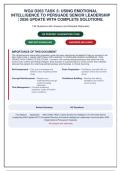
WGU D263 TASK 3: USING EMOTIONAL
INTELLIGENCE TO PERSUADE SENIOR LEADERSHIP
| 2026 UPDATE WITH COMPLETE SOLUTIONS.
140 Questions with Answers and Detailed Rationales
100 PERCENT GUARANTEED PASS
INSTANT DOWNLOAD ANSWERS INCLUDED
IMPORTANCE OF THIS DOCUMENT
This comprehensive examination preparation guide has been meticulously developed to help you succeed in the
WGU D263 TASK 3: USING EMOTIONAL INTELLIGENCE TO PERSUADE SENIOR LEADERSHIP | 2026
UPDATE WITH COMPLETE SOLUTIONS.. It contains 140 carefully selected questions that reflect the most
current exam content and testing strategies. Each question is accompanied by a correct answer and a detailed
rationale that explains the underlying pathophysiology, pharmacology, or clinical reasoning.
Self-Assessment – Test your knowledge and Exam Preparation – Familiarize yourself with the
identify areas requiring further question format and content
study areas
Concept Reinforcement – Deepen your Confidence Building – Develop test-taking
understanding through strategies and reduce
evidence-based exam anxiety
rationales
Time Management – Practice answering
questions under simulated
exam conditions
Review Summary 140 Questions
Foundations - Application - WGU D263 TASK 3 Using Emotional Intelligence TO Persuade Senior
Leadership 2026 Update WITH Complete Solutions Emotional Intelligence Leadership Communication AND
Organizational Persuasion Graduate
All answers with rationales
,Table of Contents
Content Area Questions Key Topics
Emotional Intelligence 1-24 Senior, Emotional, Intelligence, Leader, Effective
Fundamentals
Persuasion AND Influence 25-48 Emotional, Intelligence, Senior, Proposal, Presentation
Strategies
Communication AND 49-72 Senior, Emotional, Intelligence, Leader, Proposal
Interpersonal Skills
Leadership AND 73-96 Emotional, Intelligence, Senior, Leadership, Persuade
Management Theories
Organizational Behavior AND 97-120 Senior, Emotional, Intelligence, Leader, Demonstrates
Culture
Ethical Decision Making 121-140 Senior, Emotional, Intelligence, Leader, Persuade
TOTAL 140 All questions include answers and detailed rationales
,Section A - Emotional Intelligence Fundamentals
Q1.
When presenting a high-stakes proposal to a senior leadership team known for
data-driven decisions, which combination of emotional intelligence competencies is most
critical to persuade them effectively?
A. Empathy and social awareness to read B. Self-awareness to recognize personal
the room, combined with self-regulation to biases, and relationship management to
manage anxiety build coalitions
C. Empathy to understand their concerns, D. Self-regulation to remain calm under
and social skills to frame data in a scrutiny, and motivation to persist despite
compelling narrative pushback
Correct: C - Empathy to understand their concerns, and social skills to frame data in a
compelling narrative
Rationale:Persuading a data-driven senior team requires both understanding their
perspective (empathy) and tailoring your message to resonate (social skills). Self-awareness
and self-regulation are foundational but less directly persuasive. While building coalitions (B)
is useful, the core of persuasion is connecting emotionally and framing information effectively.
Q2.
A manager notices that a senior leader becomes defensive whenever the manager
proposes changes to a long-standing process. Using the Goleman framework, which
approach best leverages emotional intelligence to overcome this resistance?
A. Acknowledge the leader's expertise and B. Present data that clearly shows the
ask for their input on the proposed change inefficiency of the current process
C. Appeal to the leader's sense of authority D. Wait for the leader to be in a better mood
by framing the change as their idea before bringing up the topic again
Correct: A - Acknowledge the leader's expertise and ask for their input on the proposed
change
Rationale:Acknowledging the leader's expertise and involving them addresses the emotional
root of defensiveness by validating their identity and control. Data (B) may escalate
defensiveness. Framing as their idea (C) is manipulative and unethical. Waiting for a better
mood (D) avoids the issue and doesn't build a solution.
Q3.
In the context of persuading senior leadership, which scenario best illustrates the
application of the 'social awareness' competency as defined by Goleman?
Page 3
, Section A - Emotional Intelligence Fundamentals
A. A manager reads the non-verbal cues of B. A manager controls their frustration when
executives and adjusts the pitch in real time a proposal is rejected
C. A manager clearly articulates the benefits D. A manager motivates their team to
of a proposal to the board support a new initiative
Correct: A - A manager reads the non-verbal cues of executives and adjusts the pitch in
real time
Rationale:Social awareness involves accurately perceiving others' emotions and dynamics.
Reading non-verbal cues (A) is a direct application. Controlling frustration (B) is
self-regulation; articulating benefits (C) is social skill; motivating team (D) is relationship
management.
Q4.
When constructing a persuasive argument for a CEO who values both innovation and risk
mitigation, which emotional intelligence tactic is most effective in the opening of the
presentation?
A. Start with a compelling story that evokes B. Present a clear, data-driven risk analysis
a sense of urgency upfront
C. Acknowledge the CEO's dual priorities D. Highlight how competitors are already
and link the proposal to both adopting similar strategies
Correct: C - Acknowledge the CEO's dual priorities and link the proposal to both
Rationale:Acknowledging the CEO's values builds rapport and shows empathy, making them
receptive. Stories (A) may be engaging but miss the risk angle; data (B) may be dry;
competitor pressure (D) can feel like a threat. Linking to both values addresses the whole
person.
Q5.
Which of the following best exemplifies the use of empathy to overcome resistance from a
senior leader who is concerned about the impact of a proposed reorganization on
employee morale?
A. Presenting a detailed plan for how the B. Sharing data from employee surveys that
reorganization will be communicated to show low morale already exists
employees
C. Acknowledging the leader's concern and D. Emphasizing the long-term benefits of the
proposing a phased rollout with support reorganization for the company's bottom line
systems
Correct: C - Acknowledging the leader's concern and proposing a phased rollout with
support systems
Page 4
INTELLIGENCE TO PERSUADE SENIOR LEADERSHIP
| 2026 UPDATE WITH COMPLETE SOLUTIONS.
140 Questions with Answers and Detailed Rationales
100 PERCENT GUARANTEED PASS
INSTANT DOWNLOAD ANSWERS INCLUDED
IMPORTANCE OF THIS DOCUMENT
This comprehensive examination preparation guide has been meticulously developed to help you succeed in the
WGU D263 TASK 3: USING EMOTIONAL INTELLIGENCE TO PERSUADE SENIOR LEADERSHIP | 2026
UPDATE WITH COMPLETE SOLUTIONS.. It contains 140 carefully selected questions that reflect the most
current exam content and testing strategies. Each question is accompanied by a correct answer and a detailed
rationale that explains the underlying pathophysiology, pharmacology, or clinical reasoning.
Self-Assessment – Test your knowledge and Exam Preparation – Familiarize yourself with the
identify areas requiring further question format and content
study areas
Concept Reinforcement – Deepen your Confidence Building – Develop test-taking
understanding through strategies and reduce
evidence-based exam anxiety
rationales
Time Management – Practice answering
questions under simulated
exam conditions
Review Summary 140 Questions
Foundations - Application - WGU D263 TASK 3 Using Emotional Intelligence TO Persuade Senior
Leadership 2026 Update WITH Complete Solutions Emotional Intelligence Leadership Communication AND
Organizational Persuasion Graduate
All answers with rationales
,Table of Contents
Content Area Questions Key Topics
Emotional Intelligence 1-24 Senior, Emotional, Intelligence, Leader, Effective
Fundamentals
Persuasion AND Influence 25-48 Emotional, Intelligence, Senior, Proposal, Presentation
Strategies
Communication AND 49-72 Senior, Emotional, Intelligence, Leader, Proposal
Interpersonal Skills
Leadership AND 73-96 Emotional, Intelligence, Senior, Leadership, Persuade
Management Theories
Organizational Behavior AND 97-120 Senior, Emotional, Intelligence, Leader, Demonstrates
Culture
Ethical Decision Making 121-140 Senior, Emotional, Intelligence, Leader, Persuade
TOTAL 140 All questions include answers and detailed rationales
,Section A - Emotional Intelligence Fundamentals
Q1.
When presenting a high-stakes proposal to a senior leadership team known for
data-driven decisions, which combination of emotional intelligence competencies is most
critical to persuade them effectively?
A. Empathy and social awareness to read B. Self-awareness to recognize personal
the room, combined with self-regulation to biases, and relationship management to
manage anxiety build coalitions
C. Empathy to understand their concerns, D. Self-regulation to remain calm under
and social skills to frame data in a scrutiny, and motivation to persist despite
compelling narrative pushback
Correct: C - Empathy to understand their concerns, and social skills to frame data in a
compelling narrative
Rationale:Persuading a data-driven senior team requires both understanding their
perspective (empathy) and tailoring your message to resonate (social skills). Self-awareness
and self-regulation are foundational but less directly persuasive. While building coalitions (B)
is useful, the core of persuasion is connecting emotionally and framing information effectively.
Q2.
A manager notices that a senior leader becomes defensive whenever the manager
proposes changes to a long-standing process. Using the Goleman framework, which
approach best leverages emotional intelligence to overcome this resistance?
A. Acknowledge the leader's expertise and B. Present data that clearly shows the
ask for their input on the proposed change inefficiency of the current process
C. Appeal to the leader's sense of authority D. Wait for the leader to be in a better mood
by framing the change as their idea before bringing up the topic again
Correct: A - Acknowledge the leader's expertise and ask for their input on the proposed
change
Rationale:Acknowledging the leader's expertise and involving them addresses the emotional
root of defensiveness by validating their identity and control. Data (B) may escalate
defensiveness. Framing as their idea (C) is manipulative and unethical. Waiting for a better
mood (D) avoids the issue and doesn't build a solution.
Q3.
In the context of persuading senior leadership, which scenario best illustrates the
application of the 'social awareness' competency as defined by Goleman?
Page 3
, Section A - Emotional Intelligence Fundamentals
A. A manager reads the non-verbal cues of B. A manager controls their frustration when
executives and adjusts the pitch in real time a proposal is rejected
C. A manager clearly articulates the benefits D. A manager motivates their team to
of a proposal to the board support a new initiative
Correct: A - A manager reads the non-verbal cues of executives and adjusts the pitch in
real time
Rationale:Social awareness involves accurately perceiving others' emotions and dynamics.
Reading non-verbal cues (A) is a direct application. Controlling frustration (B) is
self-regulation; articulating benefits (C) is social skill; motivating team (D) is relationship
management.
Q4.
When constructing a persuasive argument for a CEO who values both innovation and risk
mitigation, which emotional intelligence tactic is most effective in the opening of the
presentation?
A. Start with a compelling story that evokes B. Present a clear, data-driven risk analysis
a sense of urgency upfront
C. Acknowledge the CEO's dual priorities D. Highlight how competitors are already
and link the proposal to both adopting similar strategies
Correct: C - Acknowledge the CEO's dual priorities and link the proposal to both
Rationale:Acknowledging the CEO's values builds rapport and shows empathy, making them
receptive. Stories (A) may be engaging but miss the risk angle; data (B) may be dry;
competitor pressure (D) can feel like a threat. Linking to both values addresses the whole
person.
Q5.
Which of the following best exemplifies the use of empathy to overcome resistance from a
senior leader who is concerned about the impact of a proposed reorganization on
employee morale?
A. Presenting a detailed plan for how the B. Sharing data from employee surveys that
reorganization will be communicated to show low morale already exists
employees
C. Acknowledging the leader's concern and D. Emphasizing the long-term benefits of the
proposing a phased rollout with support reorganization for the company's bottom line
systems
Correct: C - Acknowledging the leader's concern and proposing a phased rollout with
support systems
Page 4