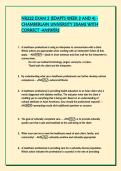
NR222 EXAM 2 (EDAPTS WEEK 3 AND 4) -
CHAMBERLAIN UNIVERSITY EXAMS WITH
CORRECT -ANSWERS
1. A healthcare professional is using an interpreter to communicate with a client.
Which actions are appropriate when working with an interpreter? Select all that
apply. - -ANS☑️☑️--- Speak in short sentences and then wait for the interpreter to
convey them.
- Do not use medical terminology, jargon, acronyms, or jokes.
- Thank both the client and the interpreter.
2. By understanding what can a healthcare professionals can further develop cultural
competence. - -ANS☑️☑️--cultural attributes
3. A healthcare professional is providing health education to an Asian client who is
newly diagnosed with diabetes mellitus. The educator notes that the client is
nodding yes to everything that is being said. Based on an understanding of
cultural attributes in Asian Americans, how should the professional respond? - -
ANS☑️☑️--prompting would elicit additional questions or concerns
4. The goal of culturally competent care.. - -ANS☑️☑️--is to provide culturally
specific care that is safe and beneficial to the well-being of the client
5. What must care be to meet the healthcare needs of each client, family, and
community? - -ANS☑️☑️--culturally sensitive and culturally appropriate
6. A healthcare professional is providing care for a culturally diverse population.
Which action indicates the professional is successful in the role of providing
, culturally competent care? - -ANS☑️☑️--provides care that fits the person's life
patterns, values, and system of meaning.
7. A healthcare professional is practicing cultural competence to improve care.
Which step should the professional take first? - -ANS☑️☑️--Become more aware
of one's biases and attitudes about human behavior.
8. Health concerns of African Americans? - -ANS☑️☑️--cardiovascular disease,
hypertension, sickle cell disease, diabetes mellitus, and lactose intolerance
9. Health concerns of American Indians/Alaska Natives? - -ANS☑️☑️--alcoholism,
tuberculosis, accidents, diabetes mellitus, and heart disease
10. Health concerns of Arab Americans? - -ANS☑️☑️--sickle cell disease, thalassemia,
cardiovascular disease, and cancer
11. Health concerns of Asian/Pacific Islanders? - -ANS☑️☑️--hypertension, cancer,
diabetes mellitus, accidents, and lactose intolerance
12. Health concerns of Latinos Americans? - -ANS☑️☑️--heart disease, cancer,
diabetes mellitus, accidents, and lactose intolerance
13. Health concerns of North European Americans? - -ANS☑️☑️--cardiovascular
disease, cancer, and diabetes mellitus
14. Culture - -ANS☑️☑️--Learned and shared beliefs, values, norms, and traditions of
a particular group, which guide thinking, decision making, and actions.
,15. Implicit Bias (also called Unconscious Bias) - -ANS☑️☑️--A bias we are unaware of
and that happens outside of our control, which is influenced by our personal
background, cultural environment, and personal experiences. For example,
activities like driving, talking, and cleaning use implicit bias. Implicit biases are
prejudices and stereotypes that we act upon without intending to do so. This type
of thinking requires little effort but is often prone to error.
16. Explicit Bias - -ANS☑️☑️--A bias that we are aware is present and are responsible
for; we must recognize and acknowledge our actions as they impact behavior,
decisions, and patient-centered care provided. This type of thinking is slow,
logical, effortful, conscious thought, where reason dominates. For example,
feeling threatened by another group and delivering hate speech as a result.
17. Stereotyping - -ANS☑️☑️--An assumed belief regarding a particular group that we
must avoid. For example, assuming that all people from a certain country are
rude.
18. Cultural Identity - -ANS☑️☑️--How individuals identify consciously or
unconsciously with those whom they feel a common bond because of similar
traditions, behaviors, values, and beliefs.
19. Acculturation - -ANS☑️☑️--Occurs when an individual or group transitions from
one culture and develops traits of another culture, but still retains unique cultural
markers of the original culture. For example, an Asian couple recently moved to
the U.S. and have adapted to a new cultural norm in preparation for the birth of
their first baby.
20. Assimilation - -ANS☑️☑️--The process in which an individual adapts to the host's
cultural values and no longer prefers the components of the origin culture; after
this process, there is no identifiable minority culture. For example, after
immigrating to the U.S., a young adult changes the way they dress and behavior
to fit into the new culture.
, 21. Enculturation - -ANS☑️☑️--The process by which an individual learns the
traditional context of a culture and assimilates its practices and values. For
example, a Hispanic grandmother teaches her granddaughter about their culture
and customs.
22. Ethnocentrism - -ANS☑️☑️--Evaluation of other cultures according to
preconceptions originating within one's own culture. For example, a nurse states
that she treats all clients just as she would want to be treated.
23. How does the journey towards cultural humility begin? - -ANS☑️☑️--through self
awareness
24. Which parts of my identity am I aware of?
25. Which parts of my identity are privileged and/or marginalized?
26. How does my sense of identity shift based on context and settings?
27. Which parts of my identity are received well by others? Which are not received
well?
28. What might be my own blind spots or biases?
29. cultural humility - -ANS☑️☑️--must listen with interest and curiosity to learn more
about a client's cultural perspective while having an awareness of their own biases.
They attempt to have a non-judgmental attitude about what they hear and
recognize their inherent privilege as a provider of care
30. cultural competence - -ANS☑️☑️--describes a set of skills, values, and principles
that acknowledge, respect, and contribute to effective interactions between
individuals and various cultural and ethnic groups
31. cultural relativism - -ANS☑️☑️--to learning about and applying the standards of
another's culture to activities. This is the opposite of ethnocentrism.
32. Standard 9 - -ANS☑️☑️--The registered nurse practices with cultural humility and
inclusiveness.
CHAMBERLAIN UNIVERSITY EXAMS WITH
CORRECT -ANSWERS
1. A healthcare professional is using an interpreter to communicate with a client.
Which actions are appropriate when working with an interpreter? Select all that
apply. - -ANS☑️☑️--- Speak in short sentences and then wait for the interpreter to
convey them.
- Do not use medical terminology, jargon, acronyms, or jokes.
- Thank both the client and the interpreter.
2. By understanding what can a healthcare professionals can further develop cultural
competence. - -ANS☑️☑️--cultural attributes
3. A healthcare professional is providing health education to an Asian client who is
newly diagnosed with diabetes mellitus. The educator notes that the client is
nodding yes to everything that is being said. Based on an understanding of
cultural attributes in Asian Americans, how should the professional respond? - -
ANS☑️☑️--prompting would elicit additional questions or concerns
4. The goal of culturally competent care.. - -ANS☑️☑️--is to provide culturally
specific care that is safe and beneficial to the well-being of the client
5. What must care be to meet the healthcare needs of each client, family, and
community? - -ANS☑️☑️--culturally sensitive and culturally appropriate
6. A healthcare professional is providing care for a culturally diverse population.
Which action indicates the professional is successful in the role of providing
, culturally competent care? - -ANS☑️☑️--provides care that fits the person's life
patterns, values, and system of meaning.
7. A healthcare professional is practicing cultural competence to improve care.
Which step should the professional take first? - -ANS☑️☑️--Become more aware
of one's biases and attitudes about human behavior.
8. Health concerns of African Americans? - -ANS☑️☑️--cardiovascular disease,
hypertension, sickle cell disease, diabetes mellitus, and lactose intolerance
9. Health concerns of American Indians/Alaska Natives? - -ANS☑️☑️--alcoholism,
tuberculosis, accidents, diabetes mellitus, and heart disease
10. Health concerns of Arab Americans? - -ANS☑️☑️--sickle cell disease, thalassemia,
cardiovascular disease, and cancer
11. Health concerns of Asian/Pacific Islanders? - -ANS☑️☑️--hypertension, cancer,
diabetes mellitus, accidents, and lactose intolerance
12. Health concerns of Latinos Americans? - -ANS☑️☑️--heart disease, cancer,
diabetes mellitus, accidents, and lactose intolerance
13. Health concerns of North European Americans? - -ANS☑️☑️--cardiovascular
disease, cancer, and diabetes mellitus
14. Culture - -ANS☑️☑️--Learned and shared beliefs, values, norms, and traditions of
a particular group, which guide thinking, decision making, and actions.
,15. Implicit Bias (also called Unconscious Bias) - -ANS☑️☑️--A bias we are unaware of
and that happens outside of our control, which is influenced by our personal
background, cultural environment, and personal experiences. For example,
activities like driving, talking, and cleaning use implicit bias. Implicit biases are
prejudices and stereotypes that we act upon without intending to do so. This type
of thinking requires little effort but is often prone to error.
16. Explicit Bias - -ANS☑️☑️--A bias that we are aware is present and are responsible
for; we must recognize and acknowledge our actions as they impact behavior,
decisions, and patient-centered care provided. This type of thinking is slow,
logical, effortful, conscious thought, where reason dominates. For example,
feeling threatened by another group and delivering hate speech as a result.
17. Stereotyping - -ANS☑️☑️--An assumed belief regarding a particular group that we
must avoid. For example, assuming that all people from a certain country are
rude.
18. Cultural Identity - -ANS☑️☑️--How individuals identify consciously or
unconsciously with those whom they feel a common bond because of similar
traditions, behaviors, values, and beliefs.
19. Acculturation - -ANS☑️☑️--Occurs when an individual or group transitions from
one culture and develops traits of another culture, but still retains unique cultural
markers of the original culture. For example, an Asian couple recently moved to
the U.S. and have adapted to a new cultural norm in preparation for the birth of
their first baby.
20. Assimilation - -ANS☑️☑️--The process in which an individual adapts to the host's
cultural values and no longer prefers the components of the origin culture; after
this process, there is no identifiable minority culture. For example, after
immigrating to the U.S., a young adult changes the way they dress and behavior
to fit into the new culture.
, 21. Enculturation - -ANS☑️☑️--The process by which an individual learns the
traditional context of a culture and assimilates its practices and values. For
example, a Hispanic grandmother teaches her granddaughter about their culture
and customs.
22. Ethnocentrism - -ANS☑️☑️--Evaluation of other cultures according to
preconceptions originating within one's own culture. For example, a nurse states
that she treats all clients just as she would want to be treated.
23. How does the journey towards cultural humility begin? - -ANS☑️☑️--through self
awareness
24. Which parts of my identity am I aware of?
25. Which parts of my identity are privileged and/or marginalized?
26. How does my sense of identity shift based on context and settings?
27. Which parts of my identity are received well by others? Which are not received
well?
28. What might be my own blind spots or biases?
29. cultural humility - -ANS☑️☑️--must listen with interest and curiosity to learn more
about a client's cultural perspective while having an awareness of their own biases.
They attempt to have a non-judgmental attitude about what they hear and
recognize their inherent privilege as a provider of care
30. cultural competence - -ANS☑️☑️--describes a set of skills, values, and principles
that acknowledge, respect, and contribute to effective interactions between
individuals and various cultural and ethnic groups
31. cultural relativism - -ANS☑️☑️--to learning about and applying the standards of
another's culture to activities. This is the opposite of ethnocentrism.
32. Standard 9 - -ANS☑️☑️--The registered nurse practices with cultural humility and
inclusiveness.