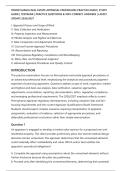
PENNSYLVANIA REAL ESTATE APPRAISAL PROCEDURES PRACTICE EXAM | STUDY
GUIDE | TESTBANK | PRACTICE QUESTIONS & 100% CORRECT ANSWERS | LATEST
UPDATE 2026/2027
I. Appraisal Process and Scope of Work
II. Data Collection and Verification
III. Property Inspection and Measurement
IV. Market Analysis and Highest and Best Use
V. Sales Comparison and Adjustment Procedures
VI. Cost and Income Approach Procedures
VII. Reconciliation and Reporting
VIII. Pennsylvania Regulatory Compliance and Recordkeeping
IX. Ethics, Bias, and Professional Judgment
X. Advanced Appraisal Procedures and Quality Control
INTRODUCTION
This practice examination focuses on Pennsylvania real estate appraisal procedures at
an advanced professional level, emphasizing the analytical and procedural judgment
expected of practicing appraisers. Questions address scope of work, inspection, market
and highest-and-best-use analysis, data verification, valuation approaches,
adjustments, reconciliation, reporting, documentation, ethics, regulatory compliance,
and emerging professional requirements. The 2026/2027 emphasis reflects current
Pennsylvania appraisal-regulatory developments, including valuation-bias and fair-
housing requirements and the current Appraiser Qualifications Board framework.
Students should expect complex scenarios requiring interpretation of appraisal
assignments, evaluation of evidence, selection of appropriate procedures, and
defensible professional conclusions rather than simple memorization.
Question 1
An appraiser is engaged to develop a market value opinion for a proposed one-unit
residential property. The client provides preliminary plans, but several material design
elements remain unresolved. The appraiser determines that the unresolved elements
could materially affect marketability and value. Which action best satisfies the
appraiser's procedural obligations?
A. Complete the appraisal using assumptions about the unresolved elements without
further disclosure because the plans are preliminary.
B. Proceed only after identifying the unresolved elements, determining their potential
,effect on the assignment, and appropriately defining and communicating the scope of
work and assumptions.
C. Reject the assignment automatically because an appraisal cannot be performed
before final construction plans exist.
D. Use the client's preferred design assumptions because the client is responsible for
providing the assignment conditions.
Correct Answer: B
Explanation: When material assignment conditions are uncertain, the appraiser must
analyze their significance, establish an appropriate scope of work, and clearly identify
relevant assumptions or limiting conditions rather than silently adopting unsupported
assumptions.
Question 2
During an appraisal, the appraiser discovers that the subject's legal description differs
from the municipal property record. The difference appears potentially material to the
property's physical boundaries. What is the most appropriate procedural response?
A. Use the municipal record automatically because it is presumed to be legally
controlling.
B. Ignore the discrepancy if the property's street address is correct.
C. Investigate and resolve the discrepancy to the extent necessary for credible
assignment results and disclose any material unresolved issue.
D. Substitute the legal description supplied by the client without independent
verification.
Correct Answer: C
Explanation: A potentially material discrepancy affecting property identification or
rights requires investigation. The appraiser should not simply select the source most
convenient to the assignment.
Question 3
An appraiser has identified five recent sales that appear comparable to the subject. One
sale is highly similar physically but occurred in a rapidly changing market, while another
,is less similar physically but closed only two weeks before the effective date. Which
principle should govern the selection and weighting of the sales?
A. Physical similarity always overrides market-date considerations.
B. The most recent sale must automatically receive the greatest weight.
C. Comparability should be evaluated holistically, including physical, legal, locational,
and market characteristics relevant to the assignment.
D. The sale with the highest price should receive the greatest weight because it
establishes the upper market boundary.
Correct Answer: C
Explanation: Comparable selection is an analytical judgment. Recency, physical
similarity, location, financing, conditions of sale, and market conditions must be
considered collectively rather than through a single automatic rule.
Question 4
A residential appraiser discovers that a comparable sale included seller-paid
concessions significantly above typical market levels. The appraiser determines that the
concessions influenced the reported transaction price. What is the most appropriate
procedure?
A. Use the sale without adjustment because concessions are part of the recorded
transaction price.
B. Exclude every sale involving concessions regardless of their significance.
C. Analyze the effect of the concessions and make an appropriate adjustment when
supported by market evidence.
D. Reduce the comparable's price by the exact dollar amount of every concession
automatically.
Correct Answer: C
Explanation: Concessions should be analyzed for their market effect. The appropriate
adjustment is based on evidence of how the concession affected the transaction, not
necessarily its face amount.
Question 5
, An appraiser is analyzing a property that could legally be used as either a single-family
residence or a small professional office. Both uses are physically possible and legally
permissible. The office use would generate greater anticipated value but would require
substantial conversion costs. Which highest-and-best-use test should receive particular
attention?
A. Whether the use is merely physically possible.
B. Whether the use is financially feasible after considering relevant costs and market
conditions.
C. Whether the owner personally prefers the use.
D. Whether the use has the highest gross potential revenue before expenses.
Correct Answer: B
Explanation: A highest-and-best-use analysis requires consideration of legal
permissibility, physical possibility, financial feasibility, and maximum productivity. A
theoretically higher revenue stream does not establish financial feasibility by itself.
Question 6
A comparable property sold 10 months before the effective date. During that period,
market prices increased approximately 8%, but the increase was not uniform across
property segments. The subject belongs to a segment that appreciated approximately
5%. What is the best adjustment procedure?
A. Apply the overall market's 8% increase automatically.
B. Make no time adjustment because the comparable is less than one year old.
C. Analyze the market segment applicable to the comparable and subject and support
the time adjustment with relevant market evidence.
D. Apply a 10% adjustment to compensate for uncertainty.
Correct Answer: C
Explanation: Time adjustments should reflect the market behavior relevant to the
properties being compared. Broad market statistics may not accurately represent the
subject's specific market segment.
Question 7
GUIDE | TESTBANK | PRACTICE QUESTIONS & 100% CORRECT ANSWERS | LATEST
UPDATE 2026/2027
I. Appraisal Process and Scope of Work
II. Data Collection and Verification
III. Property Inspection and Measurement
IV. Market Analysis and Highest and Best Use
V. Sales Comparison and Adjustment Procedures
VI. Cost and Income Approach Procedures
VII. Reconciliation and Reporting
VIII. Pennsylvania Regulatory Compliance and Recordkeeping
IX. Ethics, Bias, and Professional Judgment
X. Advanced Appraisal Procedures and Quality Control
INTRODUCTION
This practice examination focuses on Pennsylvania real estate appraisal procedures at
an advanced professional level, emphasizing the analytical and procedural judgment
expected of practicing appraisers. Questions address scope of work, inspection, market
and highest-and-best-use analysis, data verification, valuation approaches,
adjustments, reconciliation, reporting, documentation, ethics, regulatory compliance,
and emerging professional requirements. The 2026/2027 emphasis reflects current
Pennsylvania appraisal-regulatory developments, including valuation-bias and fair-
housing requirements and the current Appraiser Qualifications Board framework.
Students should expect complex scenarios requiring interpretation of appraisal
assignments, evaluation of evidence, selection of appropriate procedures, and
defensible professional conclusions rather than simple memorization.
Question 1
An appraiser is engaged to develop a market value opinion for a proposed one-unit
residential property. The client provides preliminary plans, but several material design
elements remain unresolved. The appraiser determines that the unresolved elements
could materially affect marketability and value. Which action best satisfies the
appraiser's procedural obligations?
A. Complete the appraisal using assumptions about the unresolved elements without
further disclosure because the plans are preliminary.
B. Proceed only after identifying the unresolved elements, determining their potential
,effect on the assignment, and appropriately defining and communicating the scope of
work and assumptions.
C. Reject the assignment automatically because an appraisal cannot be performed
before final construction plans exist.
D. Use the client's preferred design assumptions because the client is responsible for
providing the assignment conditions.
Correct Answer: B
Explanation: When material assignment conditions are uncertain, the appraiser must
analyze their significance, establish an appropriate scope of work, and clearly identify
relevant assumptions or limiting conditions rather than silently adopting unsupported
assumptions.
Question 2
During an appraisal, the appraiser discovers that the subject's legal description differs
from the municipal property record. The difference appears potentially material to the
property's physical boundaries. What is the most appropriate procedural response?
A. Use the municipal record automatically because it is presumed to be legally
controlling.
B. Ignore the discrepancy if the property's street address is correct.
C. Investigate and resolve the discrepancy to the extent necessary for credible
assignment results and disclose any material unresolved issue.
D. Substitute the legal description supplied by the client without independent
verification.
Correct Answer: C
Explanation: A potentially material discrepancy affecting property identification or
rights requires investigation. The appraiser should not simply select the source most
convenient to the assignment.
Question 3
An appraiser has identified five recent sales that appear comparable to the subject. One
sale is highly similar physically but occurred in a rapidly changing market, while another
,is less similar physically but closed only two weeks before the effective date. Which
principle should govern the selection and weighting of the sales?
A. Physical similarity always overrides market-date considerations.
B. The most recent sale must automatically receive the greatest weight.
C. Comparability should be evaluated holistically, including physical, legal, locational,
and market characteristics relevant to the assignment.
D. The sale with the highest price should receive the greatest weight because it
establishes the upper market boundary.
Correct Answer: C
Explanation: Comparable selection is an analytical judgment. Recency, physical
similarity, location, financing, conditions of sale, and market conditions must be
considered collectively rather than through a single automatic rule.
Question 4
A residential appraiser discovers that a comparable sale included seller-paid
concessions significantly above typical market levels. The appraiser determines that the
concessions influenced the reported transaction price. What is the most appropriate
procedure?
A. Use the sale without adjustment because concessions are part of the recorded
transaction price.
B. Exclude every sale involving concessions regardless of their significance.
C. Analyze the effect of the concessions and make an appropriate adjustment when
supported by market evidence.
D. Reduce the comparable's price by the exact dollar amount of every concession
automatically.
Correct Answer: C
Explanation: Concessions should be analyzed for their market effect. The appropriate
adjustment is based on evidence of how the concession affected the transaction, not
necessarily its face amount.
Question 5
, An appraiser is analyzing a property that could legally be used as either a single-family
residence or a small professional office. Both uses are physically possible and legally
permissible. The office use would generate greater anticipated value but would require
substantial conversion costs. Which highest-and-best-use test should receive particular
attention?
A. Whether the use is merely physically possible.
B. Whether the use is financially feasible after considering relevant costs and market
conditions.
C. Whether the owner personally prefers the use.
D. Whether the use has the highest gross potential revenue before expenses.
Correct Answer: B
Explanation: A highest-and-best-use analysis requires consideration of legal
permissibility, physical possibility, financial feasibility, and maximum productivity. A
theoretically higher revenue stream does not establish financial feasibility by itself.
Question 6
A comparable property sold 10 months before the effective date. During that period,
market prices increased approximately 8%, but the increase was not uniform across
property segments. The subject belongs to a segment that appreciated approximately
5%. What is the best adjustment procedure?
A. Apply the overall market's 8% increase automatically.
B. Make no time adjustment because the comparable is less than one year old.
C. Analyze the market segment applicable to the comparable and subject and support
the time adjustment with relevant market evidence.
D. Apply a 10% adjustment to compensate for uncertainty.
Correct Answer: C
Explanation: Time adjustments should reflect the market behavior relevant to the
properties being compared. Broad market statistics may not accurately represent the
subject's specific market segment.
Question 7