
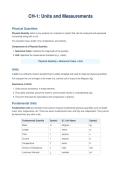
CH-1: Units and Measurements
Physical Quantities
Physical Quantity refers to any property of a material or system that can be measured and expressed
numerically along with a unit.
For example: mass, length, time, temperature, and velocity.
Components of a Physical Quantity:
1. Numerical Value: Indicates the magnitude of the quantity.
2. Unit: Specifies the measurement standard (e.g., meter).
Physical Quantity = Numerical Value + Unit
Units
A unit is an arbitrarily chosen standard that is widely accepted and used to measure physical quantities.
For example: the unit of length is the metre (m), and the unit of mass is the kilogram (kg).
Importance of Units:
1. Units ensure consistency in measurements.
2. They allow scientists across the world to communicate results in a standardized way.
3. They form the basis for calculations and comparisons in physics.
Fundamental Units
Fundamental units are standard units used to measure fundamental physical quantities such as length,
mass, time, temperature, etc. There are seven fundamental units, and they are independent. They cannot
be derived from any other units.
Fundamental Quantity Symbol S.I. Unit Name Symbol
Mass m kilogram kg
Length l metre m
Time t second s
Current I ampere A
Temperature T kelvin K
Amount of Substance n mole mol
Luminous Intensity Iv candela cd
Physical Quantities
Physical Quantity refers to any property of a material or system that can be measured and expressed
numerically along with a unit.
For example: mass, length, time, temperature, and velocity.
Components of a Physical Quantity:
1. Numerical Value: Indicates the magnitude of the quantity.
2. Unit: Specifies the measurement standard (e.g., meter).
Physical Quantity = Numerical Value + Unit
Units
A unit is an arbitrarily chosen standard that is widely accepted and used to measure physical quantities.
For example: the unit of length is the metre (m), and the unit of mass is the kilogram (kg).
Importance of Units:
1. Units ensure consistency in measurements.
2. They allow scientists across the world to communicate results in a standardized way.
3. They form the basis for calculations and comparisons in physics.
Fundamental Units
Fundamental units are standard units used to measure fundamental physical quantities such as length,
mass, time, temperature, etc. There are seven fundamental units, and they are independent. They cannot
be derived from any other units.
Fundamental Quantity Symbol S.I. Unit Name Symbol
Mass m kilogram kg
Length l metre m
Time t second s
Current I ampere A
Temperature T kelvin K
Amount of Substance n mole mol
Luminous Intensity Iv candela cd


