

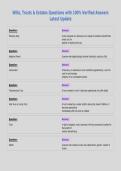
WIlls, Trusts & Estates Questions with 100% Verified Answers
Latest Update
Question: Answer:
Fiduciary Duty A duty required of a fiduciary to act solely for another's benefit that
arises out of a
position of loyalty and trust.
Question: Answer:
Adoptive Parent A person who legally adopts another individual, usually a child.
Question: Answer:
Conservator A fiduciary; an individual or trust institution appointed by a court to
care for and manage
property of an incompetent person.
Question: Answer:
Testamentary Trust A trust created in a will. It becomes operational only after death.
Question: Answer:
Inter Vivos or Living Trust A trust created by a maker (settlor) during the maker's lifetime. It
becomes operational
immediately after the trust is created.
Question: Answer:
Trust A right of property, real or personal, held by one person (trustee) for
the benefit of
another (beneficiary).
Question: Answer:
Settlor A person who creates a trust; also called donor, grantor, creator or
trustor.
,Question: Answer:
Legal Title (of a trust) The form of ownership of trust property held by the trustee, giving
the trustee the right
to control and manage the property for another's benefit, i.e., the
holder of the equitable
title.
Question: Answer:
Trustee The person or institution named by the maker of a will or a settlor of
a trust to administer
property for the benefit of another according to provisions in a
testamentary trust or an
inter vivos trust.
Question: Answer:
Beneficiary (of a trust) The person or institution who holds equitable title and to whom the
trustee distributes
the income earned from the trust property and, depending on the
terms of the trust,
even the trust property itself.
Question: Answer:
Equitable Title (of a trust) A right of the party who holds the equitable title or beneficial interest
to the benefits of
the trust.
Question: Answer:
Bypass Trust An estate planning device whereby a deceased spouse's estate
passes to a trust as a life
estate for the surviving spouse rather than entirely to the surviving
spouse, thereby
reducing the likelihood that the surviving spouse's estate will be
subject to federal estate
tax.
, Question: Answer:
Principal In trust law, the capital or property of a trust, as opposed to the
income, which is the
product of the capital.
Question: Answer:
Federal Estate Tax A tax imposed on the transfer of property at death.
Question: Answer:
Income Interest, dividends, or other return from invested capital.
Question: Answer:
Public (charitable) Trust A trust established for the social benefit either or the public at large
or the community.
Question: Answer:
Personal Representative The person who administers and distributes a decedent's estate
according to the will or
the appropriate intestate succession statue. It includes executor and
executrix when
there is a will and adminstrator/ix when there is not will.
Question: Answer:
Executor/Executrix A man or woman named in the will by the maker to be the PR of the
decedent's estate
and to carry out the provisions of the will.
Question: Answer:
Administrator/Administratrix The man or woman appointed by the probate court to administer the
decedent's estate
when there is no will.
Latest Update
Question: Answer:
Fiduciary Duty A duty required of a fiduciary to act solely for another's benefit that
arises out of a
position of loyalty and trust.
Question: Answer:
Adoptive Parent A person who legally adopts another individual, usually a child.
Question: Answer:
Conservator A fiduciary; an individual or trust institution appointed by a court to
care for and manage
property of an incompetent person.
Question: Answer:
Testamentary Trust A trust created in a will. It becomes operational only after death.
Question: Answer:
Inter Vivos or Living Trust A trust created by a maker (settlor) during the maker's lifetime. It
becomes operational
immediately after the trust is created.
Question: Answer:
Trust A right of property, real or personal, held by one person (trustee) for
the benefit of
another (beneficiary).
Question: Answer:
Settlor A person who creates a trust; also called donor, grantor, creator or
trustor.
,Question: Answer:
Legal Title (of a trust) The form of ownership of trust property held by the trustee, giving
the trustee the right
to control and manage the property for another's benefit, i.e., the
holder of the equitable
title.
Question: Answer:
Trustee The person or institution named by the maker of a will or a settlor of
a trust to administer
property for the benefit of another according to provisions in a
testamentary trust or an
inter vivos trust.
Question: Answer:
Beneficiary (of a trust) The person or institution who holds equitable title and to whom the
trustee distributes
the income earned from the trust property and, depending on the
terms of the trust,
even the trust property itself.
Question: Answer:
Equitable Title (of a trust) A right of the party who holds the equitable title or beneficial interest
to the benefits of
the trust.
Question: Answer:
Bypass Trust An estate planning device whereby a deceased spouse's estate
passes to a trust as a life
estate for the surviving spouse rather than entirely to the surviving
spouse, thereby
reducing the likelihood that the surviving spouse's estate will be
subject to federal estate
tax.
, Question: Answer:
Principal In trust law, the capital or property of a trust, as opposed to the
income, which is the
product of the capital.
Question: Answer:
Federal Estate Tax A tax imposed on the transfer of property at death.
Question: Answer:
Income Interest, dividends, or other return from invested capital.
Question: Answer:
Public (charitable) Trust A trust established for the social benefit either or the public at large
or the community.
Question: Answer:
Personal Representative The person who administers and distributes a decedent's estate
according to the will or
the appropriate intestate succession statue. It includes executor and
executrix when
there is a will and adminstrator/ix when there is not will.
Question: Answer:
Executor/Executrix A man or woman named in the will by the maker to be the PR of the
decedent's estate
and to carry out the provisions of the will.
Question: Answer:
Administrator/Administratrix The man or woman appointed by the probate court to administer the
decedent's estate
when there is no will.


