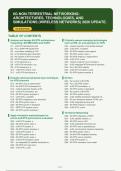
6G NON-TERRESTRIAL NETWORKING:
ARCHITECTURES, TECHNOLOGIES, AND
SIMULATIONS (WIRELESS NETWORKS) 2026 UPDATE.
160 QUESTIONS
TABLE OF CONTENTS
Analyze and design 6G NTN architectures Critically assess emerging technologies
integrating LEO/MEO/GEO and HAPS such as RIS, AI, and quantum for NTN
Q1 - a 6G NTN architecture with Q34 - network operator must decide between
Q2 - For a 3GPP NR-based NTN Q35 - a 6G NTN, a satellite
Q3 - a simulator modeling a LEO Q36 - 6G NTN network must support
Q4 - of the following best describes Q37 - 6G NTN system uses a
Q5 - the context of NTN simulation Q38 - 6G NTN employs a regenerative
Q6 - 6G NTN system employs a Q39 - a 6G NTN, a user
Q7 - of the following is a Q40 - network engineer must simulate a
Q8 - a 6G NTN simulation, you Q41 - a 6G integrated NTN-terrestrial architect...
Q9 - of the following is a Q42 - For a 6G LEO satellite
Q10 - a 6G NTN context, how Q43 - a 6G NTN simulation using
Q11 - a 6G NTN architecture, a Q44 - 6G NTN system employs a
Evaluate advanced physical layer techniques 6G Non
for NTN channels Q45 - the context of 6G NTN,
Q12 - 6G NTN uses a regenerative Q46 - For a 6G NTN system
Q13 - the 3GPP NTN framework for Q47 - a 6G NTN simulation, a
Q14 - network operator designs a 6G Q48 - 6G NTN system is designed
Q15 - a 6G NTN simulation, you Q49 - the context of 6G NTN,
Q16 - 6G NTN system employs a Q50 - 6G NTN system using a
Q17 - a 6G NTN, a satellite Q51 - a 6G satellite-terrestrial integrated net...
Q18 - 6G NTN integrates a non-terrestrial Q52 - 6G non-terrestrial network (NTN) uses
Q19 - 6G NTN system uses a Q53 - a 6G integrated sensing and
Q20 - 6G NTN system is designed Q54 - 6G NTN employs a multi-layer
Q21 - 3GPP NTN system uses a Q55 - a 6G NTN, a user
Q22 - 6G NTN system employs a
Terrestrial Networking
Apply simulation methodologies for Q56 - 6G NTN integrates a HAPS
end-to-end NTN performance evaluation Q57 - a 6G satellite network, a
Q23 - a 6G NTN system, a Q58 - 6G NTN uses a LEO
Q24 - 6G NTN system uses a Q59 - a 6G integrated terrestrial and
Q25 - a 6G NTN system, a Q60 - 6G NTN uses a geostationary
Q26 - 6G NTN system employs a Q61 - a 6G non-terrestrial network integrating
Q27 - a 6G NTN system, a Q62 - 6G NTN system uses a
Q28 - 6G NTN system uses a Q63 - the 6G NTN integrated sensing
Q29 - 6G NTN system uses a Q64 - 6G NTN uses a cognitive
Q30 - a 6G NTN simulation using Q65 - a 6G NTN system, a
Q31 - an integrated 6G satellite-terrestrial ne... Q66 - 6G NTN simulation must model
Q32 - 6G NTN cell must serve
Q33 - a 6G NTN, a LEO
Page 1
,Architectures 2026 Update.
Q67 - a 6G NTN, a high-altitude Q111 - a 3GPP NTN architecture for
Q68 - 6G NTN system uses a Q112 - 6G NTN system employs a
Q69 - a 6G NTN, network slicing Q113 - a 6G integrated terrestrial-NTN network,
Q70 - 6G NTN system uses non-orthogonal Q114 - 6G NTN system uses a
Q71 - a 6G non-terrestrial network employing Q115 - 6G NTN system employs a
Q72 - 6G NTN integrates a GEO Q116 - the context of 6G NTN,
Q73 - 6G NTN uses a transparent Q117 - 6G NTN system is designed
Q74 - a 6G non-terrestrial network, the Q118 - Consider a 6G NTN system
Q75 - 6G NTN uses a multi-layer Q119 - 6G NTN system integrates a
Q76 - non-terrestrial network operator is evalu... Q120 - 6G NTN, network slicing is
Q77 - a 6G NTN, a LEO
Foundations of 6G Non-Terrestrial
Technologies Networking
Q78 - 6G non-terrestrial network must provide Q121 - a 6G integrated NTN architecture,
Q79 - 6G NTN simulation model uses Q122 - 6G NTN uses a transparent
Q80 - 6G non-terrestrial network integrates a Q123 - For a 6G NTN cell-free
Q81 - a 3GPP NTN architecture for Q124 - a 6G NTN with a
Q82 - 6G NTN system uses a Q125 - For a 6G NTN serving
Q83 - a 6G integrated sensing and Q126 - a 6G NTN, a LEO
Q84 - 6G NTN system employs a Q127 - 6G NTN integrates a HAPS
Q85 - a 6G NTN network, a Q128 - For a 6G NTN using
Q86 - 6G NTN network integrates terrestrial Q129 - a 6G NTN simulation, you
Q87 - a 6G NTN system, a Q130 - 6G NTN integrates terrestrial and
Q88 - 6G NTN network uses a
Applied 6G Non-Terrestrial Networking
and Simulations Q131 - the 6G NTN architecture, a
Q89 - a 6G NTN system, a Q132 - For a low Earth orbit
Q90 - 6G NTN system employs a Q133 - a 6G integrated NTN-terrestrial network,
Q91 - the 3GPP NTN architecture for Q134 - 6G non-terrestrial network simulation uses
Q92 - 6G NTN uses a LEO Q135 - 6G NTN system employs a
Q93 - a 6G network integrating terrestrial Q136 - a 6G NTN, a satellite
Q94 - 6G NTN system uses spectrum Q137 - 6G NTN system uses a
Q95 - simulating a 6G NTN, a Q138 - a 6G non-terrestrial network, a
Q96 - 6G NTN employs a quantum Q139 - 6G NTN system must comply
Q97 - a 6G NTN, a high-altitude Q140 - a 6G NTN simulation, you
Q98 - 6G NTN uses a regenerative
Q99 - a 6G NTN, a federated Advanced 6G Non-Terrestrial Networking
Q141 - a 6G non-terrestrial network (NTN)
Wireless Networks Q142 - For a 6G NTN using
Q100 - 6G NTN system uses a Q143 - You are simulating a 6G
Q101 - a 6G non-terrestrial network (NTN) Q144 - a 6G NTN, which protocol
Q102 - designing a 6G NTN using Q145 - For a 6G NTN using
Q103 - 6G NTN base station (gNB) Q146 - a 6G NTN simulation, which
Q104 - the context of 6G NTN, Q147 - frequency band is most likely
Q105 - 6G NTN system uses a Q148 - a 6G NTN, which network
Q106 - a 6G NTN, the use Q149 - integrating a non-terrestrial network with
Q107 - 6G NTN system employs a Q150 - a 6G NTN, which technique
Q108 - a 6G NTN, a satellite
Q109 - the context of 6G non-terrestrial
Q110 - 6G NTN system must support
Page 2
,6G Non-Terrestrial Networking Review
Q151 - a 3GPP NTN scenario with
Q152 - system uses a LEO constellation
Q153 - the 3GPP NTN framework, which
Q154 - satellite network operator plans to
Q155 - Consider a multi-connectivity scenario in
Q156 - For the simulation of a
Q157 - the context of 6G NTN,
Q158 - 6G NTN system employs a
Q159 - a 6G NTN network, a
Q160 - of the following is the
Q1 ANALYZE AND DESIGN 6G NTN ARCHITECTURES INTEGRATING LEO/MEO/GEO AND
HAPS
In a 6G NTN architecture with a software-defined satellite constellation, which
control plane function is most critical for maintaining seamless handover between
a terrestrial gNB and a LEO satellite moving at 7.5 km/s, given the need to
minimize service interruption to under 10 ms?
A. A centralized SDN controller that computes handover decisions based on ephemeris data and
coordinates with the AMF via N2 interfaces CORRECT
B. A distributed mobility management scheme where each satellite independently executes
handover without coordination with the core network
C. A terrestrial-based MME that relies on periodic measurement reports from the UE to trigger
handover
D. A predictive handover mechanism using machine learning on historical UE trajectories,
implemented at the satellite's onboard processor
RATIONALE: The centralized SDN controller with ephemeris-aware handover minimizes
interruption by proactively managing the handover and coordinating with core network functions.
Distributed schemes lack global coordination, terrestrial MME introduces latency, and onboard
ML may not have full network context.
Page 3
, Q2 ANALYZE AND DESIGN 6G NTN ARCHITECTURES INTEGRATING LEO/MEO/GEO AND
HAPS
For a 3GPP NR-based NTN system using a GEO satellite with a bent-pipe payload,
what is the primary challenge when applying the standard 5G NR timing advance
procedure, and how does the 3GPP specification address it?
A. The large round-trip delay breaks the random access timing; the UE applies a fixed timing
offset based on its GNSS position and satellite ephemeris CORRECT
B. The Doppler shift from satellite movement corrupts timing; the network pre-compensates for
Doppler in the downlink
C. The UE cannot distinguish timing from frequency errors; the network uses an extended
random access preamble with longer cyclic prefix
D. The satellite's non-geostationary motion makes timing advance invalid; the UE uses only
open-loop timing with no closed-loop correction
RATIONALE: GEO satellites have large round-trip delays (~270 ms) that exceed standard NR
timing advance limits. 3GPP NTN solutions use GNSS-derived UE position and satellite
ephemeris to compute a common timing offset, with residual errors corrected via closed-loop TA.
Q3 ANALYZE AND DESIGN 6G NTN ARCHITECTURES INTEGRATING LEO/MEO/GEO AND
HAPS
In a simulator modeling a LEO satellite constellation with inter-satellite links (ISLs)
using free-space optical (FSO) communication, which of the following effects must
be modeled to accurately assess link performance during daytime operations?
A. Scintillation and background solar noise due to atmospheric turbulence and sunlight scattering
into the receiver CORRECT
B. Rain attenuation and fog scattering along the propagation path
C. Ionospheric scintillation and Faraday rotation of the optical beam
D. Tropospheric delay and multipath fading from ground reflection
RATIONALE: FSO links between satellites are affected by scintillation (from atmospheric
turbulence in the uplink/downlink) and background solar noise, especially during daytime.
Rain/fog affect lower frequencies, ionospheric effects are negligible for optical, and multipath is
not significant in space.
Page 4
ARCHITECTURES, TECHNOLOGIES, AND
SIMULATIONS (WIRELESS NETWORKS) 2026 UPDATE.
160 QUESTIONS
TABLE OF CONTENTS
Analyze and design 6G NTN architectures Critically assess emerging technologies
integrating LEO/MEO/GEO and HAPS such as RIS, AI, and quantum for NTN
Q1 - a 6G NTN architecture with Q34 - network operator must decide between
Q2 - For a 3GPP NR-based NTN Q35 - a 6G NTN, a satellite
Q3 - a simulator modeling a LEO Q36 - 6G NTN network must support
Q4 - of the following best describes Q37 - 6G NTN system uses a
Q5 - the context of NTN simulation Q38 - 6G NTN employs a regenerative
Q6 - 6G NTN system employs a Q39 - a 6G NTN, a user
Q7 - of the following is a Q40 - network engineer must simulate a
Q8 - a 6G NTN simulation, you Q41 - a 6G integrated NTN-terrestrial architect...
Q9 - of the following is a Q42 - For a 6G LEO satellite
Q10 - a 6G NTN context, how Q43 - a 6G NTN simulation using
Q11 - a 6G NTN architecture, a Q44 - 6G NTN system employs a
Evaluate advanced physical layer techniques 6G Non
for NTN channels Q45 - the context of 6G NTN,
Q12 - 6G NTN uses a regenerative Q46 - For a 6G NTN system
Q13 - the 3GPP NTN framework for Q47 - a 6G NTN simulation, a
Q14 - network operator designs a 6G Q48 - 6G NTN system is designed
Q15 - a 6G NTN simulation, you Q49 - the context of 6G NTN,
Q16 - 6G NTN system employs a Q50 - 6G NTN system using a
Q17 - a 6G NTN, a satellite Q51 - a 6G satellite-terrestrial integrated net...
Q18 - 6G NTN integrates a non-terrestrial Q52 - 6G non-terrestrial network (NTN) uses
Q19 - 6G NTN system uses a Q53 - a 6G integrated sensing and
Q20 - 6G NTN system is designed Q54 - 6G NTN employs a multi-layer
Q21 - 3GPP NTN system uses a Q55 - a 6G NTN, a user
Q22 - 6G NTN system employs a
Terrestrial Networking
Apply simulation methodologies for Q56 - 6G NTN integrates a HAPS
end-to-end NTN performance evaluation Q57 - a 6G satellite network, a
Q23 - a 6G NTN system, a Q58 - 6G NTN uses a LEO
Q24 - 6G NTN system uses a Q59 - a 6G integrated terrestrial and
Q25 - a 6G NTN system, a Q60 - 6G NTN uses a geostationary
Q26 - 6G NTN system employs a Q61 - a 6G non-terrestrial network integrating
Q27 - a 6G NTN system, a Q62 - 6G NTN system uses a
Q28 - 6G NTN system uses a Q63 - the 6G NTN integrated sensing
Q29 - 6G NTN system uses a Q64 - 6G NTN uses a cognitive
Q30 - a 6G NTN simulation using Q65 - a 6G NTN system, a
Q31 - an integrated 6G satellite-terrestrial ne... Q66 - 6G NTN simulation must model
Q32 - 6G NTN cell must serve
Q33 - a 6G NTN, a LEO
Page 1
,Architectures 2026 Update.
Q67 - a 6G NTN, a high-altitude Q111 - a 3GPP NTN architecture for
Q68 - 6G NTN system uses a Q112 - 6G NTN system employs a
Q69 - a 6G NTN, network slicing Q113 - a 6G integrated terrestrial-NTN network,
Q70 - 6G NTN system uses non-orthogonal Q114 - 6G NTN system uses a
Q71 - a 6G non-terrestrial network employing Q115 - 6G NTN system employs a
Q72 - 6G NTN integrates a GEO Q116 - the context of 6G NTN,
Q73 - 6G NTN uses a transparent Q117 - 6G NTN system is designed
Q74 - a 6G non-terrestrial network, the Q118 - Consider a 6G NTN system
Q75 - 6G NTN uses a multi-layer Q119 - 6G NTN system integrates a
Q76 - non-terrestrial network operator is evalu... Q120 - 6G NTN, network slicing is
Q77 - a 6G NTN, a LEO
Foundations of 6G Non-Terrestrial
Technologies Networking
Q78 - 6G non-terrestrial network must provide Q121 - a 6G integrated NTN architecture,
Q79 - 6G NTN simulation model uses Q122 - 6G NTN uses a transparent
Q80 - 6G non-terrestrial network integrates a Q123 - For a 6G NTN cell-free
Q81 - a 3GPP NTN architecture for Q124 - a 6G NTN with a
Q82 - 6G NTN system uses a Q125 - For a 6G NTN serving
Q83 - a 6G integrated sensing and Q126 - a 6G NTN, a LEO
Q84 - 6G NTN system employs a Q127 - 6G NTN integrates a HAPS
Q85 - a 6G NTN network, a Q128 - For a 6G NTN using
Q86 - 6G NTN network integrates terrestrial Q129 - a 6G NTN simulation, you
Q87 - a 6G NTN system, a Q130 - 6G NTN integrates terrestrial and
Q88 - 6G NTN network uses a
Applied 6G Non-Terrestrial Networking
and Simulations Q131 - the 6G NTN architecture, a
Q89 - a 6G NTN system, a Q132 - For a low Earth orbit
Q90 - 6G NTN system employs a Q133 - a 6G integrated NTN-terrestrial network,
Q91 - the 3GPP NTN architecture for Q134 - 6G non-terrestrial network simulation uses
Q92 - 6G NTN uses a LEO Q135 - 6G NTN system employs a
Q93 - a 6G network integrating terrestrial Q136 - a 6G NTN, a satellite
Q94 - 6G NTN system uses spectrum Q137 - 6G NTN system uses a
Q95 - simulating a 6G NTN, a Q138 - a 6G non-terrestrial network, a
Q96 - 6G NTN employs a quantum Q139 - 6G NTN system must comply
Q97 - a 6G NTN, a high-altitude Q140 - a 6G NTN simulation, you
Q98 - 6G NTN uses a regenerative
Q99 - a 6G NTN, a federated Advanced 6G Non-Terrestrial Networking
Q141 - a 6G non-terrestrial network (NTN)
Wireless Networks Q142 - For a 6G NTN using
Q100 - 6G NTN system uses a Q143 - You are simulating a 6G
Q101 - a 6G non-terrestrial network (NTN) Q144 - a 6G NTN, which protocol
Q102 - designing a 6G NTN using Q145 - For a 6G NTN using
Q103 - 6G NTN base station (gNB) Q146 - a 6G NTN simulation, which
Q104 - the context of 6G NTN, Q147 - frequency band is most likely
Q105 - 6G NTN system uses a Q148 - a 6G NTN, which network
Q106 - a 6G NTN, the use Q149 - integrating a non-terrestrial network with
Q107 - 6G NTN system employs a Q150 - a 6G NTN, which technique
Q108 - a 6G NTN, a satellite
Q109 - the context of 6G non-terrestrial
Q110 - 6G NTN system must support
Page 2
,6G Non-Terrestrial Networking Review
Q151 - a 3GPP NTN scenario with
Q152 - system uses a LEO constellation
Q153 - the 3GPP NTN framework, which
Q154 - satellite network operator plans to
Q155 - Consider a multi-connectivity scenario in
Q156 - For the simulation of a
Q157 - the context of 6G NTN,
Q158 - 6G NTN system employs a
Q159 - a 6G NTN network, a
Q160 - of the following is the
Q1 ANALYZE AND DESIGN 6G NTN ARCHITECTURES INTEGRATING LEO/MEO/GEO AND
HAPS
In a 6G NTN architecture with a software-defined satellite constellation, which
control plane function is most critical for maintaining seamless handover between
a terrestrial gNB and a LEO satellite moving at 7.5 km/s, given the need to
minimize service interruption to under 10 ms?
A. A centralized SDN controller that computes handover decisions based on ephemeris data and
coordinates with the AMF via N2 interfaces CORRECT
B. A distributed mobility management scheme where each satellite independently executes
handover without coordination with the core network
C. A terrestrial-based MME that relies on periodic measurement reports from the UE to trigger
handover
D. A predictive handover mechanism using machine learning on historical UE trajectories,
implemented at the satellite's onboard processor
RATIONALE: The centralized SDN controller with ephemeris-aware handover minimizes
interruption by proactively managing the handover and coordinating with core network functions.
Distributed schemes lack global coordination, terrestrial MME introduces latency, and onboard
ML may not have full network context.
Page 3
, Q2 ANALYZE AND DESIGN 6G NTN ARCHITECTURES INTEGRATING LEO/MEO/GEO AND
HAPS
For a 3GPP NR-based NTN system using a GEO satellite with a bent-pipe payload,
what is the primary challenge when applying the standard 5G NR timing advance
procedure, and how does the 3GPP specification address it?
A. The large round-trip delay breaks the random access timing; the UE applies a fixed timing
offset based on its GNSS position and satellite ephemeris CORRECT
B. The Doppler shift from satellite movement corrupts timing; the network pre-compensates for
Doppler in the downlink
C. The UE cannot distinguish timing from frequency errors; the network uses an extended
random access preamble with longer cyclic prefix
D. The satellite's non-geostationary motion makes timing advance invalid; the UE uses only
open-loop timing with no closed-loop correction
RATIONALE: GEO satellites have large round-trip delays (~270 ms) that exceed standard NR
timing advance limits. 3GPP NTN solutions use GNSS-derived UE position and satellite
ephemeris to compute a common timing offset, with residual errors corrected via closed-loop TA.
Q3 ANALYZE AND DESIGN 6G NTN ARCHITECTURES INTEGRATING LEO/MEO/GEO AND
HAPS
In a simulator modeling a LEO satellite constellation with inter-satellite links (ISLs)
using free-space optical (FSO) communication, which of the following effects must
be modeled to accurately assess link performance during daytime operations?
A. Scintillation and background solar noise due to atmospheric turbulence and sunlight scattering
into the receiver CORRECT
B. Rain attenuation and fog scattering along the propagation path
C. Ionospheric scintillation and Faraday rotation of the optical beam
D. Tropospheric delay and multipath fading from ground reflection
RATIONALE: FSO links between satellites are affected by scintillation (from atmospheric
turbulence in the uplink/downlink) and background solar noise, especially during daytime.
Rain/fog affect lower frequencies, ionospheric effects are negligible for optical, and multipath is
not significant in space.
Page 4