
MGT 6201 Supply Chain EXAM - 2026 (Questions + Answers) with verified
Answers (Latest Update 2026/2027) UPDATE!! Compliance Tips & How to
Pass Fast
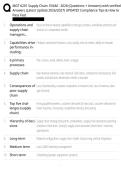
1. Operations and focus on how to develop capabilities to design, produce, and deliver products and
supply chain services in a competitive market
managers...
2. Capabilities drive Products and service features, costs, quality, time to market, ability to innovate
performance in-
cluding:
3. 6 primary Plan, Source, make, deliver, return, engage
processes
4. Supply chain Raw material extractors, Raw material Fabricators, component manufacturer, final
product manufacturer, wholesaler, retailer, consumer
5. Consequences of Loss of productivity, customer complaints, increased costs, loss of revenue, dam-
poor supply age to brand
chain
6. Top five chal- Hiring qualified workers, customer demands for low costs, customer demand for
lenges (supply faster response, increasing competitive intensity, forecasting
chain)
7. Hierarchy of deci- Supply chain strategy (long-term, competitive); supply chain operations planning
sions (medium /short term, Tactical); supply chain execution (short-term / real time,
operational)
8. Long-term Network configuration, supply chain model, Outsourcing, vertical integration
9. Medium term Lean, S&OP, Inventory management
10. Short-term Scheduling (people, equipment, product)
1/7
, MGT 6201 Supply Chain EXAM - 2026 (Questions + Answers) with verified
Answers (Latest Update 2026/2027) UPDATE!! Compliance Tips & How to
Pass Fast
11. Efficient supply Supply predictable demand efficiently at the lowest possible cost; capacity strategy:
chain model (cost maintain High average utilization rate; inventory strategy: generate High turnover
focus) and minimize inventory; lead time strategy: reduce lead time as long as it doesn't
increase cost; supplier capability: select primarily for cost and quality; logistics
strategy: greater Reliance on low-cost mode
12. Responsive sup- Respond quickly to unpredictable demand in order to minimize stockouts, lost
ply chain model sales, markdowns, and obsolete inventory; capacity strategy: deploy excess buffer
(speed focus) capacity; inventory strategy: deploy significant buffer / Safety stock; lead time
strategy: invest aggressively in ways to reduce lead time; supplier capability: select
primarily for speed, flexibility, and quality; Logistics strategy: greater Reliance on
fast/speedy modes
13. Use a low-cost Functional products -low demand uncertainty, more predictable slash stable de-
/ efficient supply mand, long product life, low inventory cost, low profit margins, low profit variety
chain when... and higher volume, low stock out and obsolescence cost
14. Use a respon- High demand uncertainty, short product life, difficult to forecast, high inventory
sive supply chain cost, high profit margins, High product variety and lower volume, High stock out
when... and obsolescence cost
15. Centralized Advantages: lower inventory, aggregate demand reduces need for safety stocks,
(Global) supply increased shipment volumes and negotiating power with shippers, lower com-
chain plexity and coordination, higher scope for standardization of practices, lower total
cost; Disadvantages: higher shipping distances and times, higher Transportation
costs, lower responsiveness
16. Decentralized (lo- Advantages: lower shipping distance and times, lower Transportation costs, higher
cal) supply chain responsiveness; Disadvantages: higher inventory, variable demand and more safe-
ty stocks, lower availability, lower shipment volumes and less negotiating power
2/7
Answers (Latest Update 2026/2027) UPDATE!! Compliance Tips & How to
Pass Fast
1. Operations and focus on how to develop capabilities to design, produce, and deliver products and
supply chain services in a competitive market
managers...
2. Capabilities drive Products and service features, costs, quality, time to market, ability to innovate
performance in-
cluding:
3. 6 primary Plan, Source, make, deliver, return, engage
processes
4. Supply chain Raw material extractors, Raw material Fabricators, component manufacturer, final
product manufacturer, wholesaler, retailer, consumer
5. Consequences of Loss of productivity, customer complaints, increased costs, loss of revenue, dam-
poor supply age to brand
chain
6. Top five chal- Hiring qualified workers, customer demands for low costs, customer demand for
lenges (supply faster response, increasing competitive intensity, forecasting
chain)
7. Hierarchy of deci- Supply chain strategy (long-term, competitive); supply chain operations planning
sions (medium /short term, Tactical); supply chain execution (short-term / real time,
operational)
8. Long-term Network configuration, supply chain model, Outsourcing, vertical integration
9. Medium term Lean, S&OP, Inventory management
10. Short-term Scheduling (people, equipment, product)
1/7
, MGT 6201 Supply Chain EXAM - 2026 (Questions + Answers) with verified
Answers (Latest Update 2026/2027) UPDATE!! Compliance Tips & How to
Pass Fast
11. Efficient supply Supply predictable demand efficiently at the lowest possible cost; capacity strategy:
chain model (cost maintain High average utilization rate; inventory strategy: generate High turnover
focus) and minimize inventory; lead time strategy: reduce lead time as long as it doesn't
increase cost; supplier capability: select primarily for cost and quality; logistics
strategy: greater Reliance on low-cost mode
12. Responsive sup- Respond quickly to unpredictable demand in order to minimize stockouts, lost
ply chain model sales, markdowns, and obsolete inventory; capacity strategy: deploy excess buffer
(speed focus) capacity; inventory strategy: deploy significant buffer / Safety stock; lead time
strategy: invest aggressively in ways to reduce lead time; supplier capability: select
primarily for speed, flexibility, and quality; Logistics strategy: greater Reliance on
fast/speedy modes
13. Use a low-cost Functional products -low demand uncertainty, more predictable slash stable de-
/ efficient supply mand, long product life, low inventory cost, low profit margins, low profit variety
chain when... and higher volume, low stock out and obsolescence cost
14. Use a respon- High demand uncertainty, short product life, difficult to forecast, high inventory
sive supply chain cost, high profit margins, High product variety and lower volume, High stock out
when... and obsolescence cost
15. Centralized Advantages: lower inventory, aggregate demand reduces need for safety stocks,
(Global) supply increased shipment volumes and negotiating power with shippers, lower com-
chain plexity and coordination, higher scope for standardization of practices, lower total
cost; Disadvantages: higher shipping distances and times, higher Transportation
costs, lower responsiveness
16. Decentralized (lo- Advantages: lower shipping distance and times, lower Transportation costs, higher
cal) supply chain responsiveness; Disadvantages: higher inventory, variable demand and more safe-
ty stocks, lower availability, lower shipment volumes and less negotiating power
2/7


