

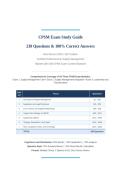
CPSM Exam Study Guide
230 Questions & 100% Correct Answers
Most Recent Edition
Certified Professional in Supply Management
Aligned with ISM CPSM Exam Content Blueprint
Comprehensive Coverage of All Three CPSM Exam Modules:
Exam 1: Supply Management Core • Exam 2: Supply Management Integration • Exam 3: Leadership and
Transformation
Sect
Focus Questions
ion
1 Sourcing and Category Management Q1 - Q30
2 Negotiation and Legal/Contractual Q31 - Q55
3 Cost, Finance, and Supplier Relationships Q56 - Q85
4 Supply Chain Strategy and S&OP; Q86 - Q120
5 Quality and Logistics Q121 - Q160
6 Strategy, Stakeholders, and People Q161 - Q190
7 Risk, Compliance, Ethics, and Technology Q191 - Q230
TOTAL 230 Questions
Cognitive Level Distribution: 25% Recall | 55% Application | 20% Analysis
Question Style: 75% Scenario-Based | 25% Direct Recall / Calculation
Format: Multiple Choice, 4 Options (A-D), One Correct Answer
,CPSM Exam Study Guide - 230 Questions - 2026/2027 100% Correct Answers
Section 1: Supply Management Core - Sourcing and Category Management
Questions Q1 - Q30 • Sourcing Strategies, Category Management, Supplier Identification, Market Analysis, and
Strategic Sourcing.
Q1: A supply manager is developing a category management strategy for indirect materials (MRO supplies)
that account for 35% of transactions but only 8% of total spend. Which approach best optimizes this
category?
A. Develop strategic supplier alliances with long-term contracts
B. Implement a catalog-based purchasing system with preferred distributors and consolidated
ordering [CORRECT]
C. Conduct competitive bidding for each purchase order
D. Issue an RFP for each individual transaction
Correct Answer: B — Implement a catalog-based purchasing system with preferred distributors and
consolidate...
Rationale: MRO items are typically high-transaction, low-value purchases where the cost of processing each order
can exceed the value of the item. A catalog-based purchasing system with preferred distributors consolidates orders,
reduces transaction costs, and leverages technology (e.g., punch-out catalogs, P-cards). Strategic alliances (option A)
are better for high-spend strategic categories. Competitive bidding per PO (option C) and RFPs per transaction (option
D) create excessive administrative overhead that outweighs any price savings on low-value items.
Q2: In the Kraljic two-by-two supply matrix, which quadrant describes items with high profit impact and
low supply risk, where organizations should leverage competitive bidding?
A. Strategic items
B. Leverage items [CORRECT]
C. Bottleneck items
D. Routine items
Correct Answer: B — Leverage items
Rationale: Leverage items have high profit impact (high spend) but low supply risk (many suppliers available). The
recommended strategy is to exploit the organization's purchasing power through competitive bidding, reverse
auctions, and aggressive negotiation to drive down prices. Strategic items (option A) have high profit impact AND high
supply risk, requiring close supplier partnerships. Bottleneck items (option C) have low profit impact but high supply
risk, requiring supply security. Routine items (option D) have low profit impact and low supply risk, requiring process
efficiency.
Q3: A supply manager is conducting market analysis for a new product category and needs to understand
the supplier landscape. Which approach provides the most comprehensive view of market structure,
supplier capabilities, and competitive dynamics?
A. Review the organization's existing supplier database
B. Conduct a Porter's Five Forces analysis combined with supplier capability assessments
[CORRECT]
C. Issue an RFI to the three current suppliers
D. Search supplier directories online
Correct Answer: B — Conduct a Porter's Five Forces analysis combined with supplier capability
assessments
Page 2
,CPSM Exam Study Guide - 230 Questions - 2026/2027 100% Correct Answers
Rationale: Porter's Five Forces analysis systematically evaluates industry rivalry, threat of new entrants, threat of
substitutes, supplier bargaining power, and buyer bargaining power, providing a comprehensive market structure
assessment. Combined with supplier capability assessments, this approach informs sourcing strategy development.
The existing supplier database (option A) is limited to known suppliers. An RFI to current suppliers only (option C)
misses the broader market. Online directories (option D) provide a list but not deep market intelligence.
Q4: An organization spends $50 million annually on a category with 12 qualified suppliers. The category has
high strategic importance and moderate supply risk. Which sourcing strategy is most appropriate?
A. Single source to one supplier for maximum partnership benefits
B. Dual source with two suppliers to balance partnership depth and risk mitigation [CORRECT]
C. Multiple source across all 12 suppliers for maximum competition
D. Spot purchase from the lowest bidder each time
Correct Answer: B — Dual source with two suppliers to balance partnership depth and risk mitigation
Rationale: For categories with high strategic importance and moderate supply risk, dual sourcing balances the
benefits of close supplier relationships (volume leverage, partnership investment, performance alignment) with risk
mitigation (continuity of supply if one supplier fails). Single sourcing (option A) maximizes partnership but increases
supply risk. Multiple sourcing across 12 suppliers (option C) fragments volume and dilutes supplier commitment. Spot
purchasing (option D) is inappropriate for strategic categories.
Q5: A supply manager is developing a sourcing strategy for a critical component with rapidly evolving
technology. The current supplier is the sole source but has not invested in R&D. Which action should the
supply manager take first?
A. Immediately switch to a new supplier
B. Conduct a make-or-buy analysis and develop alternative supplier sources [CORRECT]
C. Renegotiate the contract with the current supplier
D. Increase order volumes to incentivize the supplier's R&D investment
Correct Answer: B — Conduct a make-or-buy analysis and develop alternative supplier sources
Rationale: A sole-source critical component with a supplier not investing in R&D represents a strategic supply risk.
The supply manager should first conduct a make-or-buy analysis (evaluate whether to manufacture in-house) and
simultaneously develop alternative supplier sources to create competition and reduce dependency. Immediately
switching (option A) is risky without qualification of alternatives. Renegotiating with a non-investing supplier (option C)
may not solve the underlying capability gap. Increasing volumes (option D) rewards underperformance without
addressing the R&D deficiency.
Q6: In category management, what is the primary purpose of conducting a spend analysis as the first step?
A. To identify the lowest-cost suppliers
B. To consolidate, cleanse, and classify spend data to identify opportunities for savings, risk
reduction, and process improvement [CORRECT]
C. To determine the annual budget for the procurement department
D. To evaluate supplier performance metrics
Correct Answer: B — To consolidate, cleanse, and classify spend data to identify opportunities for
savings,...
Rationale: Spend analysis involves collecting, cleansing, and classifying procurement spend data to gain visibility into
what is being purchased, from whom, by whom, and at what price. This visibility enables identification of savings
opportunities (e.g., consolidation, negotiation), risk reduction (e.g., supplier concentration), and process improvement
(e.g., maverick spend). It is the foundational step in category management. Identifying lowest-cost suppliers (option A)
requires market analysis beyond spend data. Budget determination (option C) is a finance function. Supplier
performance evaluation (option D) uses supplier scorecards, not spend analysis.
Page 3
, CPSM Exam Study Guide - 230 Questions - 2026/2027 100% Correct Answers
Q7: A supply manager is preparing an RFP for a facilities management services contract. Which section is
most critical for ensuring comparable and evaluable supplier responses?
A. Company background and history of the buying organization
B. Detailed statement of work (SOW) with clear performance requirements and evaluation criteria
[CORRECT]
C. Standard terms and conditions boilerplate
D. List of all potential bidders
Correct Answer: B — Detailed statement of work (SOW) with clear performance requirements and
evaluation cri...
Rationale: A detailed Statement of Work (SOW) with clear performance requirements, service level agreements
(SLAs), and transparent evaluation criteria is the most critical RFP section. It ensures that all suppliers understand the
requirements equally and respond in a comparable format, enabling fair evaluation. Without a clear SOW, responses
will vary widely in scope and format, making comparison impossible. Company background (option A) is informational.
Boilerplate terms (option C) are standard. The list of bidders (option D) is typically not disclosed during the RFP
process.
Q8: An organization is implementing strategic sourcing for the first time. Which sequence of steps
represents the correct strategic sourcing process?
A. Analyze spend, identify suppliers, negotiate, sign contract
B. Assess needs, analyze market, develop strategy, select suppliers, negotiate, implement, measure
[CORRECT]
C. Issue RFP, evaluate bids, select lowest price, sign contract
D. Conduct market research, select supplier, negotiate price, monitor delivery
Correct Answer: B — Assess needs, analyze market, develop strategy, select suppliers, negotiate,
implement,...
Rationale: Strategic sourcing is a systematic, data-driven process: (1) Assess internal needs and stakeholder
requirements, (2) Analyze the supply market, (3) Develop sourcing strategy (single, dual, multiple sourcing), (4) Select
suppliers via RFP/RFQ process, (5) Negotiate terms, (6) Implement transition and contract, (7) Measure and manage
ongoing performance. This iterative process focuses on total cost of ownership and long-term value, not just price.
Options A, C, and D are simplified, transactional approaches that miss the strategic analysis, market intelligence, and
ongoing performance management components.
Q9: A supply manager needs to qualify a new supplier for a regulated medical device component. Which
approach best ensures supplier capability and compliance?
A. Review the supplier's website and marketing materials
B. Conduct an on-site supplier audit covering quality systems (ISO 13485), regulatory compliance
(FDA registration), production capacity, and financial stability [CORRECT]
C. Request three customer references
D. Require the supplier to submit a self-assessment questionnaire
Correct Answer: B — Conduct an on-site supplier audit covering quality systems (ISO 13485), regulatory
comp...
Rationale: For regulated medical device components, an on-site supplier audit is the most thorough qualification
method, directly verifying quality systems (ISO 13485), regulatory compliance (FDA 21 CFR 820), production
capacity, and financial stability through physical inspection, document review, and personnel interviews. Website
review (option A) and self-assessment questionnaires (option D) rely on unverified supplier claims. Customer
references (option C) provide anecdotal information but don't verify regulatory compliance or production capability.
Page 4
230 Questions & 100% Correct Answers
Most Recent Edition
Certified Professional in Supply Management
Aligned with ISM CPSM Exam Content Blueprint
Comprehensive Coverage of All Three CPSM Exam Modules:
Exam 1: Supply Management Core • Exam 2: Supply Management Integration • Exam 3: Leadership and
Transformation
Sect
Focus Questions
ion
1 Sourcing and Category Management Q1 - Q30
2 Negotiation and Legal/Contractual Q31 - Q55
3 Cost, Finance, and Supplier Relationships Q56 - Q85
4 Supply Chain Strategy and S&OP; Q86 - Q120
5 Quality and Logistics Q121 - Q160
6 Strategy, Stakeholders, and People Q161 - Q190
7 Risk, Compliance, Ethics, and Technology Q191 - Q230
TOTAL 230 Questions
Cognitive Level Distribution: 25% Recall | 55% Application | 20% Analysis
Question Style: 75% Scenario-Based | 25% Direct Recall / Calculation
Format: Multiple Choice, 4 Options (A-D), One Correct Answer
,CPSM Exam Study Guide - 230 Questions - 2026/2027 100% Correct Answers
Section 1: Supply Management Core - Sourcing and Category Management
Questions Q1 - Q30 • Sourcing Strategies, Category Management, Supplier Identification, Market Analysis, and
Strategic Sourcing.
Q1: A supply manager is developing a category management strategy for indirect materials (MRO supplies)
that account for 35% of transactions but only 8% of total spend. Which approach best optimizes this
category?
A. Develop strategic supplier alliances with long-term contracts
B. Implement a catalog-based purchasing system with preferred distributors and consolidated
ordering [CORRECT]
C. Conduct competitive bidding for each purchase order
D. Issue an RFP for each individual transaction
Correct Answer: B — Implement a catalog-based purchasing system with preferred distributors and
consolidate...
Rationale: MRO items are typically high-transaction, low-value purchases where the cost of processing each order
can exceed the value of the item. A catalog-based purchasing system with preferred distributors consolidates orders,
reduces transaction costs, and leverages technology (e.g., punch-out catalogs, P-cards). Strategic alliances (option A)
are better for high-spend strategic categories. Competitive bidding per PO (option C) and RFPs per transaction (option
D) create excessive administrative overhead that outweighs any price savings on low-value items.
Q2: In the Kraljic two-by-two supply matrix, which quadrant describes items with high profit impact and
low supply risk, where organizations should leverage competitive bidding?
A. Strategic items
B. Leverage items [CORRECT]
C. Bottleneck items
D. Routine items
Correct Answer: B — Leverage items
Rationale: Leverage items have high profit impact (high spend) but low supply risk (many suppliers available). The
recommended strategy is to exploit the organization's purchasing power through competitive bidding, reverse
auctions, and aggressive negotiation to drive down prices. Strategic items (option A) have high profit impact AND high
supply risk, requiring close supplier partnerships. Bottleneck items (option C) have low profit impact but high supply
risk, requiring supply security. Routine items (option D) have low profit impact and low supply risk, requiring process
efficiency.
Q3: A supply manager is conducting market analysis for a new product category and needs to understand
the supplier landscape. Which approach provides the most comprehensive view of market structure,
supplier capabilities, and competitive dynamics?
A. Review the organization's existing supplier database
B. Conduct a Porter's Five Forces analysis combined with supplier capability assessments
[CORRECT]
C. Issue an RFI to the three current suppliers
D. Search supplier directories online
Correct Answer: B — Conduct a Porter's Five Forces analysis combined with supplier capability
assessments
Page 2
,CPSM Exam Study Guide - 230 Questions - 2026/2027 100% Correct Answers
Rationale: Porter's Five Forces analysis systematically evaluates industry rivalry, threat of new entrants, threat of
substitutes, supplier bargaining power, and buyer bargaining power, providing a comprehensive market structure
assessment. Combined with supplier capability assessments, this approach informs sourcing strategy development.
The existing supplier database (option A) is limited to known suppliers. An RFI to current suppliers only (option C)
misses the broader market. Online directories (option D) provide a list but not deep market intelligence.
Q4: An organization spends $50 million annually on a category with 12 qualified suppliers. The category has
high strategic importance and moderate supply risk. Which sourcing strategy is most appropriate?
A. Single source to one supplier for maximum partnership benefits
B. Dual source with two suppliers to balance partnership depth and risk mitigation [CORRECT]
C. Multiple source across all 12 suppliers for maximum competition
D. Spot purchase from the lowest bidder each time
Correct Answer: B — Dual source with two suppliers to balance partnership depth and risk mitigation
Rationale: For categories with high strategic importance and moderate supply risk, dual sourcing balances the
benefits of close supplier relationships (volume leverage, partnership investment, performance alignment) with risk
mitigation (continuity of supply if one supplier fails). Single sourcing (option A) maximizes partnership but increases
supply risk. Multiple sourcing across 12 suppliers (option C) fragments volume and dilutes supplier commitment. Spot
purchasing (option D) is inappropriate for strategic categories.
Q5: A supply manager is developing a sourcing strategy for a critical component with rapidly evolving
technology. The current supplier is the sole source but has not invested in R&D. Which action should the
supply manager take first?
A. Immediately switch to a new supplier
B. Conduct a make-or-buy analysis and develop alternative supplier sources [CORRECT]
C. Renegotiate the contract with the current supplier
D. Increase order volumes to incentivize the supplier's R&D investment
Correct Answer: B — Conduct a make-or-buy analysis and develop alternative supplier sources
Rationale: A sole-source critical component with a supplier not investing in R&D represents a strategic supply risk.
The supply manager should first conduct a make-or-buy analysis (evaluate whether to manufacture in-house) and
simultaneously develop alternative supplier sources to create competition and reduce dependency. Immediately
switching (option A) is risky without qualification of alternatives. Renegotiating with a non-investing supplier (option C)
may not solve the underlying capability gap. Increasing volumes (option D) rewards underperformance without
addressing the R&D deficiency.
Q6: In category management, what is the primary purpose of conducting a spend analysis as the first step?
A. To identify the lowest-cost suppliers
B. To consolidate, cleanse, and classify spend data to identify opportunities for savings, risk
reduction, and process improvement [CORRECT]
C. To determine the annual budget for the procurement department
D. To evaluate supplier performance metrics
Correct Answer: B — To consolidate, cleanse, and classify spend data to identify opportunities for
savings,...
Rationale: Spend analysis involves collecting, cleansing, and classifying procurement spend data to gain visibility into
what is being purchased, from whom, by whom, and at what price. This visibility enables identification of savings
opportunities (e.g., consolidation, negotiation), risk reduction (e.g., supplier concentration), and process improvement
(e.g., maverick spend). It is the foundational step in category management. Identifying lowest-cost suppliers (option A)
requires market analysis beyond spend data. Budget determination (option C) is a finance function. Supplier
performance evaluation (option D) uses supplier scorecards, not spend analysis.
Page 3
, CPSM Exam Study Guide - 230 Questions - 2026/2027 100% Correct Answers
Q7: A supply manager is preparing an RFP for a facilities management services contract. Which section is
most critical for ensuring comparable and evaluable supplier responses?
A. Company background and history of the buying organization
B. Detailed statement of work (SOW) with clear performance requirements and evaluation criteria
[CORRECT]
C. Standard terms and conditions boilerplate
D. List of all potential bidders
Correct Answer: B — Detailed statement of work (SOW) with clear performance requirements and
evaluation cri...
Rationale: A detailed Statement of Work (SOW) with clear performance requirements, service level agreements
(SLAs), and transparent evaluation criteria is the most critical RFP section. It ensures that all suppliers understand the
requirements equally and respond in a comparable format, enabling fair evaluation. Without a clear SOW, responses
will vary widely in scope and format, making comparison impossible. Company background (option A) is informational.
Boilerplate terms (option C) are standard. The list of bidders (option D) is typically not disclosed during the RFP
process.
Q8: An organization is implementing strategic sourcing for the first time. Which sequence of steps
represents the correct strategic sourcing process?
A. Analyze spend, identify suppliers, negotiate, sign contract
B. Assess needs, analyze market, develop strategy, select suppliers, negotiate, implement, measure
[CORRECT]
C. Issue RFP, evaluate bids, select lowest price, sign contract
D. Conduct market research, select supplier, negotiate price, monitor delivery
Correct Answer: B — Assess needs, analyze market, develop strategy, select suppliers, negotiate,
implement,...
Rationale: Strategic sourcing is a systematic, data-driven process: (1) Assess internal needs and stakeholder
requirements, (2) Analyze the supply market, (3) Develop sourcing strategy (single, dual, multiple sourcing), (4) Select
suppliers via RFP/RFQ process, (5) Negotiate terms, (6) Implement transition and contract, (7) Measure and manage
ongoing performance. This iterative process focuses on total cost of ownership and long-term value, not just price.
Options A, C, and D are simplified, transactional approaches that miss the strategic analysis, market intelligence, and
ongoing performance management components.
Q9: A supply manager needs to qualify a new supplier for a regulated medical device component. Which
approach best ensures supplier capability and compliance?
A. Review the supplier's website and marketing materials
B. Conduct an on-site supplier audit covering quality systems (ISO 13485), regulatory compliance
(FDA registration), production capacity, and financial stability [CORRECT]
C. Request three customer references
D. Require the supplier to submit a self-assessment questionnaire
Correct Answer: B — Conduct an on-site supplier audit covering quality systems (ISO 13485), regulatory
comp...
Rationale: For regulated medical device components, an on-site supplier audit is the most thorough qualification
method, directly verifying quality systems (ISO 13485), regulatory compliance (FDA 21 CFR 820), production
capacity, and financial stability through physical inspection, document review, and personnel interviews. Website
review (option A) and self-assessment questionnaires (option D) rely on unverified supplier claims. Customer
references (option C) provide anecdotal information but don't verify regulatory compliance or production capability.
Page 4


