

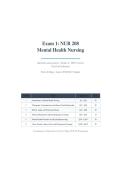
Exam 1: NUR 208
Mental Health Nursing
Questions and Answers | Grade A | 100% Correct
(Verified Solutions)
Fortis College | Latest 2026/2027 Update
Section Topic Questions Count
1 Foundations of Mental Health Nursing Q1 - Q20 20
2 Therapeutic Communication and Nurse-Client Relationship Q21 - Q40 20
3 Ethical, Legal, and Professional Issues Q41 - Q60 20
4 Defense Mechanisms and Psychodynamic Concepts Q61 - Q75 15
5 Mental Health Disorders and Psychopharmacology Q76 - Q105 30
6 Crisis, Suicide, Abuse, Grief, and Psychosocial Concepts Q106 - Q125 20
Comprehensive Preparation for Fortis College NUR 208 Examination
, NUR 208 Mental Health Nursing Exam 1
Section 1: Foundations of Mental Health Nursing (Q1-Q20)
Q1: A nursing instructor is presenting a lecture on the concept of mental health to a group of first-semester nursing
students. The instructor explains that mental health is not merely the absence of mental illness but a state of well-being
in which an individual realizes their own abilities, can cope with normal life stresses, can work productively, and is
able to make a contribution to their community. Which organization's definition of mental health is the instructor
describing?
A. World Health Organization (WHO) [CORRECT]
B. National Alliance on Mental Illness (NAMI)
C. American Psychiatric Association (APA)
D. Substance Abuse and Mental Health Services Administration (SAMHSA)
Correct Answer: A
Rationale: Rationale: The World Health Organization (WHO) defines mental health as a state of well-being in which an individual
realizes his or her own abilities, can cope with normal stresses of life, can work productively, and is able to make a contribution to his
or her community. This holistic definition goes beyond the absence of mental illness and emphasizes positive functioning and
resilience. NAMI is an advocacy organization, the APA focuses on psychiatric diagnosis and treatment, and SAMHSA is a U.S.
federal agency concerned with behavioral health.
Q2: A nurse is caring for a client on an inpatient psychiatric unit who becomes agitated when told that dinner will be
served at 6:00 PM instead of the usual 5:00 PM. The client yells at the nurse and throws a cup across the room. The
nurse observes that the client quickly appears remorseful and apologizes, stating, 'I don't know why I did that; I just
couldn't control myself.' Which component of the mental health continuum is most directly affected in this client?
A. Individual control over behavior [CORRECT]
B. Appraisal of reality
C. Integration of personality traits
D. Effective communication skills
Correct Answer: A
Rationale: Rationale: Individual control over behavior refers to a person's ability to regulate their actions, impulses, and emotional
responses in a socially acceptable manner. This client demonstrated an inability to manage frustration and impulses when faced with
a routine change, resulting in an aggressive outburst followed by remorse. While appraisal of reality, personality integration, and
communication are also components of mental health, the scenario specifically highlights a deficit in behavioral self-regulation and
impulse control.
Q3: A 45-year-old client is admitted to the psychiatric emergency department after family members report that the
client has been insisting that neighbors are spying on them through the television and that the government is
transmitting messages through the electrical wiring in their home. The client appears disheveled, is speaking rapidly,
and becomes hostile when the nurse attempts to build rapport. Which mental health component is most impaired in
this client?
A. Individual control over behavior
B. Effective communication and social interaction
C. Appraisal of reality [CORRECT]
D. Productive work performance
Correct Answer: C
Rationale: Rationale: Appraisal of reality refers to the ability to perceive and interpret one's environment accurately and to distinguish
between internal thoughts and external events. This client is experiencing paranoid delusions and ideas of reference, demonstrating a
significant impairment in reality testing. While the client also has difficulty with behavioral control and communication, the core
Page 2
, NUR 208 Mental Health Nursing Exam 1
psychiatric symptom described—fixed false beliefs about being spied on and receiving transmitted messages—represents a
fundamental disturbance in the accurate appraisal of reality.
Q4: A home health nurse visits a 62-year-old client who was recently diagnosed with end-stage renal disease and has
begun hemodialysis three times per week. The client's spouse reports that the client, who was previously active and
optimistic, now refuses to leave the house, has stopped attending church, cries frequently, and states, 'There is no
point in going on anymore.' Which concept best explains the relationship between this client's physical condition and
current mental state?
A. Mental illness directly causes physical disease progression
B. Psychiatric medications always worsen chronic medical conditions
C. Physical and mental health operate independently of each other
D. Poor physical health can lead to significant mental distress [CORRECT]
Correct Answer: D
Rationale: Rationale: The mental health-physical health continuum recognizes that poor physical health can lead to significant mental
distress, just as mental illness can negatively affect physical well-being. This client's severe chronic illness, lifestyle disruption, and loss
of independence have contributed to the development of depressive symptoms, including social withdrawal, hopelessness, and
tearfulness. Mental illness does not directly cause physical disease, not all psychiatric medications worsen medical conditions, and the
two domains are well established to be interrelated rather than independent.
Q5: According to Maslow's Hierarchy of Needs, which level of needs must be met before an individual can effectively
address higher-level needs such as self-esteem and self-actualization?
A. Safety and security needs
B. Physiological needs [CORRECT]
C. Love and belonging needs
D. Self-transcendence needs
Correct Answer: B
Rationale: Rationale: Maslow's Hierarchy of Needs posits that physiological needs—such as air, food, water, shelter, and
sleep—form the foundation of the hierarchy and must be satisfied before an individual can meaningfully address higher-level needs.
Once physiological needs are met, an individual progresses to safety and security, then love and belonging, then esteem, and finally
self-actualization. This principle is fundamental to nursing prioritization, as addressing basic survival needs takes precedence over
psychosocial and growth-oriented needs.
Q6: A nurse is assigned to care for four clients on a psychiatric unit. Client A is verbally aggressive and pacing the
hallway. Client B has not eaten in two days and is hypotensive. Client C expresses loneliness and wants to join a group
therapy session. Client D states a desire to explore personal goals and find meaning in life. Using Maslow's Hierarchy
of Needs, which client should the nurse prioritize first?
A. Client A, because safety concerns take top priority
B. Client B, because physiological needs must be met first [CORRECT]
C. Client C, because psychosocial needs are most urgent in mental health
D. Client D, because self-actualization is the ultimate goal of care
Correct Answer: B
Rationale: Rationale: According to Maslow's Hierarchy of Needs, physiological needs such as nutrition and fluid balance take the
highest priority. Client B has not eaten in two days and is experiencing hypotension, representing a potentially life-threatening
physiological deficit that requires immediate nursing intervention. While Client A's agitation raises safety concerns, Client B's
physiological instability takes precedence. Clients C and D have higher-level needs (love/belonging and self-actualization) that cannot
be effectively addressed until basic physiological needs are satisfied.
Page 3
, NUR 208 Mental Health Nursing Exam 1
Q7: A nurse is caring for a client with major depressive disorder who was recently transferred to the psychiatric unit
from another city. The client has no family in the area, has not spoken to another patient since admission three days
ago, and tells the nurse, 'No one here knows me, and I don't think anyone really cares whether I live or die.' Which
level of Maslow's Hierarchy of Needs is most unmet for this client?
A. Physiological needs
B. Safety and security needs
C. Love and belonging needs [CORRECT]
D. Self-actualization needs
Correct Answer: C
Rationale: Rationale: Love and belonging needs include the need for social connection, affection, acceptance, and meaningful
relationships. This client's recent relocation, social isolation, lack of family support, and statement about feeling uncared for all
indicate that the need for love and belonging is profoundly unmet. The client does not appear to have immediate physiological deficits
or safety threats, and the expressed hopelessness stems from social disconnection rather than a failure to achieve self-actualization.
Q8: A psychiatric nurse is working with a client who has been managing bipolar disorder successfully for several
years. The client has completed a college degree, developed a strong support network, volunteers at a community
mental health center, and recently told the nurse, 'I feel like I finally understand who I am and what I can contribute to
the world. My illness does not define me.' Which level of Maslow's Hierarchy of Needs does this statement best
reflect?
A. Esteem needs
B. Safety and security needs
C. Love and belonging needs
D. Self-actualization [CORRECT]
Correct Answer: D
Rationale: Rationale: Self-actualization is the highest level of Maslow's Hierarchy and represents the full realization of one's
potential, pursuit of personal growth, and the desire to contribute meaningfully to society. This client has achieved educational goals,
maintained supportive relationships, engaged in altruistic activities, and demonstrates a strong sense of identity and purpose beyond
their diagnosis. While the client has clearly met esteem, belonging, and safety needs, the statement about understanding their identity
and their contribution to the world specifically reflects self-actualization.
Q9: A nurse on a psychiatric unit is using behavioral therapy techniques with a client who has been socially isolating
on the unit. The nurse begins by praising the client for simply sitting in the dayroom for five minutes. Over the next
several days, the nurse provides positive reinforcement each time the client engages in progressively more social
behaviors, such as making eye contact, greeting another patient, and eventually joining a group activity. Which
operant conditioning principle is the nurse applying in this approach?
A. Shaping through successive approximations by reinforcing positive behaviors [CORRECT]
B. Negative punishment by removing social stimuli when the client isolates
C. Extinction by ignoring all maladaptive behaviors completely
D. Classical conditioning by pairing social situations with relaxation
Correct Answer: A
Rationale: Rationale: Shaping is an operant conditioning technique in which successive approximations of a desired behavior are
reinforced, gradually guiding the individual toward the target behavior. In this scenario, the nurse acknowledges and reinforces each
small step toward social engagement—sitting in the dayroom, making eye contact, greeting others, and joining group activities.
Acknowledging positive behaviors reinforces them and increases the likelihood they will be repeated. This is not negative punishment,
extinction, or classical conditioning, as the nurse is actively adding positive reinforcement for progressively closer approximations of
the desired social behavior.
Page 4
Mental Health Nursing
Questions and Answers | Grade A | 100% Correct
(Verified Solutions)
Fortis College | Latest 2026/2027 Update
Section Topic Questions Count
1 Foundations of Mental Health Nursing Q1 - Q20 20
2 Therapeutic Communication and Nurse-Client Relationship Q21 - Q40 20
3 Ethical, Legal, and Professional Issues Q41 - Q60 20
4 Defense Mechanisms and Psychodynamic Concepts Q61 - Q75 15
5 Mental Health Disorders and Psychopharmacology Q76 - Q105 30
6 Crisis, Suicide, Abuse, Grief, and Psychosocial Concepts Q106 - Q125 20
Comprehensive Preparation for Fortis College NUR 208 Examination
, NUR 208 Mental Health Nursing Exam 1
Section 1: Foundations of Mental Health Nursing (Q1-Q20)
Q1: A nursing instructor is presenting a lecture on the concept of mental health to a group of first-semester nursing
students. The instructor explains that mental health is not merely the absence of mental illness but a state of well-being
in which an individual realizes their own abilities, can cope with normal life stresses, can work productively, and is
able to make a contribution to their community. Which organization's definition of mental health is the instructor
describing?
A. World Health Organization (WHO) [CORRECT]
B. National Alliance on Mental Illness (NAMI)
C. American Psychiatric Association (APA)
D. Substance Abuse and Mental Health Services Administration (SAMHSA)
Correct Answer: A
Rationale: Rationale: The World Health Organization (WHO) defines mental health as a state of well-being in which an individual
realizes his or her own abilities, can cope with normal stresses of life, can work productively, and is able to make a contribution to his
or her community. This holistic definition goes beyond the absence of mental illness and emphasizes positive functioning and
resilience. NAMI is an advocacy organization, the APA focuses on psychiatric diagnosis and treatment, and SAMHSA is a U.S.
federal agency concerned with behavioral health.
Q2: A nurse is caring for a client on an inpatient psychiatric unit who becomes agitated when told that dinner will be
served at 6:00 PM instead of the usual 5:00 PM. The client yells at the nurse and throws a cup across the room. The
nurse observes that the client quickly appears remorseful and apologizes, stating, 'I don't know why I did that; I just
couldn't control myself.' Which component of the mental health continuum is most directly affected in this client?
A. Individual control over behavior [CORRECT]
B. Appraisal of reality
C. Integration of personality traits
D. Effective communication skills
Correct Answer: A
Rationale: Rationale: Individual control over behavior refers to a person's ability to regulate their actions, impulses, and emotional
responses in a socially acceptable manner. This client demonstrated an inability to manage frustration and impulses when faced with
a routine change, resulting in an aggressive outburst followed by remorse. While appraisal of reality, personality integration, and
communication are also components of mental health, the scenario specifically highlights a deficit in behavioral self-regulation and
impulse control.
Q3: A 45-year-old client is admitted to the psychiatric emergency department after family members report that the
client has been insisting that neighbors are spying on them through the television and that the government is
transmitting messages through the electrical wiring in their home. The client appears disheveled, is speaking rapidly,
and becomes hostile when the nurse attempts to build rapport. Which mental health component is most impaired in
this client?
A. Individual control over behavior
B. Effective communication and social interaction
C. Appraisal of reality [CORRECT]
D. Productive work performance
Correct Answer: C
Rationale: Rationale: Appraisal of reality refers to the ability to perceive and interpret one's environment accurately and to distinguish
between internal thoughts and external events. This client is experiencing paranoid delusions and ideas of reference, demonstrating a
significant impairment in reality testing. While the client also has difficulty with behavioral control and communication, the core
Page 2
, NUR 208 Mental Health Nursing Exam 1
psychiatric symptom described—fixed false beliefs about being spied on and receiving transmitted messages—represents a
fundamental disturbance in the accurate appraisal of reality.
Q4: A home health nurse visits a 62-year-old client who was recently diagnosed with end-stage renal disease and has
begun hemodialysis three times per week. The client's spouse reports that the client, who was previously active and
optimistic, now refuses to leave the house, has stopped attending church, cries frequently, and states, 'There is no
point in going on anymore.' Which concept best explains the relationship between this client's physical condition and
current mental state?
A. Mental illness directly causes physical disease progression
B. Psychiatric medications always worsen chronic medical conditions
C. Physical and mental health operate independently of each other
D. Poor physical health can lead to significant mental distress [CORRECT]
Correct Answer: D
Rationale: Rationale: The mental health-physical health continuum recognizes that poor physical health can lead to significant mental
distress, just as mental illness can negatively affect physical well-being. This client's severe chronic illness, lifestyle disruption, and loss
of independence have contributed to the development of depressive symptoms, including social withdrawal, hopelessness, and
tearfulness. Mental illness does not directly cause physical disease, not all psychiatric medications worsen medical conditions, and the
two domains are well established to be interrelated rather than independent.
Q5: According to Maslow's Hierarchy of Needs, which level of needs must be met before an individual can effectively
address higher-level needs such as self-esteem and self-actualization?
A. Safety and security needs
B. Physiological needs [CORRECT]
C. Love and belonging needs
D. Self-transcendence needs
Correct Answer: B
Rationale: Rationale: Maslow's Hierarchy of Needs posits that physiological needs—such as air, food, water, shelter, and
sleep—form the foundation of the hierarchy and must be satisfied before an individual can meaningfully address higher-level needs.
Once physiological needs are met, an individual progresses to safety and security, then love and belonging, then esteem, and finally
self-actualization. This principle is fundamental to nursing prioritization, as addressing basic survival needs takes precedence over
psychosocial and growth-oriented needs.
Q6: A nurse is assigned to care for four clients on a psychiatric unit. Client A is verbally aggressive and pacing the
hallway. Client B has not eaten in two days and is hypotensive. Client C expresses loneliness and wants to join a group
therapy session. Client D states a desire to explore personal goals and find meaning in life. Using Maslow's Hierarchy
of Needs, which client should the nurse prioritize first?
A. Client A, because safety concerns take top priority
B. Client B, because physiological needs must be met first [CORRECT]
C. Client C, because psychosocial needs are most urgent in mental health
D. Client D, because self-actualization is the ultimate goal of care
Correct Answer: B
Rationale: Rationale: According to Maslow's Hierarchy of Needs, physiological needs such as nutrition and fluid balance take the
highest priority. Client B has not eaten in two days and is experiencing hypotension, representing a potentially life-threatening
physiological deficit that requires immediate nursing intervention. While Client A's agitation raises safety concerns, Client B's
physiological instability takes precedence. Clients C and D have higher-level needs (love/belonging and self-actualization) that cannot
be effectively addressed until basic physiological needs are satisfied.
Page 3
, NUR 208 Mental Health Nursing Exam 1
Q7: A nurse is caring for a client with major depressive disorder who was recently transferred to the psychiatric unit
from another city. The client has no family in the area, has not spoken to another patient since admission three days
ago, and tells the nurse, 'No one here knows me, and I don't think anyone really cares whether I live or die.' Which
level of Maslow's Hierarchy of Needs is most unmet for this client?
A. Physiological needs
B. Safety and security needs
C. Love and belonging needs [CORRECT]
D. Self-actualization needs
Correct Answer: C
Rationale: Rationale: Love and belonging needs include the need for social connection, affection, acceptance, and meaningful
relationships. This client's recent relocation, social isolation, lack of family support, and statement about feeling uncared for all
indicate that the need for love and belonging is profoundly unmet. The client does not appear to have immediate physiological deficits
or safety threats, and the expressed hopelessness stems from social disconnection rather than a failure to achieve self-actualization.
Q8: A psychiatric nurse is working with a client who has been managing bipolar disorder successfully for several
years. The client has completed a college degree, developed a strong support network, volunteers at a community
mental health center, and recently told the nurse, 'I feel like I finally understand who I am and what I can contribute to
the world. My illness does not define me.' Which level of Maslow's Hierarchy of Needs does this statement best
reflect?
A. Esteem needs
B. Safety and security needs
C. Love and belonging needs
D. Self-actualization [CORRECT]
Correct Answer: D
Rationale: Rationale: Self-actualization is the highest level of Maslow's Hierarchy and represents the full realization of one's
potential, pursuit of personal growth, and the desire to contribute meaningfully to society. This client has achieved educational goals,
maintained supportive relationships, engaged in altruistic activities, and demonstrates a strong sense of identity and purpose beyond
their diagnosis. While the client has clearly met esteem, belonging, and safety needs, the statement about understanding their identity
and their contribution to the world specifically reflects self-actualization.
Q9: A nurse on a psychiatric unit is using behavioral therapy techniques with a client who has been socially isolating
on the unit. The nurse begins by praising the client for simply sitting in the dayroom for five minutes. Over the next
several days, the nurse provides positive reinforcement each time the client engages in progressively more social
behaviors, such as making eye contact, greeting another patient, and eventually joining a group activity. Which
operant conditioning principle is the nurse applying in this approach?
A. Shaping through successive approximations by reinforcing positive behaviors [CORRECT]
B. Negative punishment by removing social stimuli when the client isolates
C. Extinction by ignoring all maladaptive behaviors completely
D. Classical conditioning by pairing social situations with relaxation
Correct Answer: A
Rationale: Rationale: Shaping is an operant conditioning technique in which successive approximations of a desired behavior are
reinforced, gradually guiding the individual toward the target behavior. In this scenario, the nurse acknowledges and reinforces each
small step toward social engagement—sitting in the dayroom, making eye contact, greeting others, and joining group activities.
Acknowledging positive behaviors reinforces them and increases the likelihood they will be repeated. This is not negative punishment,
extinction, or classical conditioning, as the nurse is actively adding positive reinforcement for progressively closer approximations of
the desired social behavior.
Page 4


