
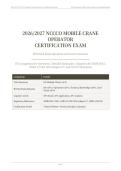
2026/2027 NCCCO Mobile Crane Operator Certification Exam 150 Questions with Correct Answers and Rationales
2026/2027 NCCCO MOBILE CRANE
OPERATOR
CERTIFICATION EXAM
With Real Exam Questions and Correct Answers
150 Comprehensive Questions | Detailed Rationales | Aligned with ASME B30.5,
OSHA 29 CFR 1926 Subpart CC, and NCCCO Standards
Component Details
Total Questions 150 Multiple Choice (A-D)
Site (20%), Operations (26%), Technical Knowledge (28%), Load
Written Exam Domains
Charts (26%)
Cognitive Levels 30% Recall, 50% Application, 20% Analysis
Regulatory References ASME B30.5-2025, OSHA 29 CFR 1926 Subpart CC, OSHA 1910.180
Certification Period 5 Years (Written + Practical within 12 months)
Page 1
,2026/2027 NCCCO Mobile Crane Operator Certification Exam 150 Questions with Correct Answers and Rationales
Section 1: Site Assessment and Preparation
Ground Conditions, Supporting Materials, Job Site Hazards, Power Line Hazards, and Travel
Requirements (Q1-Q35)
Q1: According to OSHA 29 CFR 1926 Subpart CC, which entity is primarily responsible for
ensuring adequate ground conditions are prepared before a crane arrives on site?
A. The crane operator
B. The controlling entity (employer in charge of construction) **[CORRECT]**
C. The crane manufacturer
D. The rigging crew supervisor
Correct Answer: B
Rationale: OSHA 29 CFR 1926.1402(a) designates the controlling entity as the party responsible for
ensuring adequate ground conditions are prepared before crane setup. The crane operator is not
responsible for site preparation but must verify conditions are adequate before beginning operations. The
crane manufacturer provides specifications but has no authority over job-site conditions. The rigging
crew supervisor oversees rigging operations, not ground preparation.
Q2: When evaluating ground conditions for crane setup, which of the following
below-surface hazards should be identified during a site assessment?
A. Overhead power lines
B. Voids, tanks, and loose fill **[CORRECT]**
C. Wind speed indicators
D. Traffic control devices
Correct Answer: B
Rationale: Below-surface hazards include voids, underground tanks, and loose fill material that can
compromise ground bearing capacity. Overhead power lines are an above-surface hazard evaluated
separately. Wind speed and traffic control are operational considerations, not below-surface ground
conditions. ASME B30.5 and OSHA Subpart CC both require evaluation of subsurface conditions that
could affect crane stability.
Q3: A crane must be set up near a recently excavated area. Which on-surface hazard is
MOST critical to evaluate before positioning the crane?
A. The color of the soil
B. Slopes, excavations, and depressions that could affect ground stability
**[CORRECT]**
C. The presence of construction signage
D. The distance to the break room
Correct Answer: B
Rationale: Slopes, excavations, and depressions are on-surface conditions that directly affect the crane's
stability and ground bearing capacity. According to ASME B30.5, the operator must evaluate how
proximity to excavations could cause ground failure under crane loading. Soil color has no direct
relevance to load-bearing capacity. Construction signage and break room distance are unrelated to
structural ground stability.
Q4: What is the PRIMARY purpose of using mats or blocking under a crane's outrigger pads?
Page 2
,2026/2027 NCCCO Mobile Crane Operator Certification Exam 150 Questions with Correct Answers and Rationales
A. To increase the crane's rated capacity
B. To distribute the crane's load over a larger ground surface area **[CORRECT]**
C. To level the crane without extending outriggers
D. To prevent the crane from being moved accidentally
Correct Answer: B
Rationale: Mats and blocking (cribbing) distribute the crane's concentrated outrigger loads over a larger
surface area, reducing ground bearing pressure to within the soil's allowable capacity. They do not
increase the manufacturer's rated capacity. Mats supplement but do not replace outrigger extension for
leveling. Preventing accidental movement is the function of outrigger locks and parking brakes, not mats.
ASME B30.5 and OSHA 1926.1402 require adequate supporting materials when ground conditions are
insufficient.
Q5: During crane assembly near a power line, what is the minimum clearance distance
required by OSHA 1926.1408 for lines rated at 50 kV?
A. 10 feet (3.05 m) **[CORRECT]**
B. 20 feet (6.10 m)
C. 15 feet (4.57 m)
D. 25 feet (7.62 m)
Correct Answer: A
Rationale: OSHA 29 CFR 1926.1408 establishes minimum clearance distances for power lines. For lines
rated 50 kV or below, the minimum clearance is 10 feet (3.05 m). For voltages over 50 kV, the clearance
increases by 0.4 inches (10 mm) for each 1 kV above 50 kV. The 20-foot distance applies to lines up to 350
kV under the table, but at exactly 50 kV the base 10-foot rule applies. Understanding the voltage-based
clearance table is critical for site assessment per NCCCO Domain 1.
Q6: A mobile crane needs to travel on a construction site without a load. According to ASME
B30.5, which of the following is a requirement for travel?
A. The boom must be fully retracted and lowered to the transport position
B. The travel route must be planned to avoid overhead obstructions, trenches, and
unstable ground **[CORRECT]**
C. All outriggers must remain fully extended during travel
D. A signal person must walk directly in front of the crane at all times
Correct Answer: B
Rationale: ASME B30.5 requires that the travel route be planned to identify and avoid overhead
obstructions, trenches, unstable ground, and other hazards before the crane moves. While lowering the
boom to a transport position is good practice, the specific regulatory requirement is route planning and
hazard identification. Outriggers must generally be retracted (not extended) for travel. A signal person is
required only when the operator's view is obstructed, not at all times.
Q7: Which of the following is the BEST indicator that the ground at a crane setup location
has adequate bearing capacity?
A. The ground is covered with asphalt pavement
B. A geotechnical survey confirms the soil bearing capacity meets or exceeds the
crane's load requirements **[CORRECT]**
C. Other cranes have previously operated at the same location
D. The ground appears firm and dry based on visual inspection alone
Page 3
, 2026/2027 NCCCO Mobile Crane Operator Certification Exam 150 Questions with Correct Answers and Rationales
Correct Answer: B
Rationale: A geotechnical survey provides documented, quantitative evidence of soil bearing capacity.
ASME B30.5 and OSHA Subpart CC emphasize that ground conditions must be assessed by a qualified
person. Asphalt alone does not guarantee adequate bearing capacity since it may crack or shift under
heavy loads. Previous crane operations do not guarantee current conditions are safe. Visual inspection
alone is insufficient because subsurface conditions cannot be determined by sight.
Q8: What is a 'pinch point' hazard on a crane job site?
A. A location where the crane's boom contacts an overhead structure
B. A point where a person could be caught between moving parts of the crane and a
fixed object **[CORRECT]**
C. A gap in the ground surface that could cause the crane to tip
D. An area where rigging hardware is pinched between the load and hook block
Correct Answer: B
Rationale: A pinch point is any location where a person could be caught between the crane's moving
components (such as the swing radius, boom, or counterweight) and a fixed structure or object. OSHA
requires that pinch/crush point hazards be identified during site assessment and that personnel be kept
clear of these areas. Boom contact with structures is a separate hazard (obstruction). Ground gaps relate
to stability, not pinch points. Rigging hardware issues are rigging hazards, not pinch/crush points in the
site assessment context.
Q9: When setting up a crane on a slope, what is the PRIMARY stability concern?
A. The crane may travel faster downhill
B. The crane's tipping axis is affected, reducing the effective capacity on the downhill
side **[CORRECT]**
C. The boom cannot be elevated on a slope
D. Outriggers cannot be extended on sloped surfaces
Correct Answer: B
Rationale: Slopes directly affect the crane's tipping axis and stability. When a crane is positioned on a
slope, the effective tipping radius on the downhill side is reduced, which decreases the crane's load
capacity in that direction. This is a critical concept in NCCCO Domain 1 site assessment. Travel speed is
controlled by the operator regardless of slope. The boom can be elevated, but capacity must be derated.
Outriggers can be used on slopes if the ground is stable and they are properly supported.
Q10: According to OSHA 1926.1402(b), what must an operator do if the ground conditions are
determined to be inadequate to support the crane?
A. Proceed with the lift but reduce the load by 50%
B. Notify the controlling entity and refuse to operate until adequate ground conditions
are provided **[CORRECT]**
C. Extend the outriggers fully and proceed without mats
D. Place concrete blocks under each outrigger pad
Correct Answer: B
Rationale: OSHA 1926.1402(b) requires the operator to not begin operations until adequate ground
conditions are confirmed. If conditions are inadequate, the operator must notify the controlling entity
and refuse to operate until proper ground preparation is completed. Arbitrarily reducing load by 50% is
not a code-compliant solution. Simply extending outriggers without adequate ground support does not
Page 4
2026/2027 NCCCO MOBILE CRANE
OPERATOR
CERTIFICATION EXAM
With Real Exam Questions and Correct Answers
150 Comprehensive Questions | Detailed Rationales | Aligned with ASME B30.5,
OSHA 29 CFR 1926 Subpart CC, and NCCCO Standards
Component Details
Total Questions 150 Multiple Choice (A-D)
Site (20%), Operations (26%), Technical Knowledge (28%), Load
Written Exam Domains
Charts (26%)
Cognitive Levels 30% Recall, 50% Application, 20% Analysis
Regulatory References ASME B30.5-2025, OSHA 29 CFR 1926 Subpart CC, OSHA 1910.180
Certification Period 5 Years (Written + Practical within 12 months)
Page 1
,2026/2027 NCCCO Mobile Crane Operator Certification Exam 150 Questions with Correct Answers and Rationales
Section 1: Site Assessment and Preparation
Ground Conditions, Supporting Materials, Job Site Hazards, Power Line Hazards, and Travel
Requirements (Q1-Q35)
Q1: According to OSHA 29 CFR 1926 Subpart CC, which entity is primarily responsible for
ensuring adequate ground conditions are prepared before a crane arrives on site?
A. The crane operator
B. The controlling entity (employer in charge of construction) **[CORRECT]**
C. The crane manufacturer
D. The rigging crew supervisor
Correct Answer: B
Rationale: OSHA 29 CFR 1926.1402(a) designates the controlling entity as the party responsible for
ensuring adequate ground conditions are prepared before crane setup. The crane operator is not
responsible for site preparation but must verify conditions are adequate before beginning operations. The
crane manufacturer provides specifications but has no authority over job-site conditions. The rigging
crew supervisor oversees rigging operations, not ground preparation.
Q2: When evaluating ground conditions for crane setup, which of the following
below-surface hazards should be identified during a site assessment?
A. Overhead power lines
B. Voids, tanks, and loose fill **[CORRECT]**
C. Wind speed indicators
D. Traffic control devices
Correct Answer: B
Rationale: Below-surface hazards include voids, underground tanks, and loose fill material that can
compromise ground bearing capacity. Overhead power lines are an above-surface hazard evaluated
separately. Wind speed and traffic control are operational considerations, not below-surface ground
conditions. ASME B30.5 and OSHA Subpart CC both require evaluation of subsurface conditions that
could affect crane stability.
Q3: A crane must be set up near a recently excavated area. Which on-surface hazard is
MOST critical to evaluate before positioning the crane?
A. The color of the soil
B. Slopes, excavations, and depressions that could affect ground stability
**[CORRECT]**
C. The presence of construction signage
D. The distance to the break room
Correct Answer: B
Rationale: Slopes, excavations, and depressions are on-surface conditions that directly affect the crane's
stability and ground bearing capacity. According to ASME B30.5, the operator must evaluate how
proximity to excavations could cause ground failure under crane loading. Soil color has no direct
relevance to load-bearing capacity. Construction signage and break room distance are unrelated to
structural ground stability.
Q4: What is the PRIMARY purpose of using mats or blocking under a crane's outrigger pads?
Page 2
,2026/2027 NCCCO Mobile Crane Operator Certification Exam 150 Questions with Correct Answers and Rationales
A. To increase the crane's rated capacity
B. To distribute the crane's load over a larger ground surface area **[CORRECT]**
C. To level the crane without extending outriggers
D. To prevent the crane from being moved accidentally
Correct Answer: B
Rationale: Mats and blocking (cribbing) distribute the crane's concentrated outrigger loads over a larger
surface area, reducing ground bearing pressure to within the soil's allowable capacity. They do not
increase the manufacturer's rated capacity. Mats supplement but do not replace outrigger extension for
leveling. Preventing accidental movement is the function of outrigger locks and parking brakes, not mats.
ASME B30.5 and OSHA 1926.1402 require adequate supporting materials when ground conditions are
insufficient.
Q5: During crane assembly near a power line, what is the minimum clearance distance
required by OSHA 1926.1408 for lines rated at 50 kV?
A. 10 feet (3.05 m) **[CORRECT]**
B. 20 feet (6.10 m)
C. 15 feet (4.57 m)
D. 25 feet (7.62 m)
Correct Answer: A
Rationale: OSHA 29 CFR 1926.1408 establishes minimum clearance distances for power lines. For lines
rated 50 kV or below, the minimum clearance is 10 feet (3.05 m). For voltages over 50 kV, the clearance
increases by 0.4 inches (10 mm) for each 1 kV above 50 kV. The 20-foot distance applies to lines up to 350
kV under the table, but at exactly 50 kV the base 10-foot rule applies. Understanding the voltage-based
clearance table is critical for site assessment per NCCCO Domain 1.
Q6: A mobile crane needs to travel on a construction site without a load. According to ASME
B30.5, which of the following is a requirement for travel?
A. The boom must be fully retracted and lowered to the transport position
B. The travel route must be planned to avoid overhead obstructions, trenches, and
unstable ground **[CORRECT]**
C. All outriggers must remain fully extended during travel
D. A signal person must walk directly in front of the crane at all times
Correct Answer: B
Rationale: ASME B30.5 requires that the travel route be planned to identify and avoid overhead
obstructions, trenches, unstable ground, and other hazards before the crane moves. While lowering the
boom to a transport position is good practice, the specific regulatory requirement is route planning and
hazard identification. Outriggers must generally be retracted (not extended) for travel. A signal person is
required only when the operator's view is obstructed, not at all times.
Q7: Which of the following is the BEST indicator that the ground at a crane setup location
has adequate bearing capacity?
A. The ground is covered with asphalt pavement
B. A geotechnical survey confirms the soil bearing capacity meets or exceeds the
crane's load requirements **[CORRECT]**
C. Other cranes have previously operated at the same location
D. The ground appears firm and dry based on visual inspection alone
Page 3
, 2026/2027 NCCCO Mobile Crane Operator Certification Exam 150 Questions with Correct Answers and Rationales
Correct Answer: B
Rationale: A geotechnical survey provides documented, quantitative evidence of soil bearing capacity.
ASME B30.5 and OSHA Subpart CC emphasize that ground conditions must be assessed by a qualified
person. Asphalt alone does not guarantee adequate bearing capacity since it may crack or shift under
heavy loads. Previous crane operations do not guarantee current conditions are safe. Visual inspection
alone is insufficient because subsurface conditions cannot be determined by sight.
Q8: What is a 'pinch point' hazard on a crane job site?
A. A location where the crane's boom contacts an overhead structure
B. A point where a person could be caught between moving parts of the crane and a
fixed object **[CORRECT]**
C. A gap in the ground surface that could cause the crane to tip
D. An area where rigging hardware is pinched between the load and hook block
Correct Answer: B
Rationale: A pinch point is any location where a person could be caught between the crane's moving
components (such as the swing radius, boom, or counterweight) and a fixed structure or object. OSHA
requires that pinch/crush point hazards be identified during site assessment and that personnel be kept
clear of these areas. Boom contact with structures is a separate hazard (obstruction). Ground gaps relate
to stability, not pinch points. Rigging hardware issues are rigging hazards, not pinch/crush points in the
site assessment context.
Q9: When setting up a crane on a slope, what is the PRIMARY stability concern?
A. The crane may travel faster downhill
B. The crane's tipping axis is affected, reducing the effective capacity on the downhill
side **[CORRECT]**
C. The boom cannot be elevated on a slope
D. Outriggers cannot be extended on sloped surfaces
Correct Answer: B
Rationale: Slopes directly affect the crane's tipping axis and stability. When a crane is positioned on a
slope, the effective tipping radius on the downhill side is reduced, which decreases the crane's load
capacity in that direction. This is a critical concept in NCCCO Domain 1 site assessment. Travel speed is
controlled by the operator regardless of slope. The boom can be elevated, but capacity must be derated.
Outriggers can be used on slopes if the ground is stable and they are properly supported.
Q10: According to OSHA 1926.1402(b), what must an operator do if the ground conditions are
determined to be inadequate to support the crane?
A. Proceed with the lift but reduce the load by 50%
B. Notify the controlling entity and refuse to operate until adequate ground conditions
are provided **[CORRECT]**
C. Extend the outriggers fully and proceed without mats
D. Place concrete blocks under each outrigger pad
Correct Answer: B
Rationale: OSHA 1926.1402(b) requires the operator to not begin operations until adequate ground
conditions are confirmed. If conditions are inadequate, the operator must notify the controlling entity
and refuse to operate until proper ground preparation is completed. Arbitrarily reducing load by 50% is
not a code-compliant solution. Simply extending outriggers without adequate ground support does not
Page 4


