

COMPTIA SECURITY+ SY0-701 ACRONYMS QUESTIONS & ANSWERS 2026-2027 | LAT… EXAM
P R O F E S S I O N A L P R A C T I C E M AT E R I A L S
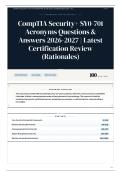
CompTIA Security+ SY0-701
Acronyms Questions &
Answers 2026-2027 | Latest
Certification Review
(Rationales)
Verified Answers Exam Ready With Rationales
100 QUESTIONS
DOCUMENT OVERVIEW
This document provides 100 CompTIA Security+ acronym questions with their correct answers and detailed
rationales. It offers a comprehensive review of key cybersecurity terminology. This resource is ideal for
students preparing for certification exams, reviewing core concepts, or reinforcing their understanding of
the subject.
CONTENTS
Core Security Concepts & Frameworks Q1–Q15
Network Security & Protocols Q16–Q28
Cryptography & Data Protection Q29–Q37
System & Application Security Q38–Q89
Identity, Access & Authentication Q90–Q100
Page 1
, E XA M Q U EST I O N S
Q1 QUESTION 1 OF 100
AAA
CORRECT ANSWER
Authentication, Authorization and Accounting
RATIONALE
AAA is a security framework that verifies user identity, controls access to resources, and logs user actions, ensuring robust
information security. This framework is foundational to network and system access management.
Q2 QUESTION 2 OF 100
AH
CORRECT ANSWER
Authentication Header
RATIONALE
The Authentication Header (AH) protocol provides connectionless integrity and data origin authentication for IP packets,
ensuring that data has not been tampered with in transit. This is the key underlying concept of ensuring data integrity and
authenticity within the IPsec suite.
Q3 QUESTION 3 OF 100
ARO
CORRECT ANSWER
Annualized Rate of Occurrence
RATIONALE
This acronym represents the frequency of an event occurring over a year, reflecting a rate that is adjusted to a twelve-month
period. The core concept tested is the understanding of time-based rate calculations and their annualized standardization.
Q4 QUESTION 4 OF 100
CIA
CORRECT ANSWER
Confidentiality, Integrity, Availability
Page 2
, RATIONALE
The CIA triad represents the three core principles of information security, ensuring data is protected from unauthorized
access, remains accurate and unaltered, and is accessible when needed. This framework guides the development of security
policies and controls to safeguard digital assets.
Q5 QUESTION 5 OF 100
COOP
CORRECT ANSWER
Continuity of Operation Planning
RATIONALE
Continuity of Operation Planning (COOP) establishes procedures to ensure essential functions continue during and after a
disruption. This planning framework is for maintaining critical operations and minimizing the impact of emergencies.
Q6 QUESTION 6 OF 100
COPE
CORRECT ANSWER
Corporate Owned, Personally Enabled
RATIONALE
This acronym describes a mobile device management strategy where the company owns the hardware and software, but
allows employees to use it for personal activities. This model balances corporate security needs with employee flexibility.
Q7 QUESTION 7 OF 100
CP
CORRECT ANSWER
Contingency Planning
RATIONALE
Contingency planning involves developing strategies and actions to address potential disruptions or crises, ensuring
business continuity. This proactive approach prepares an organization to respond effectively to unforeseen events.
Q8 QUESTION 8 OF 100
CVE
Page 3
P R O F E S S I O N A L P R A C T I C E M AT E R I A L S
CompTIA Security+ SY0-701
Acronyms Questions &
Answers 2026-2027 | Latest
Certification Review
(Rationales)
Verified Answers Exam Ready With Rationales
100 QUESTIONS
DOCUMENT OVERVIEW
This document provides 100 CompTIA Security+ acronym questions with their correct answers and detailed
rationales. It offers a comprehensive review of key cybersecurity terminology. This resource is ideal for
students preparing for certification exams, reviewing core concepts, or reinforcing their understanding of
the subject.
CONTENTS
Core Security Concepts & Frameworks Q1–Q15
Network Security & Protocols Q16–Q28
Cryptography & Data Protection Q29–Q37
System & Application Security Q38–Q89
Identity, Access & Authentication Q90–Q100
Page 1
, E XA M Q U EST I O N S
Q1 QUESTION 1 OF 100
AAA
CORRECT ANSWER
Authentication, Authorization and Accounting
RATIONALE
AAA is a security framework that verifies user identity, controls access to resources, and logs user actions, ensuring robust
information security. This framework is foundational to network and system access management.
Q2 QUESTION 2 OF 100
AH
CORRECT ANSWER
Authentication Header
RATIONALE
The Authentication Header (AH) protocol provides connectionless integrity and data origin authentication for IP packets,
ensuring that data has not been tampered with in transit. This is the key underlying concept of ensuring data integrity and
authenticity within the IPsec suite.
Q3 QUESTION 3 OF 100
ARO
CORRECT ANSWER
Annualized Rate of Occurrence
RATIONALE
This acronym represents the frequency of an event occurring over a year, reflecting a rate that is adjusted to a twelve-month
period. The core concept tested is the understanding of time-based rate calculations and their annualized standardization.
Q4 QUESTION 4 OF 100
CIA
CORRECT ANSWER
Confidentiality, Integrity, Availability
Page 2
, RATIONALE
The CIA triad represents the three core principles of information security, ensuring data is protected from unauthorized
access, remains accurate and unaltered, and is accessible when needed. This framework guides the development of security
policies and controls to safeguard digital assets.
Q5 QUESTION 5 OF 100
COOP
CORRECT ANSWER
Continuity of Operation Planning
RATIONALE
Continuity of Operation Planning (COOP) establishes procedures to ensure essential functions continue during and after a
disruption. This planning framework is for maintaining critical operations and minimizing the impact of emergencies.
Q6 QUESTION 6 OF 100
COPE
CORRECT ANSWER
Corporate Owned, Personally Enabled
RATIONALE
This acronym describes a mobile device management strategy where the company owns the hardware and software, but
allows employees to use it for personal activities. This model balances corporate security needs with employee flexibility.
Q7 QUESTION 7 OF 100
CP
CORRECT ANSWER
Contingency Planning
RATIONALE
Contingency planning involves developing strategies and actions to address potential disruptions or crises, ensuring
business continuity. This proactive approach prepares an organization to respond effectively to unforeseen events.
Q8 QUESTION 8 OF 100
CVE
Page 3


