
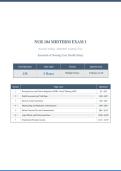
NUR 104 MIDTERM EXAM 1
Excelsior College | 2026/2027 Academic Year
Essentials of Nursing Care: Health Safety
Total Questions Time Limit Format Question Type
130 3 Hours Multiple Choice 4 Options (A-D)
Section Topic Area Questions
1 Nursing Process and Clinical Judgment (ADPIE, Critical Thinking, EBP) Q1 - Q25
2 Health Assessment and Vital Signs Q26 - Q45
3 Infection Control and Safety Q46 - Q65
4 Pharmacology and Medication Administration Q66 - Q85
5 Patient-Centered Care and Communication Q86 - Q105
6 Legal, Ethical, and Professional Issues Q106 - Q120
7 Foundational Nursing Concepts Q121 - Q130
,NUR 104 Midterm Exam 1 | Excelsior College 2026/2027 130 Questions | 3-Hour Time Limit
Q1: A nurse is teaching a group of nursing students about the nursing process. Which of the following lists
the steps of the nursing process in the correct order?
A. Assessment, Diagnosis, Planning, Implementation, Evaluation [CORRECT]
B. Assessment, Planning, Diagnosis, Implementation, Evaluation
C. Diagnosis, Assessment, Planning, Implementation, Evaluation
D. Planning, Assessment, Diagnosis, Implementation, Evaluation
Correct Answer: A
Rationale: The nursing process follows the sequence ADPIE: Assessment, Diagnosis, Planning, Implementation, and Evaluation.
Assessment must come first because data collection informs all subsequent steps. This systematic approach ensures patient-centered
and evidence-based care.
Q2: A nurse is caring for a patient who reports feeling short of breath. The nurse observes the patient using
accessory muscles to breathe and notes a respiratory rate of 28 breaths per minute. Which step of the nursing
process is the nurse performing?
A. Planning
B. Evaluation
C. Implementation
D. Assessment [CORRECT]
Correct Answer: D
Rationale: The nurse is performing the assessment step by collecting both subjective data (patient report of shortness of breath) and
objective data (accessory muscle use, respiratory rate of 28). Assessment involves gathering comprehensive data to identify patient
needs and form a basis for nursing diagnoses.
Q3: Which of the following is the correct format for a NANDA-I nursing diagnosis?
A. Related to (r/t) ... as evidenced by (aeb) ... [CORRECT]
B. Due to ... manifested by ...
C. Secondary to ... resulting in ...
D. Caused by ... demonstrated by ...
Correct Answer: A
Rationale: A NANDA-I nursing diagnosis follows the format of a problem statement (PES format) with "related to" (r/t) identifying
the etiology and "as evidenced by" (aeb) identifying the defining characteristics or signs and symptoms. This structure clearly links the
problem to its cause and supporting clinical evidence.
Q4: A nurse is caring for four patients. Which patient should the nurse prioritize based on Maslow’s
hierarchy of needs?
A. A patient requesting a different diet tray
B. A patient with a blood pressure of 84/52 mmHg and cool, clammy skin [CORRECT]
C. A patient who wants to discuss advance directives
D. A patient expressing loneliness and wanting a visit from family
Correct Answer: B
Rationale: According to Maslow’s hierarchy, physiological needs take priority over all others. A blood pressure of 84/52 mmHg with
cool, clammy skin indicates potential hypovolemic shock, which is a life-threatening physiological need that must be addressed before
safety, love/belonging, or self-actualization needs.
Q5: A nurse is developing a PICOT question for an evidence-based practice project about fall prevention.
What does the "I" in PICOT represent?
Essentials of Nursing Care: Health Safety Page 2
,NUR 104 Midterm Exam 1 | Excelsior College 2026/2027 130 Questions | 3-Hour Time Limit
A. Intervention [CORRECT]
B. Incidence
C. Implementation
D. Investigation
Correct Answer: A
Rationale: In a PICOT question, the "I" stands for Intervention, which is the treatment, action, or approach being considered. The full
framework includes Population, Intervention, Comparison, Outcome, and Time, providing a structured format for focused clinical
questions.
Q6: A nurse is reviewing evidence for a clinical practice change. Which source of evidence represents the
highest level in the evidence hierarchy?
A. Systematic review of randomized controlled trials [CORRECT]
B. Expert opinion from a nursing leader
C. Case report of a single patient
D. Cohort study of 500 patients
Correct Answer: A
Rationale: Systematic reviews of randomized controlled trials (RCTs) represent the highest level of evidence because they synthesize
findings from multiple rigorously controlled studies. The hierarchy ranks evidence from strongest (systematic reviews and
meta-analyses of RCTs) to weakest (expert opinion and case reports).
Q7: A nurse notices that a postoperative patient’s incision dressing has a small amount of serosanguineous
drainage, and the patient’s vital signs are stable. The nurse documents the findings and continues the plan of
care. Which critical thinking skill is the nurse demonstrating?
A. Inference
B. Interpretation
C. Analysis
D. Evaluation [CORRECT]
Correct Answer: D
Rationale: The nurse is demonstrating evaluation by judging the significance and meaning of the assessment data. By determining that
the serosanguineous drainage is expected and the stable vitals indicate no immediate concern, the nurse evaluates the situation and
decides to continue the current plan of care.
Q8: A nursing student asks the instructor about the NCSBN Clinical Judgment Model. Which cognitive skill
in this model involves recognizing cues that deviate from expected findings?
A. Analyze cues [CORRECT]
B. Generate solutions
C. Evaluate outcomes
D. Take action
Correct Answer: A
Rationale: In the NCSBN Clinical Judgment Model, "Analyze Cues" involves recognizing cues that deviate from expected findings and
identifying relationships among cues. This step requires the nurse to cluster relevant data and determine which findings are clinically
significant.
Q9: A nurse is developing a goal for a patient with diabetes who needs to improve blood glucose management.
Which of the following is a SMART goal?
A. The patient will understand diabetes management by discharge
Essentials of Nursing Care: Health Safety Page 3
, NUR 104 Midterm Exam 1 | Excelsior College 2026/2027 130 Questions | 3-Hour Time Limit
B. The patient will maintain blood glucose levels between 70 and 140 mg/dL for three consecutive days by
hospital day 5 [CORRECT]
C. The patient will feel better about their diabetes
D. The patient will take insulin as prescribed
Correct Answer: B
Rationale: A SMART goal is Specific, Measurable, Achievable, Relevant, and Time-bound. This goal specifies blood glucose ranges
(specific and measurable), is clinically realistic (achievable), relates to the health problem (relevant), and has a clear deadline of
hospital day 5 (time-bound).
Q10: A nurse is reviewing a patient’s chart and notes the diagnosis of "Congestive Heart Failure." Which
statement best explains the difference between a nursing diagnosis and a medical diagnosis?
A. A medical diagnosis focuses on the disease process, while a nursing diagnosis focuses on the patient’s
response to the condition [CORRECT]
B. A nursing diagnosis is used to prescribe medications, while a medical diagnosis guides nursing interventions
C. They are interchangeable terms used interchangeably in clinical practice
D. A nursing diagnosis requires laboratory confirmation, while a medical diagnosis does not
Correct Answer: A
Rationale: A medical diagnosis identifies a specific disease or pathology (e.g., Congestive Heart Failure), while a nursing diagnosis
describes the patient’s human response to the condition (e.g., Decreased Cardiac Output r/t altered contractility). Nurses treat the
human response, not the disease itself.
Q11: A nurse assesses a patient and finds flushed skin, diaphoresis, and a blood glucose of 52 mg/dL. The
nurse immediately provides orange juice. Which critical thinking skill did the nurse use to reach this
decision?
A. Inference [CORRECT]
B. Evaluation
C. Analysis
D. Interpretation
Correct Answer: A
Rationale: The nurse used inference by drawing conclusions from the assessment data. Flushed skin, diaphoresis, and a low blood
glucose of 52 mg/dL led the nurse to infer hypoglycemia, prompting the immediate intervention of providing a fast-acting
carbohydrate source.
Q12: A nursing instructor is teaching about the four patterns of knowing in nursing. Which type of
knowledge involves the nurse’s understanding of the moral and ethical aspects of patient care?
A. Ethical knowing [CORRECT]
B. Empirical knowing
C. Aesthetic knowing
D. Personal knowing
Correct Answer: A
Rationale: Ethical knowing refers to the nurse’s understanding of the moral and ethical dimensions of care, including what is right,
wrong, and obligatory. Empirical knowing is based on scientific knowledge, aesthetic knowing involves the art of nursing and
appreciation of unique patient situations, and personal knowing involves self-awareness.
Q13: A nurse has completed a care plan for a patient with impaired swallowing following a stroke. The nurse
places the patient in an upright position and thickens liquids before feeding. Which phase of the nursing
process is the nurse performing?
Essentials of Nursing Care: Health Safety Page 4
Excelsior College | 2026/2027 Academic Year
Essentials of Nursing Care: Health Safety
Total Questions Time Limit Format Question Type
130 3 Hours Multiple Choice 4 Options (A-D)
Section Topic Area Questions
1 Nursing Process and Clinical Judgment (ADPIE, Critical Thinking, EBP) Q1 - Q25
2 Health Assessment and Vital Signs Q26 - Q45
3 Infection Control and Safety Q46 - Q65
4 Pharmacology and Medication Administration Q66 - Q85
5 Patient-Centered Care and Communication Q86 - Q105
6 Legal, Ethical, and Professional Issues Q106 - Q120
7 Foundational Nursing Concepts Q121 - Q130
,NUR 104 Midterm Exam 1 | Excelsior College 2026/2027 130 Questions | 3-Hour Time Limit
Q1: A nurse is teaching a group of nursing students about the nursing process. Which of the following lists
the steps of the nursing process in the correct order?
A. Assessment, Diagnosis, Planning, Implementation, Evaluation [CORRECT]
B. Assessment, Planning, Diagnosis, Implementation, Evaluation
C. Diagnosis, Assessment, Planning, Implementation, Evaluation
D. Planning, Assessment, Diagnosis, Implementation, Evaluation
Correct Answer: A
Rationale: The nursing process follows the sequence ADPIE: Assessment, Diagnosis, Planning, Implementation, and Evaluation.
Assessment must come first because data collection informs all subsequent steps. This systematic approach ensures patient-centered
and evidence-based care.
Q2: A nurse is caring for a patient who reports feeling short of breath. The nurse observes the patient using
accessory muscles to breathe and notes a respiratory rate of 28 breaths per minute. Which step of the nursing
process is the nurse performing?
A. Planning
B. Evaluation
C. Implementation
D. Assessment [CORRECT]
Correct Answer: D
Rationale: The nurse is performing the assessment step by collecting both subjective data (patient report of shortness of breath) and
objective data (accessory muscle use, respiratory rate of 28). Assessment involves gathering comprehensive data to identify patient
needs and form a basis for nursing diagnoses.
Q3: Which of the following is the correct format for a NANDA-I nursing diagnosis?
A. Related to (r/t) ... as evidenced by (aeb) ... [CORRECT]
B. Due to ... manifested by ...
C. Secondary to ... resulting in ...
D. Caused by ... demonstrated by ...
Correct Answer: A
Rationale: A NANDA-I nursing diagnosis follows the format of a problem statement (PES format) with "related to" (r/t) identifying
the etiology and "as evidenced by" (aeb) identifying the defining characteristics or signs and symptoms. This structure clearly links the
problem to its cause and supporting clinical evidence.
Q4: A nurse is caring for four patients. Which patient should the nurse prioritize based on Maslow’s
hierarchy of needs?
A. A patient requesting a different diet tray
B. A patient with a blood pressure of 84/52 mmHg and cool, clammy skin [CORRECT]
C. A patient who wants to discuss advance directives
D. A patient expressing loneliness and wanting a visit from family
Correct Answer: B
Rationale: According to Maslow’s hierarchy, physiological needs take priority over all others. A blood pressure of 84/52 mmHg with
cool, clammy skin indicates potential hypovolemic shock, which is a life-threatening physiological need that must be addressed before
safety, love/belonging, or self-actualization needs.
Q5: A nurse is developing a PICOT question for an evidence-based practice project about fall prevention.
What does the "I" in PICOT represent?
Essentials of Nursing Care: Health Safety Page 2
,NUR 104 Midterm Exam 1 | Excelsior College 2026/2027 130 Questions | 3-Hour Time Limit
A. Intervention [CORRECT]
B. Incidence
C. Implementation
D. Investigation
Correct Answer: A
Rationale: In a PICOT question, the "I" stands for Intervention, which is the treatment, action, or approach being considered. The full
framework includes Population, Intervention, Comparison, Outcome, and Time, providing a structured format for focused clinical
questions.
Q6: A nurse is reviewing evidence for a clinical practice change. Which source of evidence represents the
highest level in the evidence hierarchy?
A. Systematic review of randomized controlled trials [CORRECT]
B. Expert opinion from a nursing leader
C. Case report of a single patient
D. Cohort study of 500 patients
Correct Answer: A
Rationale: Systematic reviews of randomized controlled trials (RCTs) represent the highest level of evidence because they synthesize
findings from multiple rigorously controlled studies. The hierarchy ranks evidence from strongest (systematic reviews and
meta-analyses of RCTs) to weakest (expert opinion and case reports).
Q7: A nurse notices that a postoperative patient’s incision dressing has a small amount of serosanguineous
drainage, and the patient’s vital signs are stable. The nurse documents the findings and continues the plan of
care. Which critical thinking skill is the nurse demonstrating?
A. Inference
B. Interpretation
C. Analysis
D. Evaluation [CORRECT]
Correct Answer: D
Rationale: The nurse is demonstrating evaluation by judging the significance and meaning of the assessment data. By determining that
the serosanguineous drainage is expected and the stable vitals indicate no immediate concern, the nurse evaluates the situation and
decides to continue the current plan of care.
Q8: A nursing student asks the instructor about the NCSBN Clinical Judgment Model. Which cognitive skill
in this model involves recognizing cues that deviate from expected findings?
A. Analyze cues [CORRECT]
B. Generate solutions
C. Evaluate outcomes
D. Take action
Correct Answer: A
Rationale: In the NCSBN Clinical Judgment Model, "Analyze Cues" involves recognizing cues that deviate from expected findings and
identifying relationships among cues. This step requires the nurse to cluster relevant data and determine which findings are clinically
significant.
Q9: A nurse is developing a goal for a patient with diabetes who needs to improve blood glucose management.
Which of the following is a SMART goal?
A. The patient will understand diabetes management by discharge
Essentials of Nursing Care: Health Safety Page 3
, NUR 104 Midterm Exam 1 | Excelsior College 2026/2027 130 Questions | 3-Hour Time Limit
B. The patient will maintain blood glucose levels between 70 and 140 mg/dL for three consecutive days by
hospital day 5 [CORRECT]
C. The patient will feel better about their diabetes
D. The patient will take insulin as prescribed
Correct Answer: B
Rationale: A SMART goal is Specific, Measurable, Achievable, Relevant, and Time-bound. This goal specifies blood glucose ranges
(specific and measurable), is clinically realistic (achievable), relates to the health problem (relevant), and has a clear deadline of
hospital day 5 (time-bound).
Q10: A nurse is reviewing a patient’s chart and notes the diagnosis of "Congestive Heart Failure." Which
statement best explains the difference between a nursing diagnosis and a medical diagnosis?
A. A medical diagnosis focuses on the disease process, while a nursing diagnosis focuses on the patient’s
response to the condition [CORRECT]
B. A nursing diagnosis is used to prescribe medications, while a medical diagnosis guides nursing interventions
C. They are interchangeable terms used interchangeably in clinical practice
D. A nursing diagnosis requires laboratory confirmation, while a medical diagnosis does not
Correct Answer: A
Rationale: A medical diagnosis identifies a specific disease or pathology (e.g., Congestive Heart Failure), while a nursing diagnosis
describes the patient’s human response to the condition (e.g., Decreased Cardiac Output r/t altered contractility). Nurses treat the
human response, not the disease itself.
Q11: A nurse assesses a patient and finds flushed skin, diaphoresis, and a blood glucose of 52 mg/dL. The
nurse immediately provides orange juice. Which critical thinking skill did the nurse use to reach this
decision?
A. Inference [CORRECT]
B. Evaluation
C. Analysis
D. Interpretation
Correct Answer: A
Rationale: The nurse used inference by drawing conclusions from the assessment data. Flushed skin, diaphoresis, and a low blood
glucose of 52 mg/dL led the nurse to infer hypoglycemia, prompting the immediate intervention of providing a fast-acting
carbohydrate source.
Q12: A nursing instructor is teaching about the four patterns of knowing in nursing. Which type of
knowledge involves the nurse’s understanding of the moral and ethical aspects of patient care?
A. Ethical knowing [CORRECT]
B. Empirical knowing
C. Aesthetic knowing
D. Personal knowing
Correct Answer: A
Rationale: Ethical knowing refers to the nurse’s understanding of the moral and ethical dimensions of care, including what is right,
wrong, and obligatory. Empirical knowing is based on scientific knowledge, aesthetic knowing involves the art of nursing and
appreciation of unique patient situations, and personal knowing involves self-awareness.
Q13: A nurse has completed a care plan for a patient with impaired swallowing following a stroke. The nurse
places the patient in an upright position and thickens liquids before feeding. Which phase of the nursing
process is the nurse performing?
Essentials of Nursing Care: Health Safety Page 4


