
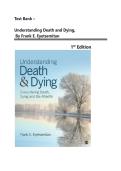
Test Bank –
Understanding Death and Dying,
By Frank E. Eyetsemitan
1st Edition
,TABLE OF CONTENTS
1 Introduction to Death and Dying
2 Death in Historical and Cultural Perspectives
3 Theories and Perspectives on Death and Dying
4 Death Anxiety and Fear of Death
5 Death and Dying Across the Lifespan: Children
6 Death and Dying Across the Lifespan: Adolescents and Young Adults
7 Death and Dying Across the Lifespan: Middle and Older Adults
8 The Dying Process
9 End-of-Life Care and Hospice
10 Grief, Bereavement, and Mourning
11 Suicide
12 Euthanasia and Assisted Death
13 Legal and Ethical Issues in Death and Dying
14 Funeral Practices and Disposition of the Body
15 The Future of Death and Dying
,CHAPTER 1: INTRODUCTION TO DEATH AND DYING
Multiple Choice Questions
1. The academic study of death and dying is known as:
a) Eschatology
b) Thanatology
c) Gerontology
d) Palliative science
Answer: b) Thanatology
Rationale: Thanatology is derived from the Greek word "Thanatos," meaning death. It is
the interdisciplinary study of death, dying, and bereavement.
2. The term "thanatology" is derived from which language?
a) Latin
b) Hebrew
c) Greek
d) Sanskrit
Answer: c) Greek
Rationale: "Thanatos" is the Greek personification and word for death, from which the
term thanatology is derived.
3. Which of the following is considered a pioneer in the modern death and dying
movement?
a) Sigmund Freud
b) Elisabeth Kübler-Ross
c) Carl Jung
d) William James
Answer: b) Elisabeth Kübler-Ross
Rationale: Elisabeth Kübler-Ross is widely regarded as a pioneer in the death and dying
movement, particularly through her groundbreaking book "On Death and Dying" (1969).
4. In the United States, the death awareness movement gained significant momentum
during which decade?
a) 1940s
b) 1950s
c) 1960s-1970s
d) 1990s
, Answer: c) 1960s-1970s
Rationale: The death awareness movement gained prominence in the 1960s and 1970s,
partly due to the work of Kübler-Ross and broader social changes.
5. Which of the following best describes the concept of "death denial" in modern
Western society?
a) People refuse to acknowledge that death exists
b) Society tends to distance itself from death through institutionalization and
euphemisms
c) People believe they will never die
d) Medical professionals refuse to discuss death with patients
Answer: b) Society tends to distance itself from death through institutionalization and
euphemisms
Rationale: Death denial in modern Western culture refers to the tendency to shield
individuals from direct contact with death by moving death to hospitals, using
euphemistic language, and avoiding open discussion.
6. Which of the following is NOT a reason for the increased interest in the study of death
and dying?
a) The aging of the population
b) The AIDS epidemic
c) Increased rates of infant mortality
d) Advances in medical technology
Answer: c) Increased rates of infant mortality
Rationale: Infant mortality rates have actually decreased over time. The other options
are all factors that have contributed to increased interest in death studies.
7. The interdisciplinary nature of thanatology draws from all of the following fields
EXCEPT:
a) Psychology
b) Sociology
c) Astronomy
d) Philosophy
Answer: c) Astronomy
Understanding Death and Dying,
By Frank E. Eyetsemitan
1st Edition
,TABLE OF CONTENTS
1 Introduction to Death and Dying
2 Death in Historical and Cultural Perspectives
3 Theories and Perspectives on Death and Dying
4 Death Anxiety and Fear of Death
5 Death and Dying Across the Lifespan: Children
6 Death and Dying Across the Lifespan: Adolescents and Young Adults
7 Death and Dying Across the Lifespan: Middle and Older Adults
8 The Dying Process
9 End-of-Life Care and Hospice
10 Grief, Bereavement, and Mourning
11 Suicide
12 Euthanasia and Assisted Death
13 Legal and Ethical Issues in Death and Dying
14 Funeral Practices and Disposition of the Body
15 The Future of Death and Dying
,CHAPTER 1: INTRODUCTION TO DEATH AND DYING
Multiple Choice Questions
1. The academic study of death and dying is known as:
a) Eschatology
b) Thanatology
c) Gerontology
d) Palliative science
Answer: b) Thanatology
Rationale: Thanatology is derived from the Greek word "Thanatos," meaning death. It is
the interdisciplinary study of death, dying, and bereavement.
2. The term "thanatology" is derived from which language?
a) Latin
b) Hebrew
c) Greek
d) Sanskrit
Answer: c) Greek
Rationale: "Thanatos" is the Greek personification and word for death, from which the
term thanatology is derived.
3. Which of the following is considered a pioneer in the modern death and dying
movement?
a) Sigmund Freud
b) Elisabeth Kübler-Ross
c) Carl Jung
d) William James
Answer: b) Elisabeth Kübler-Ross
Rationale: Elisabeth Kübler-Ross is widely regarded as a pioneer in the death and dying
movement, particularly through her groundbreaking book "On Death and Dying" (1969).
4. In the United States, the death awareness movement gained significant momentum
during which decade?
a) 1940s
b) 1950s
c) 1960s-1970s
d) 1990s
, Answer: c) 1960s-1970s
Rationale: The death awareness movement gained prominence in the 1960s and 1970s,
partly due to the work of Kübler-Ross and broader social changes.
5. Which of the following best describes the concept of "death denial" in modern
Western society?
a) People refuse to acknowledge that death exists
b) Society tends to distance itself from death through institutionalization and
euphemisms
c) People believe they will never die
d) Medical professionals refuse to discuss death with patients
Answer: b) Society tends to distance itself from death through institutionalization and
euphemisms
Rationale: Death denial in modern Western culture refers to the tendency to shield
individuals from direct contact with death by moving death to hospitals, using
euphemistic language, and avoiding open discussion.
6. Which of the following is NOT a reason for the increased interest in the study of death
and dying?
a) The aging of the population
b) The AIDS epidemic
c) Increased rates of infant mortality
d) Advances in medical technology
Answer: c) Increased rates of infant mortality
Rationale: Infant mortality rates have actually decreased over time. The other options
are all factors that have contributed to increased interest in death studies.
7. The interdisciplinary nature of thanatology draws from all of the following fields
EXCEPT:
a) Psychology
b) Sociology
c) Astronomy
d) Philosophy
Answer: c) Astronomy


