

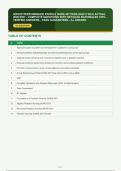
GROUP PERFORMANCE PROFILE NURS 307 PEDS QUIZ 5 WCU ACTUAL
2026/2027 - COMPLETE QUESTIONS WITH DETAILED RATIONALES 100%
VERIFIED ANSWERS - PASS GUARANTEED - A+ GRADED
190 QUESTIONS
TABLE OF CONTENTS
# TOPIC
1 Apply principles of growth and development to pediatric nursing care
2 Analyze pediatric pathophysiology and pharmacotherapeutics across age groups
3 Integrate family-centered and culturally competent care in pediatric practice
4 Evaluate evidence-based interventions for common and complex pediatric conditions
5 Prioritize nursing actions using clinical judgment and safety standards
6 Group Performance Profile NURS 307 Peds Quiz 5 WCU Actual 2026
7 2027
8 Complete Questions with Detailed Rationales 100% Verified Answers
9 Pass Guaranteed
10 A+ Graded
11 Foundations of Pediatric Nursing (NURS 307)
12 Applied Pediatric Nursing (NURS 307)
13 Advanced Pediatric Nursing (NURS 307)
14 Pediatric Nursing (NURS 307) Review
Page 1
,Q1 APPLY PRINCIPLES OF GROWTH AND DEVELOPMENT TO PEDIATRIC NURSING CARE
In a pediatric resuscitation scenario, the team leader orders an intraosseous (IO)
line after multiple failed peripheral attempts. Which action demonstrates the
correct priority when administering medications via the IO route?
A. Flush with 5 mL normal saline before each medication to ensure patency.
B. Use a manual push with a 10 mL syringe to overcome intramedullary resistance. CORRECT
C. Administer medications via continuous infusion only, as bolus dosing is unsafe.
D. Confirm placement by bone marrow aspiration before any drug administration.
RATIONALE: IO access requires high-pressure flush; a 10 mL syringe generates sufficient
pressure for marrow infusion. A 5 mL flush is insufficient, continuous infusion is not required, and
aspiration confirms placement but delays critical meds.
Q2 APPLY PRINCIPLES OF GROWTH AND DEVELOPMENT TO PEDIATRIC NURSING CARE
A nurse is teaching a family about the pharmacokinetics of a medication that is
extensively metabolized by the liver. Which developmental change in a school-age
child compared to an infant most significantly alters drug dosing?
A. Increased glomerular filtration rate.
B. Increased hepatic microsomal enzyme activity. CORRECT
C. Decreased total body water proportion.
D. Increased gastric acid production.
RATIONALE: Hepatic enzyme activity matures during early childhood, reaching adult levels by
school age, increasing metabolism and requiring higher mg/kg doses. Glomerular filtration affects
renal clearance, not hepatic metabolism. Body water and gastric acid affect distribution and
absorption, not hepatic metabolism.
Page 2
,Q3 APPLY PRINCIPLES OF GROWTH AND DEVELOPMENT TO PEDIATRIC NURSING CARE
A previously healthy child presents with a 3-day history of high fever, irritability,
and a maculopapular rash that started on the face and spread to the trunk. The
child has a positive Koplik spots on buccal mucosa. Which nursing intervention is
most critical?
A. Initiate airborne precautions and report to public health. CORRECT
B. Administer measles-mumps-rubella (MMR) vaccine immediately.
C. Place on droplet precautions and provide dim lighting.
D. Prepare for lumbar puncture to rule out meningitis.
RATIONALE: The presentation is classic measles, a highly contagious airborne disease. Airborne
precautions and immediate reporting are essential for outbreak control. MMR is contraindicated
during active infection, droplet precautions are insufficient, and lumbar puncture is not indicated
without neurological signs.
Q4 APPLY PRINCIPLES OF GROWTH AND DEVELOPMENT TO PEDIATRIC NURSING CARE
A nurse is assessing a child with suspected increased intracranial pressure (ICP).
Which finding is most indicative of Cushing's triad in a child?
A. Irregular respirations, bradycardia, and widened pulse pressure. CORRECT
B. Tachycardia, hypotension, and rapid shallow respirations.
C. Fever, hypertension, and tachypnea.
D. Cheyne-Stokes respirations, tachycardia, and narrowed pulse pressure.
RATIONALE: Cushing's triad-irregular respirations, bradycardia, and hypertension with widened
pulse pressure-indicates brainstem compression. The other options do not reflect this classic
triad.
Page 3
, Q5 APPLY PRINCIPLES OF GROWTH AND DEVELOPMENT TO PEDIATRIC NURSING CARE
A 6-month-old infant is diagnosed with respiratory syncytial virus (RSV)
bronchiolitis. Which assessment finding would indicate the need for immediate
respiratory support?
A. Oxygen saturation of 92% on room air.
B. Mild intercostal retractions and nasal flaring.
C. Apnea lasting 15 seconds with bradycardia. CORRECT
D. Feeding difficulty but alert and interactive.
RATIONALE: Apnea is a severe sign in infants with RSV and indicates impending respiratory
failure. Mild hypoxemia and retractions may be managed with oxygen and supportive care.
Apnea requires immediate intervention.
Q6 APPLY PRINCIPLES OF GROWTH AND DEVELOPMENT TO PEDIATRIC NURSING CARE
A nurse is reviewing the laboratory results of a child with acute
glomerulonephritis. Which finding is most consistent with this diagnosis?
A. Elevated serum complement C3.
B. Low serum albumin and proteinuria.
C. Elevated antistreptolysin O (ASO) titer and hematuria. CORRECT
D. Hyperkalemia and metabolic acidosis.
RATIONALE: Post-streptococcal glomerulonephritis presents with elevated ASO titers,
hematuria, and low complement C3. Low albumin and proteinuria are more typical of nephrotic
syndrome. Hyperkalemia and acidosis are not primary features.
Page 4
2026/2027 - COMPLETE QUESTIONS WITH DETAILED RATIONALES 100%
VERIFIED ANSWERS - PASS GUARANTEED - A+ GRADED
190 QUESTIONS
TABLE OF CONTENTS
# TOPIC
1 Apply principles of growth and development to pediatric nursing care
2 Analyze pediatric pathophysiology and pharmacotherapeutics across age groups
3 Integrate family-centered and culturally competent care in pediatric practice
4 Evaluate evidence-based interventions for common and complex pediatric conditions
5 Prioritize nursing actions using clinical judgment and safety standards
6 Group Performance Profile NURS 307 Peds Quiz 5 WCU Actual 2026
7 2027
8 Complete Questions with Detailed Rationales 100% Verified Answers
9 Pass Guaranteed
10 A+ Graded
11 Foundations of Pediatric Nursing (NURS 307)
12 Applied Pediatric Nursing (NURS 307)
13 Advanced Pediatric Nursing (NURS 307)
14 Pediatric Nursing (NURS 307) Review
Page 1
,Q1 APPLY PRINCIPLES OF GROWTH AND DEVELOPMENT TO PEDIATRIC NURSING CARE
In a pediatric resuscitation scenario, the team leader orders an intraosseous (IO)
line after multiple failed peripheral attempts. Which action demonstrates the
correct priority when administering medications via the IO route?
A. Flush with 5 mL normal saline before each medication to ensure patency.
B. Use a manual push with a 10 mL syringe to overcome intramedullary resistance. CORRECT
C. Administer medications via continuous infusion only, as bolus dosing is unsafe.
D. Confirm placement by bone marrow aspiration before any drug administration.
RATIONALE: IO access requires high-pressure flush; a 10 mL syringe generates sufficient
pressure for marrow infusion. A 5 mL flush is insufficient, continuous infusion is not required, and
aspiration confirms placement but delays critical meds.
Q2 APPLY PRINCIPLES OF GROWTH AND DEVELOPMENT TO PEDIATRIC NURSING CARE
A nurse is teaching a family about the pharmacokinetics of a medication that is
extensively metabolized by the liver. Which developmental change in a school-age
child compared to an infant most significantly alters drug dosing?
A. Increased glomerular filtration rate.
B. Increased hepatic microsomal enzyme activity. CORRECT
C. Decreased total body water proportion.
D. Increased gastric acid production.
RATIONALE: Hepatic enzyme activity matures during early childhood, reaching adult levels by
school age, increasing metabolism and requiring higher mg/kg doses. Glomerular filtration affects
renal clearance, not hepatic metabolism. Body water and gastric acid affect distribution and
absorption, not hepatic metabolism.
Page 2
,Q3 APPLY PRINCIPLES OF GROWTH AND DEVELOPMENT TO PEDIATRIC NURSING CARE
A previously healthy child presents with a 3-day history of high fever, irritability,
and a maculopapular rash that started on the face and spread to the trunk. The
child has a positive Koplik spots on buccal mucosa. Which nursing intervention is
most critical?
A. Initiate airborne precautions and report to public health. CORRECT
B. Administer measles-mumps-rubella (MMR) vaccine immediately.
C. Place on droplet precautions and provide dim lighting.
D. Prepare for lumbar puncture to rule out meningitis.
RATIONALE: The presentation is classic measles, a highly contagious airborne disease. Airborne
precautions and immediate reporting are essential for outbreak control. MMR is contraindicated
during active infection, droplet precautions are insufficient, and lumbar puncture is not indicated
without neurological signs.
Q4 APPLY PRINCIPLES OF GROWTH AND DEVELOPMENT TO PEDIATRIC NURSING CARE
A nurse is assessing a child with suspected increased intracranial pressure (ICP).
Which finding is most indicative of Cushing's triad in a child?
A. Irregular respirations, bradycardia, and widened pulse pressure. CORRECT
B. Tachycardia, hypotension, and rapid shallow respirations.
C. Fever, hypertension, and tachypnea.
D. Cheyne-Stokes respirations, tachycardia, and narrowed pulse pressure.
RATIONALE: Cushing's triad-irregular respirations, bradycardia, and hypertension with widened
pulse pressure-indicates brainstem compression. The other options do not reflect this classic
triad.
Page 3
, Q5 APPLY PRINCIPLES OF GROWTH AND DEVELOPMENT TO PEDIATRIC NURSING CARE
A 6-month-old infant is diagnosed with respiratory syncytial virus (RSV)
bronchiolitis. Which assessment finding would indicate the need for immediate
respiratory support?
A. Oxygen saturation of 92% on room air.
B. Mild intercostal retractions and nasal flaring.
C. Apnea lasting 15 seconds with bradycardia. CORRECT
D. Feeding difficulty but alert and interactive.
RATIONALE: Apnea is a severe sign in infants with RSV and indicates impending respiratory
failure. Mild hypoxemia and retractions may be managed with oxygen and supportive care.
Apnea requires immediate intervention.
Q6 APPLY PRINCIPLES OF GROWTH AND DEVELOPMENT TO PEDIATRIC NURSING CARE
A nurse is reviewing the laboratory results of a child with acute
glomerulonephritis. Which finding is most consistent with this diagnosis?
A. Elevated serum complement C3.
B. Low serum albumin and proteinuria.
C. Elevated antistreptolysin O (ASO) titer and hematuria. CORRECT
D. Hyperkalemia and metabolic acidosis.
RATIONALE: Post-streptococcal glomerulonephritis presents with elevated ASO titers,
hematuria, and low complement C3. Low albumin and proteinuria are more typical of nephrotic
syndrome. Hyperkalemia and acidosis are not primary features.
Page 4


