

NASM Corrective Exercise Specialist Exam Study Guide
Study online at https://quizlet.com/_ezgrlx
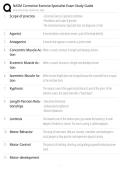
1. Scope of practice -Corrective Exercise Specialist credential
-Procedures and scope of practice
-The Corrective Exercise Specialist does not diagnose or treat
2. Agonist A muscle whose contraction moves a part of the body directly
3. Antagonist A muscle that opposes or reverses a prime mover
4. Concentric Muscle Ac- When a muscle shortens in length and develops tension
tion
5. Eccentric Muscle Ac- When a muscle increases in length and develops tension
tion
6. Isometric Muscle Ac- When muscle length does not change because the contractile force is equal
tion to the resistive force
7. Kyphosis The natural curve of the upper back (thoracic) area of the spine. In the
extreme curves, the spine looks like a "hunchback.".
8. Length-Tension Rela- -Overactive/Shortened
tionships -Underactive/Lengthened
-Muscle imbalances
9. Lordosis The inward curve of the lumbar spine (just above the buttocks). A small
degree of lordosis is normal. Too much curving is called swayback.
10. Motor Behavior The study of how motor skills are. learned, controlled, and developed to
assist people as they practice and experience physical activity.
11. Motor Control The process of initiating, directing, and grading purposeful voluntary move-
ment.
12. Motor development
1/9
, NASM Corrective Exercise Specialist Exam Study Guide
Study online at https://quizlet.com/_ezgrlx
The physical growth and strengthening of a child's bones, muscles and
ability to move and touch his/her surroundings
13. Motor Learning A complex process occurring in the brain in response to practice or experi-
ence of a certain skill resulting in changes in the central nervous system.
14. Movement Compen- When an athlete moves in a way that is less effective and efficient, and
sation therefore has less transferability.
15. Neural Drive The body's ability to recruit motor units and activate the muscle.
16. Neuro Muscular Effi- A variable that evaluates the relationship between the amount of neural
ciency stimuli and the ability to generate force of in a given muscle, with the
most efficient being the one that produces greater muscle force, with less
activation of muscle fibers.
17. Overactive/Short- A state of having disrupted neuromuscular recruitment patterns that lead a
ened Muscle muscle to be more active during a joint action.
18. Proprioception Perception or awareness of the position and movement of the body.
19. Reciprocal Inhibition A general phenomenon in which the stretch of one muscle inhibits the
activity of the opposing muscle.
20. Synergist A muscle that assists the agonist muscle or "primary mover" for a specific
action at a joint.
21. Stabalizer Muscles that contribute to joint stiffness by co-contraction and show an early
onset of activation in response to perturbation via either a feed-forward or
a feedback control mechanism.
22. Underactive/Length- A state of having disrupted neuromuscular recruitment patterns that lead a
ened Muscle muscle to be relatively less active during a joint action
2/9
Study online at https://quizlet.com/_ezgrlx
1. Scope of practice -Corrective Exercise Specialist credential
-Procedures and scope of practice
-The Corrective Exercise Specialist does not diagnose or treat
2. Agonist A muscle whose contraction moves a part of the body directly
3. Antagonist A muscle that opposes or reverses a prime mover
4. Concentric Muscle Ac- When a muscle shortens in length and develops tension
tion
5. Eccentric Muscle Ac- When a muscle increases in length and develops tension
tion
6. Isometric Muscle Ac- When muscle length does not change because the contractile force is equal
tion to the resistive force
7. Kyphosis The natural curve of the upper back (thoracic) area of the spine. In the
extreme curves, the spine looks like a "hunchback.".
8. Length-Tension Rela- -Overactive/Shortened
tionships -Underactive/Lengthened
-Muscle imbalances
9. Lordosis The inward curve of the lumbar spine (just above the buttocks). A small
degree of lordosis is normal. Too much curving is called swayback.
10. Motor Behavior The study of how motor skills are. learned, controlled, and developed to
assist people as they practice and experience physical activity.
11. Motor Control The process of initiating, directing, and grading purposeful voluntary move-
ment.
12. Motor development
1/9
, NASM Corrective Exercise Specialist Exam Study Guide
Study online at https://quizlet.com/_ezgrlx
The physical growth and strengthening of a child's bones, muscles and
ability to move and touch his/her surroundings
13. Motor Learning A complex process occurring in the brain in response to practice or experi-
ence of a certain skill resulting in changes in the central nervous system.
14. Movement Compen- When an athlete moves in a way that is less effective and efficient, and
sation therefore has less transferability.
15. Neural Drive The body's ability to recruit motor units and activate the muscle.
16. Neuro Muscular Effi- A variable that evaluates the relationship between the amount of neural
ciency stimuli and the ability to generate force of in a given muscle, with the
most efficient being the one that produces greater muscle force, with less
activation of muscle fibers.
17. Overactive/Short- A state of having disrupted neuromuscular recruitment patterns that lead a
ened Muscle muscle to be more active during a joint action.
18. Proprioception Perception or awareness of the position and movement of the body.
19. Reciprocal Inhibition A general phenomenon in which the stretch of one muscle inhibits the
activity of the opposing muscle.
20. Synergist A muscle that assists the agonist muscle or "primary mover" for a specific
action at a joint.
21. Stabalizer Muscles that contribute to joint stiffness by co-contraction and show an early
onset of activation in response to perturbation via either a feed-forward or
a feedback control mechanism.
22. Underactive/Length- A state of having disrupted neuromuscular recruitment patterns that lead a
ened Muscle muscle to be relatively less active during a joint action
2/9


