
Esthetician State Board Q
Esthetician State Board
Study online at https://quizlet.com/_4y3lw9
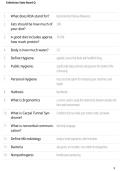
1. What does RDA stand for? Recommended Dietary Allowances
2. Fats should be how much of 30%
your diet?
3. A good diet includes approx. 10-35%
how much protein?
4. Body is how much water? 2/3
5. Define Hygiene. applied science that deals with healthful living.
6. Public Hygiene. significantly helps promote and preserve the health of the
community.
7. Personal Hygiene Your personal system for maintaing your cleanliness and
health.
8. Halitosis bad breath
9. What is Ergonomics a science used to study the relationship between people and
their work enviornment.
10. What is Carpal Tunnel Syn- Condition that can make your hands numb, and weak.
drome?
11. What is nonverbal communi- Aka Body language.
cation?
12. Define MIcrobiology study of small organisms called microbes.
13. Bacteria aka germs, or microbes. one celled microorganisms.
14. Nonpathogenic Nondiesease-producing
1
, Esthetician State Board Q
Esthetician State Board
Study online at https://quizlet.com/_4y3lw9
15. Pathogenic Disease producing
16. Nonpathogenic Bacteria are 70%
approx. ___ of all bacteria.
17. Saprophytes nonpathogenic bacteria that live on dead matter
18. Bacteriology study of bacteria.
19. What are the three basic Circular, Rod, and Spiral
shapes of bacteria?
20. Cocci Spherical or round shaped bacterial cells - can appear singu-
larly or in groups.
21. Staphylococci pus-forming bacterial cells that form grape like clusters. pre-
sent in abcesses, pustules, and boils.
22. Staphylococci can be in pre- abcesses, pustules, and boils
sent in .....
23. Streptococci pus-forming bacterial cells that form long chains and can
cause septicemia (blood poisoning) strept throat, rheumatic
fever etc ..
24. Diplococci grow in pairs. cause pneumonia
25. Bacilli most common. bar or rod shaped. can cause influenza, tuber-
culosis
26. Spirilla spiraled, coiled, corkscrew shaped bacterial cells. HIGHLY
CONTAGIOUS DISEASES ! ex: syphilis, and cholera
27. Bacillia and spirilla have the Flagella or cilia
ability to move themselves
2
, Esthetician State Board Q
Esthetician State Board
Study online at https://quizlet.com/_4y3lw9
using hair like projections
called...
28. Bacteria thrive in .... dark, damp, and dirty areas where food source is available.
29. 2 stages of bacteria Inactive, and Active
30. Active Stage aka vegatative Bacteria reproduce and grow rapidly as many as 16 million
(Bacteria) offspring in 12 hrs.
31. Mitosis process of cell division
32. Inactive Stage Unfavorable conditions for bacteria to grow cells die or be-
come inactive Some bacteria enter a spore forming stage.
spherical spores resistant to disinfectants, cold, or heat.
33. Virus sub-microscopic infectious agent that replicates itself only
within the cells of living hosts. Much smaller than bacteria but
causes more serious diseases ex: herpes, chicken pox.
34. HBV Hepatitis B Virus highly infectious disease that affects liver.
35. AIDS highly infectious disease caused by HIV interferes with bodys
natural immune system. HIV is spread by blood or body fluids
from an infected individual
36. External Parasites organisms that grow and feed on other living organisms
referred to as hosts. Contribute nothing to host and cause
contagious diseases.
37. Name 2 Parasitic Animals Head lice, and Itch mites
38. Infection
3
Esthetician State Board
Study online at https://quizlet.com/_4y3lw9
1. What does RDA stand for? Recommended Dietary Allowances
2. Fats should be how much of 30%
your diet?
3. A good diet includes approx. 10-35%
how much protein?
4. Body is how much water? 2/3
5. Define Hygiene. applied science that deals with healthful living.
6. Public Hygiene. significantly helps promote and preserve the health of the
community.
7. Personal Hygiene Your personal system for maintaing your cleanliness and
health.
8. Halitosis bad breath
9. What is Ergonomics a science used to study the relationship between people and
their work enviornment.
10. What is Carpal Tunnel Syn- Condition that can make your hands numb, and weak.
drome?
11. What is nonverbal communi- Aka Body language.
cation?
12. Define MIcrobiology study of small organisms called microbes.
13. Bacteria aka germs, or microbes. one celled microorganisms.
14. Nonpathogenic Nondiesease-producing
1
, Esthetician State Board Q
Esthetician State Board
Study online at https://quizlet.com/_4y3lw9
15. Pathogenic Disease producing
16. Nonpathogenic Bacteria are 70%
approx. ___ of all bacteria.
17. Saprophytes nonpathogenic bacteria that live on dead matter
18. Bacteriology study of bacteria.
19. What are the three basic Circular, Rod, and Spiral
shapes of bacteria?
20. Cocci Spherical or round shaped bacterial cells - can appear singu-
larly or in groups.
21. Staphylococci pus-forming bacterial cells that form grape like clusters. pre-
sent in abcesses, pustules, and boils.
22. Staphylococci can be in pre- abcesses, pustules, and boils
sent in .....
23. Streptococci pus-forming bacterial cells that form long chains and can
cause septicemia (blood poisoning) strept throat, rheumatic
fever etc ..
24. Diplococci grow in pairs. cause pneumonia
25. Bacilli most common. bar or rod shaped. can cause influenza, tuber-
culosis
26. Spirilla spiraled, coiled, corkscrew shaped bacterial cells. HIGHLY
CONTAGIOUS DISEASES ! ex: syphilis, and cholera
27. Bacillia and spirilla have the Flagella or cilia
ability to move themselves
2
, Esthetician State Board Q
Esthetician State Board
Study online at https://quizlet.com/_4y3lw9
using hair like projections
called...
28. Bacteria thrive in .... dark, damp, and dirty areas where food source is available.
29. 2 stages of bacteria Inactive, and Active
30. Active Stage aka vegatative Bacteria reproduce and grow rapidly as many as 16 million
(Bacteria) offspring in 12 hrs.
31. Mitosis process of cell division
32. Inactive Stage Unfavorable conditions for bacteria to grow cells die or be-
come inactive Some bacteria enter a spore forming stage.
spherical spores resistant to disinfectants, cold, or heat.
33. Virus sub-microscopic infectious agent that replicates itself only
within the cells of living hosts. Much smaller than bacteria but
causes more serious diseases ex: herpes, chicken pox.
34. HBV Hepatitis B Virus highly infectious disease that affects liver.
35. AIDS highly infectious disease caused by HIV interferes with bodys
natural immune system. HIV is spread by blood or body fluids
from an infected individual
36. External Parasites organisms that grow and feed on other living organisms
referred to as hosts. Contribute nothing to host and cause
contagious diseases.
37. Name 2 Parasitic Animals Head lice, and Itch mites
38. Infection
3


