
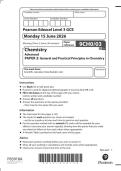
Please check the examination details below before entering your candidate information
Candidate surname Other names
Centre Number Candidate Number
Pearson Edexcel Level 3 GCE
Monday 15 June 2026
Morning (Time: 2 hours 30 minutes) Paper
reference 9CH0/03
Chemistry
Advanced
PAPER 3: General and Practical Principles in Chemistry
You must have: Total Marks
Scientific calculator, Data Booklet, ruler
Instructions
• Use black ink or ball-point pen.
• IfFillpencil is used for diagrams/sketches/graphs it must be dark (HB or B).
• centrein the boxes at the top of this page with your name,
number and candidate number.
• Answer allthequestions.
Answer
• – there may questions in the spaces provided
be more space than you need.
Information
• The total mark for this paper is 120.
• The marks for each question are shown in brackets
– use this as a guide as to how much time to spend on each question.
• For the question marked with an asterisk (*), marks will be awarded for your
ability to structure your answer logically, showing how the points that you make
are related or follow on from each other where appropriate.
• A Periodic Table is printed on the back cover of this paper.
Advice
• Read each question carefully before you start to answer it.
• Show all your working in calculations and include units where appropriate.
• Check your answers if you have time at the end. Turn over
P83918A
©2026 Pearson Education Ltd.
P:1/1/1/1/1/1/1/1/
*P83918A0136* for more:
, Answer ALL questions.
Write your answers in the spaces provided.
DO NOT WRITE IN THIS AREA
1 This question is about isotopes.
(a) Explain why isotopes of the same element are distinguished by
mass number and not by atomic number.
Refer to sub-atomic particles in your answer.
(2)
. . . . . . . . . . . . ..................... . . . . . . . . . . . . . . . . . . . . . . . . . . . . . . . . . . . . . . . . . . . . . . . . . . . . . . . . . . . . . . . . . . . . ........................................................................................................................................... .............. .. . . . . . . . . . . . . . . . . . . . .
. . . . . . . . . . . . ..................... . . . . . . . . . . . . . . . . . . . . . . . . . . . . . . . . . . . . . . . . . . . . . . . . . . . . . . . . . . . . . . . . . . . . ........................................................................................................................................... .............. .. . . . . . . . . . . . . . . . . . . . .
. . . . . . . . . . . . ..................... . . . . . . . . . . . . . . . . . . . . . . . . . . . . . . . . . . . . . . . . . . . . . . . . . . . . . . . . . . . . . . . . . . . . ........................................................................................................................................... .............. .. . . . . . . . . . . . . . . . . . . . .
. . . . . . . . . . . . ..................... . . . . . . . . . . . . . . . . . . . . . . . . . . . . . . . . . . . . . . . . . . . . . . . . . . . . . . . . . . . . . . . . . . . . ........................................................................................................................................... .............. .. . . . . . . . . . . . . . . . . . . . .
(b) Twenty isotopes of neon are known.
DO NOT WRITE IN THIS AREA
One sample of neon contained three stable isotopes of neon with the percentage
abundances shown.
Isotope Relative isotopic mass Percentage abundance
20
Ne 19.99 90.48
21
Ne 20.99 0.27
22
Ne 21.99 9.25
Calculate the relative atomic mass of neon in this sample.
Give your answer to two decimal places.
(2)
DO NOT WRITE IN THIS AREA
2 for more:
*P83918A0236*
Candidate surname Other names
Centre Number Candidate Number
Pearson Edexcel Level 3 GCE
Monday 15 June 2026
Morning (Time: 2 hours 30 minutes) Paper
reference 9CH0/03
Chemistry
Advanced
PAPER 3: General and Practical Principles in Chemistry
You must have: Total Marks
Scientific calculator, Data Booklet, ruler
Instructions
• Use black ink or ball-point pen.
• IfFillpencil is used for diagrams/sketches/graphs it must be dark (HB or B).
• centrein the boxes at the top of this page with your name,
number and candidate number.
• Answer allthequestions.
Answer
• – there may questions in the spaces provided
be more space than you need.
Information
• The total mark for this paper is 120.
• The marks for each question are shown in brackets
– use this as a guide as to how much time to spend on each question.
• For the question marked with an asterisk (*), marks will be awarded for your
ability to structure your answer logically, showing how the points that you make
are related or follow on from each other where appropriate.
• A Periodic Table is printed on the back cover of this paper.
Advice
• Read each question carefully before you start to answer it.
• Show all your working in calculations and include units where appropriate.
• Check your answers if you have time at the end. Turn over
P83918A
©2026 Pearson Education Ltd.
P:1/1/1/1/1/1/1/1/
*P83918A0136* for more:
, Answer ALL questions.
Write your answers in the spaces provided.
DO NOT WRITE IN THIS AREA
1 This question is about isotopes.
(a) Explain why isotopes of the same element are distinguished by
mass number and not by atomic number.
Refer to sub-atomic particles in your answer.
(2)
. . . . . . . . . . . . ..................... . . . . . . . . . . . . . . . . . . . . . . . . . . . . . . . . . . . . . . . . . . . . . . . . . . . . . . . . . . . . . . . . . . . . ........................................................................................................................................... .............. .. . . . . . . . . . . . . . . . . . . . .
. . . . . . . . . . . . ..................... . . . . . . . . . . . . . . . . . . . . . . . . . . . . . . . . . . . . . . . . . . . . . . . . . . . . . . . . . . . . . . . . . . . . ........................................................................................................................................... .............. .. . . . . . . . . . . . . . . . . . . . .
. . . . . . . . . . . . ..................... . . . . . . . . . . . . . . . . . . . . . . . . . . . . . . . . . . . . . . . . . . . . . . . . . . . . . . . . . . . . . . . . . . . . ........................................................................................................................................... .............. .. . . . . . . . . . . . . . . . . . . . .
. . . . . . . . . . . . ..................... . . . . . . . . . . . . . . . . . . . . . . . . . . . . . . . . . . . . . . . . . . . . . . . . . . . . . . . . . . . . . . . . . . . . ........................................................................................................................................... .............. .. . . . . . . . . . . . . . . . . . . . .
(b) Twenty isotopes of neon are known.
DO NOT WRITE IN THIS AREA
One sample of neon contained three stable isotopes of neon with the percentage
abundances shown.
Isotope Relative isotopic mass Percentage abundance
20
Ne 19.99 90.48
21
Ne 20.99 0.27
22
Ne 21.99 9.25
Calculate the relative atomic mass of neon in this sample.
Give your answer to two decimal places.
(2)
DO NOT WRITE IN THIS AREA
2 for more:
*P83918A0236*


