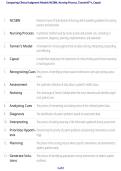
Comparing Clinical Judgment Models NCSBN, Nursing Process, Tanner’s, Caputi
Comparing Clinical Judgment Models: NCSBN, Nursing Process, Tanner’s,
Caputi
Study online at https://quizlet.com/_jrcbcr
1. NCSBN National Council of State Boards of Nursing, which provides guidelines for nursing
practice and education.
2. Nursing Process A systematic method used by nurses to plan and provide care, consisting of
assessment, diagnosis, planning, implementation, and evaluation.
3. Tanner's Model A framework for clinical judgment that includes noticing, interpreting, responding,
and reflecting.
4. Caputi A model that emphasizes the importance of critical thinking and clinical reasoning
in nursing practice.
5. Recognizing Cues The process of identifying relevant patient information and signs during assess-
ment.
6. Assessment The systematic collection of data about a patient's health status.
7. Noticing The initial stage of Tanner's Model where the nurse observes and identifies signif-
icant patient cues.
8. Analyzing Cues The process of interpreting and making sense of the collected patient data.
9. Diagnosis The identification of patient problems based on assessment data.
10. Interpreting The process of making meaning of the information gathered during assessment.
11. Prioritize Hypoth- Determining the priority of patient problems and planning interventions accord-
esis ingly.
12. Planning The phase in the nursing process where specific interventions are determined to
address patient needs.
13. Generate Solu- The process of identifying appropriate nursing interventions to address patient
tions problems.
1/2
1 of 2
Comparing Clinical Judgment Models: NCSBN, Nursing Process, Tanner’s,
Caputi
Study online at https://quizlet.com/_jrcbcr
1. NCSBN National Council of State Boards of Nursing, which provides guidelines for nursing
practice and education.
2. Nursing Process A systematic method used by nurses to plan and provide care, consisting of
assessment, diagnosis, planning, implementation, and evaluation.
3. Tanner's Model A framework for clinical judgment that includes noticing, interpreting, responding,
and reflecting.
4. Caputi A model that emphasizes the importance of critical thinking and clinical reasoning
in nursing practice.
5. Recognizing Cues The process of identifying relevant patient information and signs during assess-
ment.
6. Assessment The systematic collection of data about a patient's health status.
7. Noticing The initial stage of Tanner's Model where the nurse observes and identifies signif-
icant patient cues.
8. Analyzing Cues The process of interpreting and making sense of the collected patient data.
9. Diagnosis The identification of patient problems based on assessment data.
10. Interpreting The process of making meaning of the information gathered during assessment.
11. Prioritize Hypoth- Determining the priority of patient problems and planning interventions accord-
esis ingly.
12. Planning The phase in the nursing process where specific interventions are determined to
address patient needs.
13. Generate Solu- The process of identifying appropriate nursing interventions to address patient
tions problems.
1/2
1 of 2