
HLSC 222 - Pathophysiology: Final Exam
Study online at https://quizlet.com/_6h1i8i
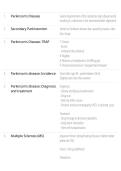
1. Parkinson's Disease Severe degeneration of the substantia nigra (basal nuclei)
resulting in a decrease in the neurotransmitter dopamine
2. Secondary Parkinsonism Similar to Parkinson disease but caused by trauma, infec-
tion, drugs
3. Parkinson's Disease: TRAP T: Tremor
- At rest
- Unilateral then bilateral
R: Rigidity
A: Akinesia or bradykinesia: Shuffling gait
P: Postural disturbances: Stooped/bent forward
4. Parkinson's disease: Incidence Onset after age 40 - peak between 58-62
Slightly more men than women
5. Parkinson's disease: Diagnosis Diagnosis:
and treatment - History and physical examination
- Drug trial
- Rule out other causes
- Positron emission tomography (PET) in selected cases
Treatment:
- Drug therapy to decrease symptoms
- Deep brain stimulation
- Stem cell transplantation
6. Multiple Sclerosis (MS) Acquired chronic demyelinating disease of white matter
within the CNS
Onset - Young adulthood
Prevalence:
, HLSC 222 - Pathophysiology: Final Exam
Study online at https://quizlet.com/_6h1i8i
- Increased in northern latitudes
- Women affected twice as much as men
- Northern european ancestors
7. MS pathophysiology Autoimmune disorder
- T cells and B cells cross the BBB
- Inflammation-induced loss of oligodendrocytes
- Disrupted nerve conduction with death of neurons and
brain atrophy
8. MS Diagnosis and Treatment: Diagnosis:
- History and Physical exam
- MRI (lesions show up)
- Evoked response studies
- Elevated IgG in CSF (autoimmune)
Treatment:
- Medication to reduce relapses (loss of oligodendro-
cytes)
Relapse = sick
Remission = Better
- Symptom management therapies (bladder, bowel, fa-
tigue, pain
- Treatment in development: Repair treatment such as
stem cells
9. MS manifestations Visual disturbances, loss of sensation, Limb weakness,
bowel and bladder dysfunction, mental changes, depres-
sion/paranoia, muscle spasms
10. Delirium Acute confusional state
- Reversible = can be treated and reversed
- Common in the elderly
, HLSC 222 - Pathophysiology: Final Exam
Study online at https://quizlet.com/_6h1i8i
- Functional in nature:
Due to drug/alcohol withdrawal, adverse effects of meds,
sepsis, fever, pain
- Develops over 2-3 days (quickly)
11. Dementia Progressive and irreversible
- Impaired memory, judgement and learning
- Behavioural changes
- Supportive treatment only
Associated with Parkinson's disease, CNS infection, ather-
osclerosis
12. Types of Dementia - Alzheimer's disease
- Frontotemporal dementia
- Creutzfeldt - Jakob disease
- Lewy Body dementia
13. Alzheimer's epidemiology Most common, 4th leading cause of death in Canada
14. Alzheimer's Disease Pathophysi- 1. Amyloid (sensile) plaque
ology - Amyloid beta protein
2. Neurofibrillary tangles
- Tau protein
3. Degeneration of cholinergic neurons
- ACh = Linked with memory loss
- Atrophy
15. Alzheimer's Disease: Manifesta- Early:
tions - Forgetfulness
- Memory loss
- Getting lost
- Missing appointments (never realizing it was forgotten)
- Personality changes
Study online at https://quizlet.com/_6h1i8i
1. Parkinson's Disease Severe degeneration of the substantia nigra (basal nuclei)
resulting in a decrease in the neurotransmitter dopamine
2. Secondary Parkinsonism Similar to Parkinson disease but caused by trauma, infec-
tion, drugs
3. Parkinson's Disease: TRAP T: Tremor
- At rest
- Unilateral then bilateral
R: Rigidity
A: Akinesia or bradykinesia: Shuffling gait
P: Postural disturbances: Stooped/bent forward
4. Parkinson's disease: Incidence Onset after age 40 - peak between 58-62
Slightly more men than women
5. Parkinson's disease: Diagnosis Diagnosis:
and treatment - History and physical examination
- Drug trial
- Rule out other causes
- Positron emission tomography (PET) in selected cases
Treatment:
- Drug therapy to decrease symptoms
- Deep brain stimulation
- Stem cell transplantation
6. Multiple Sclerosis (MS) Acquired chronic demyelinating disease of white matter
within the CNS
Onset - Young adulthood
Prevalence:
, HLSC 222 - Pathophysiology: Final Exam
Study online at https://quizlet.com/_6h1i8i
- Increased in northern latitudes
- Women affected twice as much as men
- Northern european ancestors
7. MS pathophysiology Autoimmune disorder
- T cells and B cells cross the BBB
- Inflammation-induced loss of oligodendrocytes
- Disrupted nerve conduction with death of neurons and
brain atrophy
8. MS Diagnosis and Treatment: Diagnosis:
- History and Physical exam
- MRI (lesions show up)
- Evoked response studies
- Elevated IgG in CSF (autoimmune)
Treatment:
- Medication to reduce relapses (loss of oligodendro-
cytes)
Relapse = sick
Remission = Better
- Symptom management therapies (bladder, bowel, fa-
tigue, pain
- Treatment in development: Repair treatment such as
stem cells
9. MS manifestations Visual disturbances, loss of sensation, Limb weakness,
bowel and bladder dysfunction, mental changes, depres-
sion/paranoia, muscle spasms
10. Delirium Acute confusional state
- Reversible = can be treated and reversed
- Common in the elderly
, HLSC 222 - Pathophysiology: Final Exam
Study online at https://quizlet.com/_6h1i8i
- Functional in nature:
Due to drug/alcohol withdrawal, adverse effects of meds,
sepsis, fever, pain
- Develops over 2-3 days (quickly)
11. Dementia Progressive and irreversible
- Impaired memory, judgement and learning
- Behavioural changes
- Supportive treatment only
Associated with Parkinson's disease, CNS infection, ather-
osclerosis
12. Types of Dementia - Alzheimer's disease
- Frontotemporal dementia
- Creutzfeldt - Jakob disease
- Lewy Body dementia
13. Alzheimer's epidemiology Most common, 4th leading cause of death in Canada
14. Alzheimer's Disease Pathophysi- 1. Amyloid (sensile) plaque
ology - Amyloid beta protein
2. Neurofibrillary tangles
- Tau protein
3. Degeneration of cholinergic neurons
- ACh = Linked with memory loss
- Atrophy
15. Alzheimer's Disease: Manifesta- Early:
tions - Forgetfulness
- Memory loss
- Getting lost
- Missing appointments (never realizing it was forgotten)
- Personality changes


