

DEPED K-12 — UNDERSTANDING CULTURE, SOCIETY, AND POLITICS (UCSP)
EDITION — ALIGNED TO THE DEPED K-12 UCSP CURRICULUM
UCSP GRADE 11
TERM 1 REVIEWER EXAM
Comprehensive Practice — Understanding Culture, Society, and Politics
100 Grade 11 Term 1 A–D
Questions Level Coverage Multiple Choice
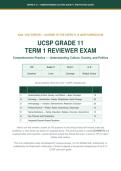
Seven sections mirror the Term 1 UCSP competencies:
Secti
on Domain Items
1 Understanding Culture, Society, and Politics — Basic Concepts 15
2 Sociology — Socialization, Groups, Stratification, Social Change 20
3 Anthropology — Variation, Ethnocentrism, Relativism, Evolution 20
4 Political Science — Politics, Power, Governance, Citizenship 15
5 Social Institutions — Family, Education, Religion, Economy, Government 15
6 Key Theories and Perspectives 10
7 Integrated Scenario-Based Questions 5
How to use this reviewer: answer all 100 questions in one sitting of about 90 minutes under test
conditions, or work section by section for targeted review. The correct answer is marked [CORRECT] and
explained after every question; a quick-reference answer key follows the exam. A score of 75% or higher
reflects solid mastery.
This is an independent study aid prepared for review purposes. It is not affiliated with, endorsed by, or
published by the Department of Education. Content is aligned to the general competencies of the K-12
UCSP curriculum guide.
, Section 1: Understanding Culture, Society, and Politics
Basic Concepts and Definitions (15 questions)
Q1. Which statement best defines culture?
A. The learned and shared beliefs, values, norms, language, objects, and practices that people use to
interpret and organize their lives [CORRECT]
B. The biological instincts that all humans inherit at birth
C. The territory and armed forces claimed by a nation
D. The written laws enforced by courts and police
Correct Answer: A
Rationale: Culture is learned and shared — not instinctive — and it includes both non-material elements (values, norms,
language) and material objects. Territory and law relate to society and the state rather than to culture itself.
Q2. A society is best described as:
A. The complete set of rules written by politicians
B. A group of people who interact with one another, share a common culture, and occupy a definite
territory [CORRECT]
C. The natural habitat where wild animals live
D. A random collection of strangers with nothing in common
Correct Answer: B
Rationale: A society involves sustained interaction, shared culture, and a territory. Interaction and sharing are what turn a
mere crowd into a society.
Q3. Harold Lasswell famously defined politics as:
A. the science of the perfectly just state
B. the study of ancient artifacts and fossils
C. the study of who gets what, when, and how [CORRECT]
D. the method of spreading religious doctrine
Correct Answer: C
Rationale: Lasswell's classic definition highlights politics as the process of allocating scarce values and resources —
deciding who benefits, when, and by what means. The distractors describe philosophy, archaeology, and religion.
Q4. The social sciences differ from the natural sciences mainly because they:
A. rely exclusively on laboratory experiments on chemicals
B. reject observation, evidence, and measurement
C. study only the physical structure of the earth
D. study human behavior, society, and culture using systematic and empirical methods [CORRECT]
Correct Answer: D
Rationale: Both are empirical, but the social sciences — anthropology, sociology, political science, and their neighbors —
apply scientific methods to human behavior and social life rather than to physical or chemical phenomena.
Q5. Understanding Culture, Society, and Politics (UCSP) draws mainly on which three disciplines?
A. Anthropology, sociology, and political science [CORRECT]
B. Biology, chemistry, and physics
C. Grammar, logic, and rhetoric
D. Geology, astronomy, and meteorology
Correct Answer: A
Rationale: UCSP is built on the three core social science disciplines that study humanity's cultures (anthropology),
societies (sociology), and political life (political science).
UCSP Grade 11 Term 1 Reviewer — Comprehensive Practice (2026/2027) Page 2
, Q6. A Filipino child adopted at birth by a Japanese family in Tokyo grows up speaking Japanese, bowing in
greeting, and preferring Japanese food. This best demonstrates that culture is:
A. carried in the blood and determined by race
B. learned through socialization rather than biologically inherited [CORRECT]
C. an instinct present at birth
D. acquired only through formal schooling
Correct Answer: B
Rationale: Despite Filipino parentage, the child absorbs the culture of the family that raises him — proof that culture is
transmitted through socialization, not genetics. Formal school is only one channel of learning culture.
Q7. Which of the following is an example of NON-MATERIAL culture?
A. The jeepney
B. The bahay kubo
C. The Filipino value of utang na loob (debt of gratitude) [CORRECT]
D. The barong tagalog
Correct Answer: C
Rationale: Non-material culture consists of intangible creations — values, beliefs, norms, and language. The jeepney,
bahay kubo, and barong are physical objects, which make up material culture.
Q8. Text messaging gave rise to shortcuts like 'wer na u' and emojis replacing phrases once written in full.
This illustrates that culture is:
A. static and fixed forever
B. encoded in human genes
C. destroyed rather than reshaped by technology
D. dynamic — it continuously changes across time [CORRECT]
Correct Answer: D
Rationale: Culture adapts to new conditions; language is one of its fastest-changing parts. The change here is
transformation, not destruction, and biology plays no part in it.
Q9. When cellphones spread, courtship, selling, and even classes changed together. This shows that culture
is:
A. integrated — its parts are interconnected, so change in one part affects the others [CORRECT]
B. made of isolated, unrelated pieces
C. purely material and object-based
D. immune to technological influence
Correct Answer: A
Rationale: Because culture is an integrated system, a technology adopted in one area ripples through family life, the
economy, and education. The other choices deny either the interconnection or the change itself.
Q10. A student insists that imported chocolates are automatically better than local tablea 'because anything
foreign is superior.' This attitude is:
A. ethnocentrism — judging others by one's own culture
B. xenocentrism — regarding foreign products and cultures as better than one's own [CORRECT]
C. cultural relativism — judging a culture on its own terms
D. cultural universals — traits shared by all cultures
Correct Answer: B
Rationale: Xenocentrism is the mirror image of ethnocentrism: the belief that the foreign is inherently superior. The
student is devaluing his own culture, not judging other cultures by his standards.
UCSP Grade 11 Term 1 Reviewer — Comprehensive Practice (2026/2027) Page 3
EDITION — ALIGNED TO THE DEPED K-12 UCSP CURRICULUM
UCSP GRADE 11
TERM 1 REVIEWER EXAM
Comprehensive Practice — Understanding Culture, Society, and Politics
100 Grade 11 Term 1 A–D
Questions Level Coverage Multiple Choice
Seven sections mirror the Term 1 UCSP competencies:
Secti
on Domain Items
1 Understanding Culture, Society, and Politics — Basic Concepts 15
2 Sociology — Socialization, Groups, Stratification, Social Change 20
3 Anthropology — Variation, Ethnocentrism, Relativism, Evolution 20
4 Political Science — Politics, Power, Governance, Citizenship 15
5 Social Institutions — Family, Education, Religion, Economy, Government 15
6 Key Theories and Perspectives 10
7 Integrated Scenario-Based Questions 5
How to use this reviewer: answer all 100 questions in one sitting of about 90 minutes under test
conditions, or work section by section for targeted review. The correct answer is marked [CORRECT] and
explained after every question; a quick-reference answer key follows the exam. A score of 75% or higher
reflects solid mastery.
This is an independent study aid prepared for review purposes. It is not affiliated with, endorsed by, or
published by the Department of Education. Content is aligned to the general competencies of the K-12
UCSP curriculum guide.
, Section 1: Understanding Culture, Society, and Politics
Basic Concepts and Definitions (15 questions)
Q1. Which statement best defines culture?
A. The learned and shared beliefs, values, norms, language, objects, and practices that people use to
interpret and organize their lives [CORRECT]
B. The biological instincts that all humans inherit at birth
C. The territory and armed forces claimed by a nation
D. The written laws enforced by courts and police
Correct Answer: A
Rationale: Culture is learned and shared — not instinctive — and it includes both non-material elements (values, norms,
language) and material objects. Territory and law relate to society and the state rather than to culture itself.
Q2. A society is best described as:
A. The complete set of rules written by politicians
B. A group of people who interact with one another, share a common culture, and occupy a definite
territory [CORRECT]
C. The natural habitat where wild animals live
D. A random collection of strangers with nothing in common
Correct Answer: B
Rationale: A society involves sustained interaction, shared culture, and a territory. Interaction and sharing are what turn a
mere crowd into a society.
Q3. Harold Lasswell famously defined politics as:
A. the science of the perfectly just state
B. the study of ancient artifacts and fossils
C. the study of who gets what, when, and how [CORRECT]
D. the method of spreading religious doctrine
Correct Answer: C
Rationale: Lasswell's classic definition highlights politics as the process of allocating scarce values and resources —
deciding who benefits, when, and by what means. The distractors describe philosophy, archaeology, and religion.
Q4. The social sciences differ from the natural sciences mainly because they:
A. rely exclusively on laboratory experiments on chemicals
B. reject observation, evidence, and measurement
C. study only the physical structure of the earth
D. study human behavior, society, and culture using systematic and empirical methods [CORRECT]
Correct Answer: D
Rationale: Both are empirical, but the social sciences — anthropology, sociology, political science, and their neighbors —
apply scientific methods to human behavior and social life rather than to physical or chemical phenomena.
Q5. Understanding Culture, Society, and Politics (UCSP) draws mainly on which three disciplines?
A. Anthropology, sociology, and political science [CORRECT]
B. Biology, chemistry, and physics
C. Grammar, logic, and rhetoric
D. Geology, astronomy, and meteorology
Correct Answer: A
Rationale: UCSP is built on the three core social science disciplines that study humanity's cultures (anthropology),
societies (sociology), and political life (political science).
UCSP Grade 11 Term 1 Reviewer — Comprehensive Practice (2026/2027) Page 2
, Q6. A Filipino child adopted at birth by a Japanese family in Tokyo grows up speaking Japanese, bowing in
greeting, and preferring Japanese food. This best demonstrates that culture is:
A. carried in the blood and determined by race
B. learned through socialization rather than biologically inherited [CORRECT]
C. an instinct present at birth
D. acquired only through formal schooling
Correct Answer: B
Rationale: Despite Filipino parentage, the child absorbs the culture of the family that raises him — proof that culture is
transmitted through socialization, not genetics. Formal school is only one channel of learning culture.
Q7. Which of the following is an example of NON-MATERIAL culture?
A. The jeepney
B. The bahay kubo
C. The Filipino value of utang na loob (debt of gratitude) [CORRECT]
D. The barong tagalog
Correct Answer: C
Rationale: Non-material culture consists of intangible creations — values, beliefs, norms, and language. The jeepney,
bahay kubo, and barong are physical objects, which make up material culture.
Q8. Text messaging gave rise to shortcuts like 'wer na u' and emojis replacing phrases once written in full.
This illustrates that culture is:
A. static and fixed forever
B. encoded in human genes
C. destroyed rather than reshaped by technology
D. dynamic — it continuously changes across time [CORRECT]
Correct Answer: D
Rationale: Culture adapts to new conditions; language is one of its fastest-changing parts. The change here is
transformation, not destruction, and biology plays no part in it.
Q9. When cellphones spread, courtship, selling, and even classes changed together. This shows that culture
is:
A. integrated — its parts are interconnected, so change in one part affects the others [CORRECT]
B. made of isolated, unrelated pieces
C. purely material and object-based
D. immune to technological influence
Correct Answer: A
Rationale: Because culture is an integrated system, a technology adopted in one area ripples through family life, the
economy, and education. The other choices deny either the interconnection or the change itself.
Q10. A student insists that imported chocolates are automatically better than local tablea 'because anything
foreign is superior.' This attitude is:
A. ethnocentrism — judging others by one's own culture
B. xenocentrism — regarding foreign products and cultures as better than one's own [CORRECT]
C. cultural relativism — judging a culture on its own terms
D. cultural universals — traits shared by all cultures
Correct Answer: B
Rationale: Xenocentrism is the mirror image of ethnocentrism: the belief that the foreign is inherently superior. The
student is devaluing his own culture, not judging other cultures by his standards.
UCSP Grade 11 Term 1 Reviewer — Comprehensive Practice (2026/2027) Page 3


