

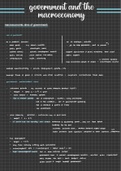
role of government
as a producer , provides as an employer , provides
?
a
merit goods e. g . schools , hospitals .
job for large population ,
work to provide
•
public goods streetlights , parks
.
welfare services pensions , unemployment benefits support agriculture & prime industries that need
a
public services police station , fire station public support
°
infrastructure roads , electricity & welfare schemes
help vulnerable groups of people -
redistribute income
manage macro economy -
prices , employment , growth , etc
manage trade in goods d services with other countries -
negotiate international trade deals
government macroeconomic alms
•
economic growth :
the increase of gross domestic product ( GDP )
-
target =
grow z -
3% a year
-
more output = economic growth
-
fall in output causes fall in employment , incomes , living standards
fall in tax revenue ,
cut in
government spending
fall in revenue & profits of firms
low investments
°
price stability : inflation -
continuous rise In price levels
-
target
=
2 - 3%
-
if prices rise too quickly can cause reduction Ip purchasing power , buy less than before
hardship for the poor
increase business costs ,
workers demand higher wages
less
makes products more expensive compared to other countries , competition
•
full employment
3%
target -
-
=
-
only those actively seeking work considered
-
unemployment rate =
( unemployed ÷ labour force ) x 100
-
high unemployment causes fall in total national output
government have to provide unemployment benefits ,
increase pubic expidenture
while income tax falls -
cause budget deficit
public unrest
&
anger towards government
, •
balance of payments stability
-
exports > imports =
surplus in Bop
-
exports < Imports = deficit in Bop
-
target =
exports & imports roughly same ,
avoid deficit
-
deficit in Bop causes economy to run out of foreign currency to buy further imports
of currency to fall other foreign imports
value against currencies ,
make expensive
( surplus cause currency to rise , makes exports more expensive )
•
income redistribution : reduce the inequality of income among citizens
-
can impose tax on rich ,
to finance welfare schemes for poor
higher level of poverty
-
inequality causes
↳ restricts from
economy reaching maximum productive capacity
comfits of alms
•
full employment vs price stability
-
low unemployment boosts incomes of businesses d workers
rise in incomes means higher demand d consumption
-
-
cause firms to raise prices -
inflation
growth Bop
economic vs stability
•
incomes rise from growth & low unemployment
-
economic
people will import more foreign products consume less domestic products
-
,
-
rise in imports ,
deficit may arise
°
economic growth vs full employment
-
when economic growth is continuous ,
firms may invest in more capital
-
cause labour to be replaced , unemployment increases
as a producer , provides as an employer , provides
?
a
merit goods e. g . schools , hospitals .
job for large population ,
work to provide
•
public goods streetlights , parks
.
welfare services pensions , unemployment benefits support agriculture & prime industries that need
a
public services police station , fire station public support
°
infrastructure roads , electricity & welfare schemes
help vulnerable groups of people -
redistribute income
manage macro economy -
prices , employment , growth , etc
manage trade in goods d services with other countries -
negotiate international trade deals
government macroeconomic alms
•
economic growth :
the increase of gross domestic product ( GDP )
-
target =
grow z -
3% a year
-
more output = economic growth
-
fall in output causes fall in employment , incomes , living standards
fall in tax revenue ,
cut in
government spending
fall in revenue & profits of firms
low investments
°
price stability : inflation -
continuous rise In price levels
-
target
=
2 - 3%
-
if prices rise too quickly can cause reduction Ip purchasing power , buy less than before
hardship for the poor
increase business costs ,
workers demand higher wages
less
makes products more expensive compared to other countries , competition
•
full employment
3%
target -
-
=
-
only those actively seeking work considered
-
unemployment rate =
( unemployed ÷ labour force ) x 100
-
high unemployment causes fall in total national output
government have to provide unemployment benefits ,
increase pubic expidenture
while income tax falls -
cause budget deficit
public unrest
&
anger towards government
, •
balance of payments stability
-
exports > imports =
surplus in Bop
-
exports < Imports = deficit in Bop
-
target =
exports & imports roughly same ,
avoid deficit
-
deficit in Bop causes economy to run out of foreign currency to buy further imports
of currency to fall other foreign imports
value against currencies ,
make expensive
( surplus cause currency to rise , makes exports more expensive )
•
income redistribution : reduce the inequality of income among citizens
-
can impose tax on rich ,
to finance welfare schemes for poor
higher level of poverty
-
inequality causes
↳ restricts from
economy reaching maximum productive capacity
comfits of alms
•
full employment vs price stability
-
low unemployment boosts incomes of businesses d workers
rise in incomes means higher demand d consumption
-
-
cause firms to raise prices -
inflation
growth Bop
economic vs stability
•
incomes rise from growth & low unemployment
-
economic
people will import more foreign products consume less domestic products
-
,
-
rise in imports ,
deficit may arise
°
economic growth vs full employment
-
when economic growth is continuous ,
firms may invest in more capital
-
cause labour to be replaced , unemployment increases


