
Page |1
AHIP MEDICARE MODULE 4 PRACTICE EXAM Medicare Part D Prescription Drug Coverage &
Key Rules 50 SURE Questions | Answers & Rationales
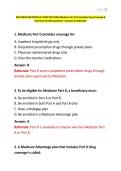
1. Medicare Part D provides coverage for:
A. Inpatient hospital drugs only
B. Outpatient prescription drugs through private plans
C. Physician-administered drugs only
D. Over-the-counter medications
Answer: B
Rationale: Part D covers outpatient prescription drugs through
private plans approved by Medicare.
2. To be eligible for Medicare Part D, a beneficiary must:
A. Be enrolled in Part A or Part B
B. Be enrolled in both Part A and Part B only
C. Have a Medigap plan
D. Be enrolled in a Medicare Advantage plan
Answer: A
Rationale: Part D is available to anyone who has Medicare Part
A or Part B.
3. A Medicare Advantage plan that includes Part D drug
coverage is called:
, Page |2
A. MA-PD
B. PDP only
C. PFFS
D. MSA
Answer: A
Rationale: MA-PD plans are Medicare Advantage plans that
include Part D prescription drug coverage.
4. A standalone Part D plan is also known as a:
A. Prescription Drug Plan (PDP)
B. Medigap plan
C. Medicare Advantage plan
D. Special Needs Plan
Answer: A
Rationale: Standalone Part D plans are called Prescription Drug
Plans (PDPs).
5. Which of the following is a core function of a Part D plan?
A. Providing all drugs without restriction
B. Maintaining a formulary and pharmacy network
C. Covering only generic drugs
D. Covering all over-the-counter medications
, Page |3
Answer: B
Rationale: Part D plans use formularies and pharmacy networks
to manage drug coverage and costs.
6. A formulary is:
A. A list of covered prescription drugs organized by tiers
B. A list of doctors in a network
C. A schedule of premiums
D. A billing form
Answer: A
Rationale: A formulary is a list of covered drugs, often
organized into tiers with different cost-sharing.
7. Which of the following is a utilization management tool
used by Part D plans?
A. Prior authorization
B. Step therapy
C. Quantity limits
D. All of the above
Answer: D
Rationale: Part D plans may use prior authorization, step
therapy, and quantity limits to manage drug use and costs.
AHIP MEDICARE MODULE 4 PRACTICE EXAM Medicare Part D Prescription Drug Coverage &
Key Rules 50 SURE Questions | Answers & Rationales
1. Medicare Part D provides coverage for:
A. Inpatient hospital drugs only
B. Outpatient prescription drugs through private plans
C. Physician-administered drugs only
D. Over-the-counter medications
Answer: B
Rationale: Part D covers outpatient prescription drugs through
private plans approved by Medicare.
2. To be eligible for Medicare Part D, a beneficiary must:
A. Be enrolled in Part A or Part B
B. Be enrolled in both Part A and Part B only
C. Have a Medigap plan
D. Be enrolled in a Medicare Advantage plan
Answer: A
Rationale: Part D is available to anyone who has Medicare Part
A or Part B.
3. A Medicare Advantage plan that includes Part D drug
coverage is called:
, Page |2
A. MA-PD
B. PDP only
C. PFFS
D. MSA
Answer: A
Rationale: MA-PD plans are Medicare Advantage plans that
include Part D prescription drug coverage.
4. A standalone Part D plan is also known as a:
A. Prescription Drug Plan (PDP)
B. Medigap plan
C. Medicare Advantage plan
D. Special Needs Plan
Answer: A
Rationale: Standalone Part D plans are called Prescription Drug
Plans (PDPs).
5. Which of the following is a core function of a Part D plan?
A. Providing all drugs without restriction
B. Maintaining a formulary and pharmacy network
C. Covering only generic drugs
D. Covering all over-the-counter medications
, Page |3
Answer: B
Rationale: Part D plans use formularies and pharmacy networks
to manage drug coverage and costs.
6. A formulary is:
A. A list of covered prescription drugs organized by tiers
B. A list of doctors in a network
C. A schedule of premiums
D. A billing form
Answer: A
Rationale: A formulary is a list of covered drugs, often
organized into tiers with different cost-sharing.
7. Which of the following is a utilization management tool
used by Part D plans?
A. Prior authorization
B. Step therapy
C. Quantity limits
D. All of the above
Answer: D
Rationale: Part D plans may use prior authorization, step
therapy, and quantity limits to manage drug use and costs.


